
惯性聚合 高效追踪和阅读你感兴趣的博客、新闻、科技资讯
阅读原文 在惯性聚合中打开

推荐订阅源

B
Blog
D
Docker
J
Java Code Geeks
腾讯CDC
Blog — PlanetScale
Blog — PlanetScale
G
Google Developers Blog
M
MIT News - Artificial intelligence
L
LangChain Blog
T
The Blog of Author Tim Ferriss
P
Proofpoint News Feed
MyScale Blog
MyScale Blog
博客园 - Franky
GbyAI
GbyAI
Hugging Face - Blog
Hugging Face - Blog
aimingoo的专栏
aimingoo的专栏
Last Week in AI
Last Week in AI
OSCHINA 社区最新新闻
OSCHINA 社区最新新闻
博客园 - 聂微东
N
Netflix TechBlog - Medium
B
Blog RSS Feed
Y
Y Combinator Blog
阮一峰的网络日志
阮一峰的网络日志
奇客Solidot–传递最新科技情报
奇客Solidot–传递最新科技情报
Google DeepMind News

The Guardian

New Zealand’s North Island braces for Cyclone Vaianu with thousands ordered to evacuate Artemis II splashdown – in pictures Swalwell denies allegations of sexual assault as calls grow for him to withdraw from California governor race Trump news at a glance: Epstein survivors have words for Melania Trump after surprise statement Multiple people face charges, including murder, in California fireworks blast Rory McIlroy surges into six-shot Masters lead with stunning second-round flourish Roberto De Zerbi targets ‘Ange-ball’ revival to save Spurs from relegation Bath hit back to reach semi-final after stunning Northampton in 11-try epic Australia crash out of BJK Cup after Britain secure upset with doubles win Zebras, wealth and power: Hungary’s election tests Orbán’s grip on power ‘TikTok effect’ brings sellout crowds and younger fans to Grand National meeting King signs up David Beckham to his Chelsea flower show team The war over Omagh’s gold: the £21bn mine plan tearing a community apart Britain’s shadow workforce is paid as little as 65p an hour. Who cares for the carers? Tim Dowling: my wife is on a quest to restore my thinning hair SUVs are making Britain’s potholes worse, say scientists Blind date: ‘She claimed she was usually shy. I wouldn’t have guessed’ I’m a sauna person now: the Becky Barnicoat cartoon ‘I got everything I dreamed of – when I had no ability to handle it’: Lena Dunham on toxic fame, broken friendships and her ‘lost decade’ Six great reads: the man who let snakes bite him, masked heavy metal and the brutal reality for foreign students in the UK Meera Sodha’s recipe for noodles with rose beancurd, spring greens and egg Cuba’s doctors were a lifeline for the world. Now the Caribbean is shamefully complicit in the US drive to expel them An environmental disaster in Moldova has Russia’s fingerprints all over it ‘This is as important as your teeth’: are you skipping this key part of mouth hygiene? Man arrested after four die trying to cross Channel in small boat Ukraine war briefing: doubts linger in Kyiv over Moscow’s promise to uphold Orthodox Easter ceasefire Ichiro Suzuki statue unveiling goes awry as bronze bat snaps during ceremony Arrest of national war hero Ben Roberts-Smith cuts deeply to core of Australian psyche European football: Real Madrid held at home by Girona to extend winless run ‘You come back different’: how rugby players change after motherhood
‘Cries of delight’ as Sumatran orangutan filmed using can...
Isaaq Tomkin · 2026-04-25 · via The Guardian

The critically endangered Sumatran orangutan has been filmed for the first time using a canopy bridge to cross a road.

In 2024, conservationists in the Pakpak Bharat district of North Sumatra in Indonesia built the bridge high over the Lagan-Pagindar road, which provides an essential route for local people but which became a barrier for animals.

Natural crossing was “impossible for wildlife”, said Erwin Alamsyah Siregar, director of Tangguh Hutan Khatulistiwa (TaHuKah), the environmental organisation that helped install the bridge.

For two years, the Sumatran Orangutan Society (SOS) and TaHuKah, its local partner, had been watching camera-trap footage of the bridge, waiting for the day that an orangutan would finally cross.

Sumatran orangutan filmed using a canopy bridge to cross a public road in North Sumatra

“You should have heard the cries of delight from the team,” said Helen Buckland, chief executive of SOS. “After two long years, it’s finally happened.”

This is the first time the species has been caught on camera crossing a wildlife bridge, offering a glimmer of hope to conservationists worried that this population would become functionally extinct if it were sequestered in one part of the forest.

For the 350 orangutans in the area, the road spelled disaster, as it split them into two populations, one at the Siranggas wildlife reserve, the other at the Sikulaping protection forest.

“Orangutans have a very slow life history, and are really prone to genetic bottlenecks,” said Buckland. If they are kept in small groups, they will be weakened by inbreeding until they are functionally extinct: surviving for now but heading towards long-term extinction.

After building the bridge with the help of the local government, a few different species began to use it: black giant squirrels, long-tailed macaques, agile gibbons – but no orangutans.
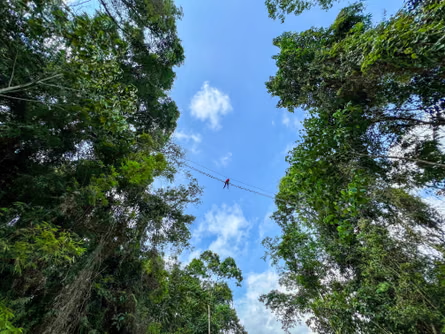
An animal on a canopy bridge seen from below against the sky.
The canopy bridge that allows animals to cross the Lagan-Pagindar road. Photograph: Juang Solala Laiya/Courtesy of Sumatran Orangutan Society

The young male orangutan is seen edging on to the bridge before making its way across. Halfway across, it pauses to look down at the road below, then back at the camera, before proceeding into the Sikulaping protection forest.

Orangutans, the largest arboreal (tree-dwelling) mammal, are a keystone species and spend more than 90% of their time in the forest canopy. They have excellent memories and can make mental maps of new routes through their forest habitat.

In total, there are three species of orangutan, and the entire wild population is concentrated in this corner of south-east Asia. There are only 14,000 Sumatran orangutans left, which makes them one of the world’s most threatened apes.

Franc Bernhard Tumanggor, head of the Pakpak Bharat district, said: “Witnessing a Sumatran orangutan confidently crossing that bridge is living proof that we need not sever the forest’s lifeline in order to build our communities’ own. Modernisation does not have to mean destruction.”

Find more age of extinction coverage here, and follow the biodiversity reporters Phoebe Weston and Patrick Greenfield in the Guardian app for more nature coverage