


Israel’s destruction in southern Lebanon happened in phases. Hours after Hezbollah launched rockets at Israel on 2 March, the Israeli military issued forced evacuation orders for more than 100 villages close to the Lebanese-Israeli border.
Bombing quickly followed. Tens of thousands of residents of south Lebanon began heading north, taking shelter in cities such as Tyre, Sidon and Beirut. Many people outside the formal evacuation zones fled their homes prematurely, recalling the autumn 2024 war in which Israel bombed wide swathes of south Lebanon without warning.
On 4 March, the Israeli military told all people living south of the Litani River to head northwards. On 12 March, forced evacuation orders were issued up to the Zahrani River, adding another chunk of south Lebanon to the Israeli-declared no man’s land. Further north still, evacuation orders were issued for the southern suburbs of Beirut.
Step by step, Israel had ordered roughly 14.3% of Lebanon’s territory to be vacated – displacing more than 1.2 million people from their homes. The vast majority of those displaced were from south Lebanon, where Israel’s bombing campaign was disproportionately focused.
More than two months after fighting began, most of the residents of south Lebanon remain displaced. Many of their homes lie in ruins, destroyed in airstrikes or controlled demolitions. Return is impossible for those from areas under the “yellow line”, an area established by Israel after the 17 April ceasefire along the Lebanon-Israel border comprising more than 50 villages occupied by Israeli soldiers.
The areas under the yellow line comprise about 608 sq km, or approximately 6% of Lebanese territory, which is now under Israeli occupation. Despite the Lebanon-Israel ceasefire, Israel continues to carry out strikes across Lebanon, and Hezbollah has continued to attack Israeli soldiers there.
The yellow line is a term imported from Gaza, one of a number of military techniques Israel has transplanted from Gaza to Lebanon. The Israeli defence minister, Israel Katz, also told the military to apply what he called the “Rafah and Beit Hanoun model” in south Lebanon, ordering the demolition of villages along the border.
Israel carried out the invasion and eventual occupation of parts of south Lebanon while its military pounded the country.
Threre were more than 3,688 Israeli strikes between 2 March and 1 May, according to the war monitor Acled, most of them concentrated in south Lebanon, the southern suburbs of Beirut and the Bekaa valley. Houses, valleys and cars were hit, and civilian infrastructure became an explicit target.
Israel announced on 12 March – 10 days after the air campaign began – that it would begin bombing bridges crossing the Litani River, which it said were being used by Hezbollah to transport fighters and weapons. Human rights groups said targeting bridges could be war crimes, due to their status as civilian infrastructure and their role in transporting supplies to civilians still living in south Lebanon.
For people still trapped in south Lebanon, each bridge destroyed was another route to the outside world cut off. Hours before the 17 April ceasefire went into effect, Israel bombed the last bridge out of Tyre, one of the largest cities in south Lebanon, leaving a crater where the structure once stood.
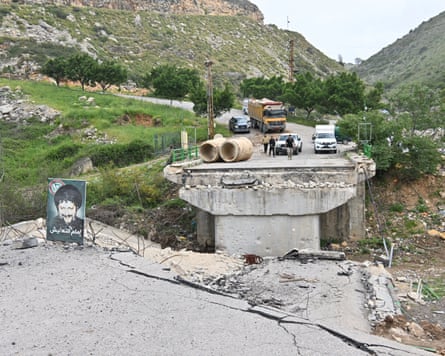
People were forced to abandon their cars and walk through the crater if they wanted to leave the city.
Fighting continued between Hezbollah and Israel after the ceasefire. Analysts described it as not a cessation in hostilities, but a move to a lower-intensity war.
The Israeli military has continued to issue forced evacuation orders, telling people in dozens of towns – including some outside the yellow line – to leave.
With much of south Lebanon depopulated, the pace of demolitions has increased. The Israeli military, no longer facing the same intensity of attacks from Hezbollah, began to bring in civilian contractors who used excavators to knock down buildings along the border.
With jugs filled with explosive liquids strung together by red wire, armoured personnel carriers filled with explosives, and bulldozers, the Israeli military flattened entire villages. One by one, videos of the destruction began to emerge. Some were published by the Israeli military itself, others by Israeli journalists.
In Qantara, south Lebanon, the Israeli military used more than 450 tonnes of explosives to blow up the hillside town. A video of the aftermath showed a sandy crater where the buildings used to stand.
“You feel a deep sense of frustration. Like someone has the power to erase you,” Ahmad Abu Taam, a shop owner from Taybeh, told the Guardian.
Villlages – some centuries old – are no longer recognisable to even their residents.
At least 2,154 buildings have been damaged or destroyed across Lebanon, according to an analysis from Conflict Ecology, a US-based research lab that uses satellite imagery and geospatial data from areas of conflict around the world.
Human Rights Watch said Israel’s demolishing of border villages could amount to wanton destruction, a war crime.
Israel has said its destruction of border villages is an attempt to get rid of what it says is embedded Hezbollah military infrastructure within civilian areas. HRW has also said that the possibility that Hezbollah uses some civilian structures for military purposes does not justify the wide-scale destruction of border villages.
In one case, the Israeli military blew up the public secondary school in the town of Marwahin, south Lebanon.
The Israeli military posted a picture of what it said was a cache of arms used by Hezbollah found in the school as a justification for its demolishment. The Legal Agenda, a Beirut-based legal monitor, said the weapons were hunting rifles confiscated by local authorities, citing judicial authorities, and photographed in a court room with a tag affixed to each gun containing case information.
More than 2,846 people have been killed and 8,693 wounded by Israeli strikes in Lebanon since the war began.
The pace of death has slowed since the 17 April ceasefire, but people are killed by Israeli airstrikes daily. On Friday, a civil defence employee died in an Israeli airstrike near Rachaya, south Lebanon. The night before, three people, including an infant, were killed and 15 injured in Duweir, outside the southern Lebanese city of Nabatieh.
The fighting is also steadily escalating. Hezbollah has targeted Israeli troops in south Lebanon with increasing success while Israel has slowly pushed past previous “red lines”, including targeting the southern suburbs of Beirut on Wednesday.
Lebanese people are worried that the ceasefire could collapse before negotiations in Washington have a chance to reach an armistice deal, plunging the country back into war.