


No one can dispute that, today, the news industry is once again experiencing a revolution; a revolution that is reshaping news for a new generation of consumers. The disruption transcends all news brands. It impacts all journalists and all journalism, everywhere.
I am an optimist. I believe there are very good reasons to believe in a bright future for what I call the established news providers. So I am determined, having spoken to many people for this dispatch from the frontline, to set out a positive way forward.
I’ve spoken to people across the industry in the UK and in the US, because the tidal wave of disruption that hits us here often begins across the Atlantic. This moment of disruption is so potent because it goes to the heart of how the relationship between news provider and consumer is shifting. From institutions to individuals, from big media brands to personalities, from public service broadcasters to independent journalists: all with dramatic consequences for where news consumption is collapsing and where it is growing at speed.
We’re all familiar with the decline in TV news audiences – with nearly 4 million fewer people getting their news from television in the past five years, and that includes streaming. At the same time, we’ve seen a trebling of the number of people getting their news from YouTube, and a 10-fold increase from TikTok.
I believe that the established media hasn’t confronted the hard truth – that this revolution isn’t just about consumers moving to different platforms. It’s that they are choosing more direct forms of journalism. We’ve seen an explosion of independent journalists and commentators hosting podcasts, creating their own YouTube channels and writing their own Substack feeds, where they can monetise their work directly.
From Piers Morgan’s Uncensored YouTube channel to Emily Maitlis, Jon Sopel and Lewis Goodall’s The News Agents podcast. From the hugely successful The Rest is … brand to Jim Waterson’s fast-growing London Centric on Substack. And in the US, from Tina Brown’s Fresh Hell to new brands such as Puck and The Ankler. This creator journalism is not a sideshow. It is fast becoming the show.
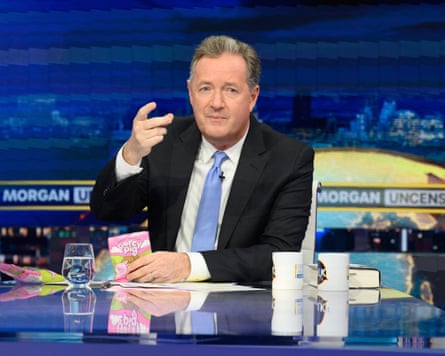
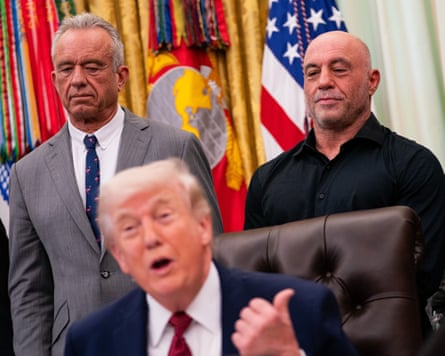
Just look at the audiences the biggest independent journalists in the US have built on YouTube alone: Joe Rogan, with 20.9m subscribers; Tucker Carlson, 5.6m; Megyn Kelly, 4.2m; Mehdi Hasan, 1.96m. What we are witnessing is the wholesale shift from one established information ecosystem to another.
These new forms of content are driving growth in audiences and revenues. This is a new gold rush, with private equity investors eager to fund the next big talent who can turn their brand into an empire. The value of the global podcast market alone is projected to grow – to quadruple – from $32bn last year to $114bn by 2030.
In this fragmented universe, news and information content across YouTube, podcasts, Substack and its competitors, newsletters and more are far bigger in aggregate than broadcast. The UK is Substack’s second-largest and fastest-growing market after the US, with more than half a million people now paying subscriptions direct to writers for their work.
The move away from mass reach, and its replacement with a fragmented media landscape, is what defines this revolution. It is a long-term irreversible shift more profound than we have so far understood. And it is completely reshaping our industry.
This was brought home to me recently when I spoke to Sarah, the nurse who treated me when I found myself in A&E, after my hand became embroiled in a fight between a cat and a dog. Despite juggling long shifts and a five-year-old, she never misses an episode of The Rest is Politics or The News Agents. She listens to Pod Save America and The Rachel Maddow Show. She has just downloaded Substack. I asked her why – and her answer was very simple: “I trust them. I feel like I know them.” Not once did she mention a traditional news provider. We have lost Sarah.
The reason why this matters transcends the impact of any one organisation. It matters because this new media diet is, in the main, driven by commentary and conversation. And because the established media has not yet broken into this new world at scale, it isn’t yet the home of frontline reporting by courageous journalists from dark and dangerous places across the globe. Or, with notable exceptions, the home of risky undercover investigations.
How will consumers access this kind of vital journalism in the future? And, just as importantly, how will it be funded?
So, the challenge is clear: will we wake up to the existential nature of this great shift in our industry? Or will we be like the proverbial frog in boiling water, who knew it was getting warm but failed to jump?
I believe the established news media has everything it needs to succeed, the assets required to win in this new world. The talented, experienced, expert journalists who have spent a lifetime carving out a reputation – and consumers who crave a connection with them. Brands that have meaning for audiences. And a legacy of trust.
However, my optimism is conditional on whether the established media is willing to deploy those assets to win and not be left behind. As I see it, there are three clear priorities. Restore trust, reconnect through authenticity and reinvent the newsroom.
Let me take each of these in turn.
The social scientist Alfie Spencer argues that the rupture in trust goes back to the 2008 financial crash, when banks were bailed out but many ordinary people lost their hard-earned homes and livelihoods, and suffered for years. The system failed them and they felt they had been lied to.
Trust in news was a casualty, falling in the UK, according to Reuters, from 51% in 2015 to only 35% last year – a 16-percentage-point decline.
This downward trajectory was the reality when I walked into BBC News in late 2022. The BBC was then – and remains – the world’s most-trusted news provider. But on every metric, in common with many institutions, the long-term trend was down. I was therefore clear that my number one priority must be to build a plan to reverse that decline in trust. And we did.
Through radical interventions, we saw trust begin to grow again – even during the last UK and US election cycles, when it usually takes a hit – with public views of the trustworthiness of BBC News increasing in the year to 2024/2025 from 57% to 62%.
So, what did we do? We started – as I’ve again been doing – by listening to audiences. They told us to earn their trust, they need: clarity in the chaos – giving them the facts they need to make decisions about their lives; courage – reporting from difficult and dangerous places and to uncover wrongdoing; fairness and respect – fairness in reflecting the true breadth of the broadening political spectrum, and respect in recognising that licence-fee payers are stakeholders and should be given a voice. And, finally, transparency – show us your workings, so we know why we can trust you. That’s how BBC Verify was born.
My second priority is: reconnect through authenticity.
I believe this will require established media players to face up to the consequences of the shift of trust and attention from institutions to individuals; from programmes and platforms to people. And to respond to the consumer desire for authentic, independent voices. That is what authenticity looks like to today’s audience.
News providers will need to accept that, in future, the connection with their consumers must flow through a more direct relationship with their talent. One that feels less controlled, less formal and less corporate. It might mean going to a news organisation’s website and, instead of finding content organised only around topics, being able to follow individual correspondents and specialists.
Journalists will also want to build those relationships in the spaces where people are increasingly getting their news: YouTube, Spotify, Substack and TikTok. News providers are going to have to be more prepared to liberate their talent. To strike a “new deal”, with a compelling offer that outweighs the value of going it alone in the new “talent economy”.
For too long, we – the established media – have limited the potential of our talent to build these kinds of direct relationships, and undervalued the potential for what I would call the “connected correspondent”.
My third priority is reinventing the newsroom.
I know how tough it is to drive transformation and change in a 24/7 business, during a relentless news agenda. But the brutal truth is that, even with all this innovation, most large news organisations remain structured around broadcast – with key decisions being made with a broadcast-first approach.
Yet I would argue that they need to start from where the consumer is: allocating people and resources on that basis. That means building a digital and social production studio that enables them to produce and distribute content in the formats and on the platforms that consumers want. A greenfield or startup approach, if you like.
This studio must be capable of delivering a flywheel of content from visualised podcasts to short clips, from newsletters to live streams, analysis articles to long reads, long-form documentaries to live events. The output from this digital studio becomes the building blocks of the broadcast offer. Turning today’s newsroom model upside down. This “flywheel newsroom” is what a genuinely digital-first model looks like. For the avoidance of doubt, I’m not saying we should be killing off the concept of the evening news bulletin. I am saying we should make it differently.
Let me leave you with one further, perhaps provocative, thought. Debate and opinion have always been a critical part of the established news media’s broadcast offer – from LBC and Radio 5 Live to Question Time – yet replicating this in the digital world has somehow proved harder. Instead, opinion is the preserve of online spaces that have increasingly become echo chambers, that keep people in their own tribes, reinforcing polarisation.
Established media organisations have an opportunity to become the town square – creating digital spaces where people are exposed to ideas different from their own. Spaces that are thought-provoking and even provocative. I am not arguing that correspondents working for organisations with a duty of impartiality should be giving their own opinions. But what I am asking is the extent to which freedom of speech should become a companion to impartiality.
Why wouldn’t an organisation have a walled op-ed section online, clearly signposted and thoughtfully curated, commissioning its own range of voices and linking to articles on other news providers? Why wouldn’t they curate a range of podcasts from different perspectives?
For public service broadcasters, this will no doubt throw up some challenges, but I think it’s time to trust that audiences are well versed in navigating the difference between news and opinion.
I believe that we are in a new golden age of journalism. And that the explosion of new platforms has opened up new routes for journalists to reach consumers with more original, thoughtful, intelligent writing and storytelling than ever before. In a world of AI slop and exploitative algorithms, consumers are seeking out this journalism, and choosing human-to-human connections.
So, this dispatch is rooted in optimism and confidence in the future of news providers. Provided the established news media is willing to do what it takes, it will not just survive, but can thrive – as an essential part of the revolution reshaping news.
-
Deborah Turness is a former head of BBC News, ITN and a former president of the NBC News division in the US. This is an extract from the Sir David Nicholas memorial lecture she delivered in London on Tuesday evening