


Human rights experts at the United Nations issued a rare public appeal to Equatorial Guinea, urging the central African country to halt its plans to return US deportees to their home countries, where they face political violence, torture and death.
The statement, co-signed by a representative of the African Commission on Human and People’s Rights, adds diplomatic pressure on Equatorial Guinea, one of the world’s most repressive regimes, to comply with international human rights standards and avoid refoulement, or the expulsion of people to countries where they face persecution.
“States must ensure that no one is returned, directly or indirectly, to a situation where their life, freedom or physical or mental integrity would be in danger,” the experts said in a statement on Wednesday.
The Trump administration made deals with dozens of countries to receive US deportees, as part of the president’s goal of “mass deportation”. The US gave Equatorial Guinea $7.5m to take in third-country nationals, who had been granted protections against expulsion to homelands where they faced persecution.
The UN’s public plea came after several deportees sent by the US to Equatorial Guinea said security officials presented nine of the US deportees with salvo-conductos – temporary travel documents – and told them they would be deported imminently to their home countries.
“Equatorial Guinea should never be treated as a safe country for migrants or asylum seekers. This is a highly repressive authoritarian state,” said Tutu Alicante, director of the human rights group Equatorial Guinea Justice. “Vulnerable migrants are being transferred into a country where they have no legal status, no family networks, and no meaningful protection mechanisms.”
Esther, who landed in Malabo, Equatorial Guinea, weeks ago, said the conditions at the hotel where she has been detained are not unlike a prison. She and other deportees had been held without access to soap, toothbrushes or clean clothes.
“I have cried. I have struggled. I have done everything,” she said in a phone call with the Guardian from the hotel room where she has been confined. “I have fought and fought. Now I don’t have anything left in me.”
Esther is from a different African country. The Guardian is using a pseudonym for her, and not naming her home country in order to protect her safety. She said she fled in 2024, after she was arrested and tortured at the behest of government officials – first making her way to South America, and then migrating north through Mexico before arriving at the US southern border. She spent 14 months at a US immigration detention center before a judge heard her case, and granted her a “withholding of removal” – a special immigration status guaranteeing she wouldn’t be sent back to her home country where she faced violence.
She moved in with her uncle, in New York, and had complied with requirements to regularly check in with Immigration and Customs Enforcement, she said. It was during a check-in appointment that she was arrested, she said, denied access to her lawyer, moved to Louisiana and then eventually shackled and placed on a plane to Equatorial Guinea. Officials repeatedly declined to tell her where she was being sent, she said, until she boarded the flight and an airline employee informed her of the destination.
Since then, she has been confined to a hotel in Malabo, guarded by armed officials. Her only access to the outside world is through her hotel room window, she said, and via her cellphone, which she managed to retain even after officials in the US and Equatorial Guinea confiscated her travel documents and other belongings.
Lawyers were repeatedly blocked from delivering her and other deportees phone chargers, soap, fresh clothes and pads. Eventually, she was able to receive a charger and pads, she said – but she was wearing the same clothes she had on when she was arrested in the US. She has also been unable to get medication after catching the flu, she said, or any treatment for the pain she feels in her hands and ankles from being shackled for hours during her journey.
On Saturday, Esther said, officials told her and at least eight others that they would be expelled. “I know what awaits me if they send me where they want to send me. I will be locked up, I will be in jail,” she said. Two years ago, she said, authorities arrested and disappeared her father, then arrested, beat and starved her until she was at the brink of death. Her mother, who begged officials to let her escort Esther to the hospital, had also arranged for her daughter to escape.
“I want to share my story so that others do not go through what I went through,” Esther said.
Lawyers from a coalition of legal and human rights non-profits who are advocating for at least 28 people sent to Equatorial Guinea said the deportees were granted protections under US immigration laws or the international Convention Against Torture – meaning that they proved, before an immigration judge, that they would probably face severe pain and suffering at the hands of the government in their home countries. Nonetheless, officials in Equatorial Guinea had already refouled several of them – including a west African man who had been persecuted for his sexual orientation. He is now in hiding, his lawyers said.
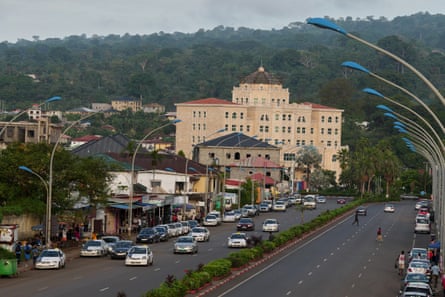
These sorts of secondary and tertiary expulsions have become increasingly common.
The Trump administration has made deals with at least 25 countries – including Panama, Costa Rica, Eswatini and Cameroon – to receive third-country nationals from the US, according to a report released by Democratic members of the Senate foreign relations committee in February.
Some countries, such as El Salvador, agreed to incarcerate deportees from the US; that is how more than 250 Venezuelan nationals ended up at a notorious Salvadorian mega-prison for four months last year. In other cases, foreign governments have been holding migrants in hotel rooms or temporary accommodations before sending them onward to their home countries.
“The Trump administration is utilizing all lawful options to carry out the largest deportation operation in history, just as President Trump promised,” a spokesperson for the US Department of Homeland Security told the Guardian. The agency did not respond to detailed questions about its policies on third-country deportations, and why US officials had declined to inform Esther and other deportees of where they were being sent before their expulsions.
The Trump administration was empowered by a supreme court ruling last summer that cleared the way for the US government to send deportees to South Sudan. In many cases, US deportees are being sent to countries with troubling human rights records, active civil conflict or repressive leadership. Many of these agreements have been conducted in a “secretive” manner, said Beatrice Njeri, the Africa regional litigator for the Global Strategic Litigation Council, which is representing Esther and several other migrants sent to Equatorial Guinea.
“Our clients, like Esther, had been granted protection in the US, including survivors of female genital mutilation, women subjected to various forms of sexual violence, LGBTQ+ persons, and individuals facing political or religious persecution,” Njeri said. Instead of receiving protection, she added, the deportees have been subject to “prolonged, inhumane detention” and onward journeys where they face grave danger.
The Global Strategic Litigation Council and a coalition of other human rights groups have been working to stop these “third country” deportations and help those who have already been forcibly expelled to these countries find asylum or safety.
“What we are seeing in Equatorial Guinea is not an isolated issue. It is the expansion of a deliberate system designed to outsource cruelty and erode protections for people seeking safety in the US,” said Bella Mosselmans, director of the Global Strategic Litigation Council. “These agreements are causing immense human suffering and flagrantly violating international law. They must end.”
She and other human rights advocates are hopeful that they will, she added, amid growing international pressure.
In September, the United Nations human rights office called on Ghana to stop the removal of migrants sent there from the US to their home countries where they faced torture. In their statement on Wednesday, human rights experts from the UN and the African Commission said they were alarmed by the Trump administration’s tactic of expelling migrants, including asylum seekers, to third countries without any arrangements for their long-term safety.
“We are also concerned that these developments appear to reflect broader trends of migration externalisation arrangements involving transfers of migrants, asylum seekers and persons in need of international protection to third countries, including African States, without sufficient human rights safeguards.”
For now, Esther said, she is surviving by trying her best not to think about the future. She has been able to call her uncle and her mother, she said, who are panicked. “My mother told me I am still young, I have so much life to live – that is why she has helped me escape,” she said.
When they last parted, her mother thought she might never see her daughter again. Now she worries they will reunite, “but she’ll see me as a corpse, to bury”, Esther said.