




Filming polar bears in their Arctic home requires bravery and patience. Of all the wildlife film-makers who bring images of the natural world to our TV screens, few were as courageous or boundlessly patient as Doug Allan, who would spend weeks, even months on end in this harsh environment in order to capture unique and astounding footage.
His long list of credits features many of the classic television series that have captivated audiences over the past few decades, including Life in the Freezer (1993), The Blue Planet (2001), Planet Earth (2006) and Frozen Planet (2011).
Doug, who has died aged 74 of a brain haemorrhage in Nepal while heading for base camp at Annapurna, was particularly admired for his work in two of the world’s toughest environments: the polar regions and beneath the ocean’s surface. He loved the challenge of filming the world’s largest and most charismatic wild creatures, once declaring: “Put me eye to eye with a big whale and I’m in heaven.”
Doug was an “old-school” cameraman from long before the days of motion-activated surveillance cameras or drones. For much of his career he shot on film, and would have to wait until he got home before knowing if he had managed to successfully capture the sequence at all.
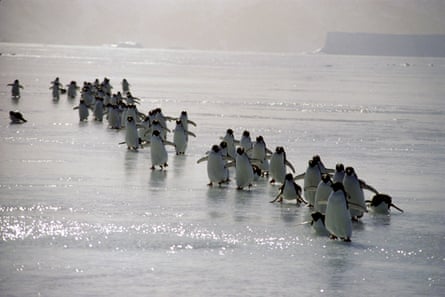
He generally worked either in hides, or, while diving beneath the ocean surface, using a waterproof housing for his camera. This was both dangerous and hard – his reputation rested on him not only producing great visuals, but also his toughness in these unforgiving environments.
Martha Holmes, producer on Life in the Freezer, Blue Planet and other wildlife series, said: “He always remained calm when close to, and sometimes threatened by, large mammals such as polar bears, walruses and whales. He was also unbelievably tough. When diving with leopard seals in Antarctica at -2C he could happily stay underwater for an hour.”
In doing so, Doug, who was the first person to film leopard seals hunting underwater in their Antarctic home for Life in the Freezer, caught a memorable sequence of a seal catching and dismembering a penguin.
Filming could, however, also be frustrating and “boring as hell”, according to Doug, as when he filmed snow leopards in the Himalayas for Planet Earth. After seven weeks holed up in a hide, he only managed to get a single shot of a distant animal, which spent most of the time asleep.
Nevertheless, Sir David Attenborough, who worked with him for many years, noted that: “Over his long career, Doug captured some of the most memorable wildlife images to have ever appeared on television.”
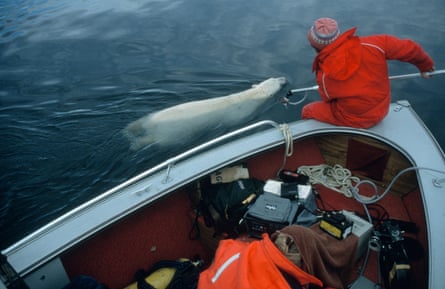
Doug was a compelling storyteller, not least when relating hair-raising tales of his close encounters with potentially deadly predators, including several with polar bears. He once recalled his first ever sighting, after searching unsuccessfully for several days: “The big male just stood there, so close you could see its breath. It looked at us for a little bit, and then just ambled off. I’d never seen an animal that seemed so absolutely at home in his environment.”
Danger came not just from the wildlife but also the extreme environments. On one occasion, he and Martha were rescued by plane from an ice floe in the nick of time, as it was breaking up far out in the open sea.
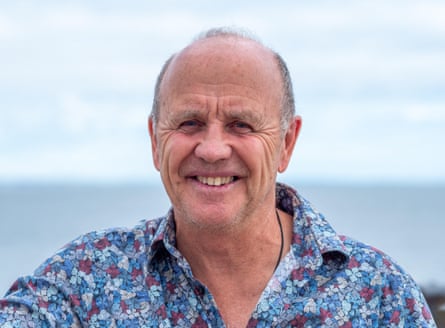
Julian Hector, former head of the BBC Natural History Unit, described Doug as “a powerful voice for the fragility of the polar regions”. A passionate environmentalist, Doug used his fame to warn of the dangers faced by the world’s fragile habitats and their wildlife. Earlier this year, he called on the Scottish government to back an “ecocide” bill that would penalise companies that caused harm to the natural world.
Doug was born in Dunfermline, along with his twin brother, Ron, and three younger siblings. His father, Morris, ran his own photography shop in the town, worked as a wedding photographer, and provided sports footage for Scottish TV; his mother, Betty (nee O’Brien), had been a journalist before supporting the family business and raising the children.
From an early age, inspired by the books and underwater films of the French explorer Jacques Cousteau, Doug was a keen diver. On leaving Dunfermline high school in 1969 he studied marine biology at the University of Stirling. After graduating in 1973, he worked as a pearl diver for Bill Abernethy, the last professional hunter of freshwater pearl mussels in Scotland.
He then spent eight years as a research diver, scientist and photographer with the British Antarctic Survey in Antarctica, where he rose to be station commander, and was presented with the Polar medal by Queen Elizabeth II.
It was in Antarctica, following a chance encounter with Attenborough and a visiting film crew, that he decided to change career, buying a 16mm film camera and shooting footage of emperor penguins, which he sold to the BBC. In 1985 he became a full-time wildlife film-maker.
During the following decades, Doug won an array of awards in the US and UK. These included eight Emmys, five Baftas, five Wildscreen Pandas, and the Royal Geographical Society’s Cherry Kearton medal. A proud Scot, he was delighted to receive three honorary doctorates, from the University of Stirling, Edinburgh Napier University and the University of St Andrews. In 2024 he was appointed OBE. Yet he always remained modest and approachable, willing and eager to share his expertise with his fellow film-makers.
In 2012, he self-published a beautifully illustrated book about his experiences, Freeze Frame – A Wildlife Cameraman’s Adventures on Ice, which he sold at his talks, having captivated the audience with his gripping anecdotes.
In July 2014 he was interviewed for the BBC Radio 4 series Desert Island Discs, and chose as his luxury item a pair of binoculars. Five years later he appeared on The Museum of Curiosity show, also on Radio 4, where his donation to the (imaginary) collection was “the feeling you get when a wild animal trusts you”.
Attenborough said of Doug: “Capturing animal behaviour in extreme and sometimes hostile places takes a very special kind of wildlife cameraman … There’s just no one else who knew these frozen worlds and their unique wildlife as he did.”
Doug was twice married, first to Elisabeth Smith, then to Sue Flood. Both marriages ended in divorce. He is survived by his partner, Susannah Lipscombe, by his son, Liam, from his first marriage, and by his siblings, Ron, Graeme, Judy and April.