








When we think of what governments do, we think of everything from building highways to waging war. What they also do is capture the world in the form of information. The US government may be the foremost producer of information in the world.
For decades, federal agencies have gathered data on everything from climate risk to the rising cost of childcare. It is information funded by taxes, and that belongs to the American people. This data is often how the government decides what to do: what is a problem, what is a policy priority, what should be funded. It tells the story of America.
But over the past year, the Trump administration has been altering and removing decades’ worth of datasets as part of a sweeping campaign targeting so-called “woke programs”, “racial equity”, “gender ideology” and “climate extremism”.
This censorship has affected not just datasets, but also a wide swath of federal resources: tools that helped the public access data, ongoing surveys and, perhaps most concerning, the agency staff that made it all possible.
Experts warn that Trump’s destruction of the country’s data infrastructure will have lasting impacts on all aspects of life – whether it’s the Federal Emergency Management Agency’s response to extreme weather, public health departments’ monitoring of harmful new drugs in their communities or how food banks get meals to hungry families.
“Federal data touch every corner of American lives,” said Denice Ross, former US chief data scientist under the Biden administration who is now director of federal data policy at the Federation of American Scientists. She also helps run America’s Data Index, a group that monitors changes to federal data. When data disappears, she said, “we might not know or be able to connect the dots for why our lives are getting harder – but our lives will get harder”.
Here are five ways Americans will be affected by deleted data.
1. One in three Americans live near hazardous chemicals. Now it’s harder to tell if you’re one of them
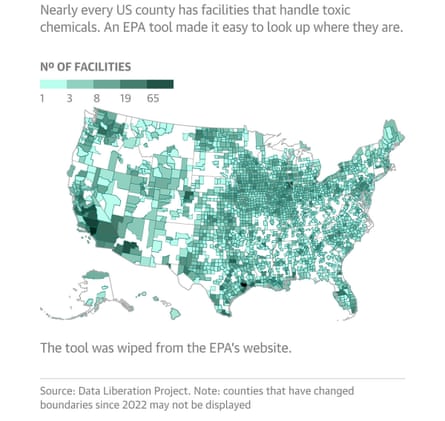
Until last year, one of the best ways to find out if you live near one of the roughly 12,000 facilities that store hazardous, cancer-causing chemicals used in manufacturing products like pesticides or medical devices was to go to an EPA webpage for the Risk Management Program (RMP). There you could type in your zip code in a search tool, and see if any of these chemical factories are nearby. (Latino, Black and low-income people are more likely to bear the brunt of chemical pollution; they disproportionately live closer to chemical plants than other groups.)
But last April, the Trump administration took down this tool. Now the only way to get this information is to drive to one of several dozen EPA reading rooms across the country to examine paper records.
“Another layer of protection for environmental justice communities was taken down when they took away the RMP tool,” said Nalleli Hidalgo, community outreach and education liaison for Tejas, a Houston environmental justice advocacy group.
Much of Tejas’s organizing is based around the Houston Ship Channel, a roughly 50-mile waterway that’s home to more than 600 petrochemical facilities. In 2021, about 100,000lbs of toxic acid was released during a chemical leak along the ship channel that left two people dead and injured 30.
Having the RMP tool allowed residents who live near the ship channel to use their phones to look up facilities near their schools and homes.
“You have a right to know what’s in your back yard,” said Maya Nye, federal policy director for Coming Clean, a non-profit environmental health collaborative. She said the removal of the tool is particularly concerning because “we haven’t figured out how to prevent chemical disasters and people are still experiencing them”.
The deletion of the RMP tool comes as the Trump administration proposes further dismantling accident-prevention regulations at chemical plants, even though the US continues to average one chemical accident every two days, a rate that will only accelerate amid the climate crisis.
2. Babies born in the US have a higher chance of dying than almost all other high-income countries. We’ve stopped tracking why
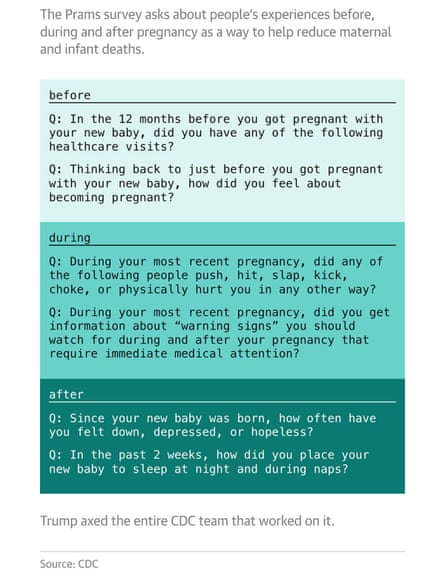
The Pregnancy Risk Assessment Monitoring System (Prams) is the nation’s most comprehensive survey on women’s experiences before, during and after pregnancy.
Researchers rely on Prams to answer questions like whether the lack of a national paid leave policy affects mothers’ ability to breastfeed, or how poverty influences outcomes such as low birth weight and preterm births. State health departments also use it to design and fund intervention programs. In New Jersey, for instance, Prams data helped public health officials get funding for free prenatal care and community doulas in neighborhoods with the highest racial gaps in maternal health outcomes.
“We don’t really have another dataset like it in the country,” said Rita Hamad, an associate professor of social epidemiology and public policy at the Harvard TH Chan School of Public Health.
Last spring, the Trump administration dismissed most of the employees at the Centers for Disease Control and Prevention’s (CDC) division of reproductive health, including the entire full-time team working on Prams.
With no federal staff to approve data requests, Prams data is now completely inaccessible to the public.
Losing this data could especially hurt women and babies in states that already have poor health outcomes. Last fall, Mississippi, which has the highest infant mortality rate in the country, terminated its Prams data collection, which could make it harder for the state’s health department to appeal for more federal funding for prenatal care and home visit programs for expectant moms.
“It’s mind-boggling and really heartbreaking to me that we are literally having babies dying, and we’re not able to look and say, ‘OK, what is it about those babies? Are they in particular parts of the state? What kinds of health behaviors were their mothers engaged in? What kind of healthcare access did they have?’” Hamad said.
Some state health departments are still trying to continue Prams data collection, but without federal support, it will be difficult, if not impossible, for many states, experts say.
3. Hunger is rampant in the US. But the government is no longer asking people about it
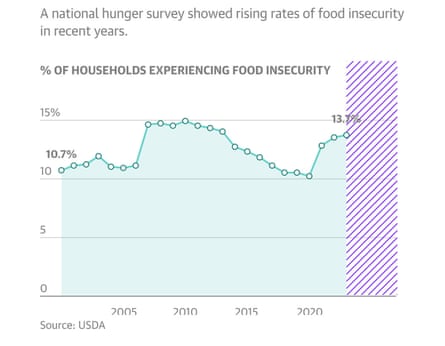
The Food Security Supplement to the Current Population Survey (CPS-FSS) was an annual review that has, since 1995, been the gold standard for tracking the state of hunger in the US. The national survey asked 18 questions about food insecurity, such as how many children skipped meals or didn’t eat for a whole day because their families did not have enough money.
But now, as the Trump administration makes what will probably be the largest cuts in history to the Supplemental Nutrition Assistance Program (Snap) – the hunger-relief program that serves 42 million Americans – the US Department of Agriculture has also terminated a national survey of food insecurity. The USDA called the survey “redundant” and said it does “nothing more than fear monger”.
Results from the final survey, published in December, found that nearly one in seven US households is food insecure – a rate that has increased over the last few years.
Experts say the loss of the only national survey measuring hunger means understanding the impacts of the recent Snap cuts on hunger in the US will be nearly impossible.
“There’s only one reason for doing this,” said Marion Nestle, professor of nutrition at New York University, on the termination of the survey. “If you don’t measure it, it’s not there.”
Gina Plata-Nino, deputy director of Snap at the Food Research and Action Center, said that the Trump administration is trying to “write their own narrative” about the Snap cuts and we no longer “have the data to push back against that narrative because they eliminated it”.
The termination of the CPS-FSS will also make it harder for food banks and anti-hunger programs to advocate for more funding and serve people most at risk of losing their Snap benefits.
In New York, a statewide anti-hunger non-profit used the data to determine which communities to place in its network of more than 80 Snap navigators, people who help families enroll and navigate recent changes to work requirements and eligibility, said Krista Hesdorfer, director of public affairs at Hunger Solutions New York. “Not having data available on the prevalence of food insecurity really jeopardizes our ability to understand the outcome of the [federal] cuts.”
4. More than half of trans youth have considered suicide. But any mention of trans people has been deleted from a critical survey
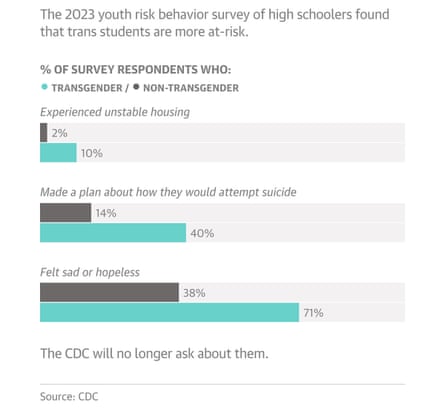
The Youth Risk Behavior Survey (YRBS) is an anonymous survey of high school students on a range of topics including mental health, substance use and sexual behavior.
School districts often used this data when applying for grant funding for youth drug abuse interventions. The survey results also informed suicide prevention programs specifically tailored for trans and queer youth, who, according to the most recent results of the YRBS, reported making plans to attempt suicide at more than double the rate of non-trans youth.
But earlier last year, a question about trans youth was removed from the survey.
Caroline Medina, senior adviser for data policy and strategy at the Movement Advancement Project, says this is part of a broader targeting and erasure of trans, non-binary and intersex identities as outlined in an executive order Trump signed on his first day in office.
“In addition to the elimination of data, we’re talking about restrictions on the ability to access essential healthcare, the rolling back of civil rights protections and trying to restrict the ability of trans people to access public accommodations,” Medina said.
The removal of gender identity questions isn’t just happening to the YRBS. Researchers from the Williams Institute at the University of California, Los Angeles found at least 360 federal data collections in which questions about gender identity or sexual orientation have been removed. These include surveys about topics that disproportionately affect queer and trans youth, such as a database on unhoused youth and a survey on sexual victimization.
Most of these changes are being pushed through without public input, said Elana Redfield, federal policy director at the Williams Institute.
Earlier last year, after a successful lawsuit from Doctors for America, the YRBS was among hundreds of deleted CDC webpages that were restored, but a banner added to the top of the page still notes “any information on this page promoting gender ideology is extremely inaccurate”.
“There’s nothing normal about what’s happening,” Redfield said. “This process is unprecedented and extreme [and] it is testing the limits of what the executive branch can do with administrative procedures.”
5. The cost of US climate disasters has climbed to nearly $200bn per year. The government is no longer recording them
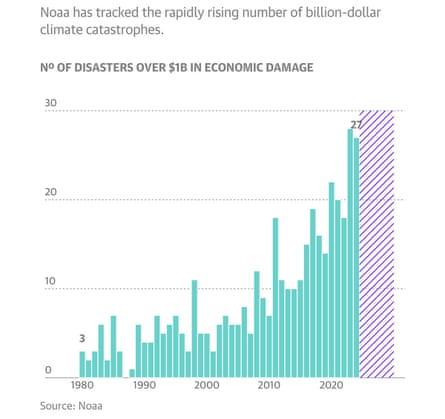
Since 1980, the National Oceanic and Atmospheric Administration’s Billion-Dollar Weather and Climate Disasters database has provided detailed information on the increasing number of large-scale climate disasters in the US. The consistency and detail of the data was useful for researchers and policymakers – and also for insurance companies.
The database was used as an input for insurance pricing and risk models, and especially for disasters that historically aren’t well-modeled, like severe storms and floods, said David Blades, an associate director at AM Best, an insurance rating agency.
Last May, Noaa announced it would no longer be updating the database due to “evolving priorities, statutory mandates and staffing changes” at the agency.
“The immediate threat is not having, on a going-forward basis, some of the information that we’ve had for the last 30 years,” Blades said. Without the data, some pricing could be less accurate, and insurers could over- or under-price premiums relative to payouts, which could lead to financial losses that cause insurers to leave some markets, he said.
Carly Fabian, director of insurance policy at Public Citizen, a non-profit consumer advocacy group, said a lack of insurer pricing confidence could have material impacts for homeowners.
“When insurance companies feel less confident, they tend to hedge by raising prices in response to uncertainty,” Fabian said. She added that if insurance companies can’t predict the impact of climate-driven disasters in a particular area, they may also stop providing coverage there, as has been the case in states such as California, Florida and Louisiana, leaving consumers with gaps in coverage.
“The less data [insurers] have, the more insurance will cost and the less likely it is that people will be able to afford it at all,” Fabian said.
The Guardian’s Deleted Data series explores how critical US government information is being deleted and what the consequences will be, and will preserve or re-create lost datasets. If you know about any datasets, webpages, or government materials that have been deleted or altered in the past year, or how those changes affect you, we’d love to hear from you. Please reach out at deleted-data@theguardian.com.