







It’s certainly a novel way to announce your comeback. On the opening song of Yard Act’s new album, over a cacophony of doomy piano chords and crashing drums, singer James Smith announces: “I’ve got absolutely nothing – absolutely nothing new to say!” And he’s not finished there. Later in the same track, Empty Pledges, Smith whips himself up into unhinged preacher mode only to declare: “Do you feel like an impostor for every new level you ascend to too? Do you have to bluff as much as I do?”
Is it refreshingly honest to begin a record by saying you haven’t got a clue what you’re doing – or an act of ludicrous self-sabotage? “Well, I don’t know if anyone has anything new to say really,” says Smith with a grin when I meet him and bassist Ryan Needham in a London bar to discuss You’re Gonna Need a Little Music, the band’s forthcoming third LP. “We’re in this age where everything has to be a manifesto and a statement, but it’s mainly just a one-way conversation. Nobody wants to explore the grey areas any more.”
If Yard Act’s music suggests that self-doubt is the new braggadocio, then speaking to Smith is no different. He fluctuates between confidence and worry, frequently backtracking or qualifying his statements in case he comes across like a berk. Was that quote too pretentious? Too flippant? Is he underselling himself? Overselling himself? At times it’s like listening to someone have a live philosophical argument with themself.
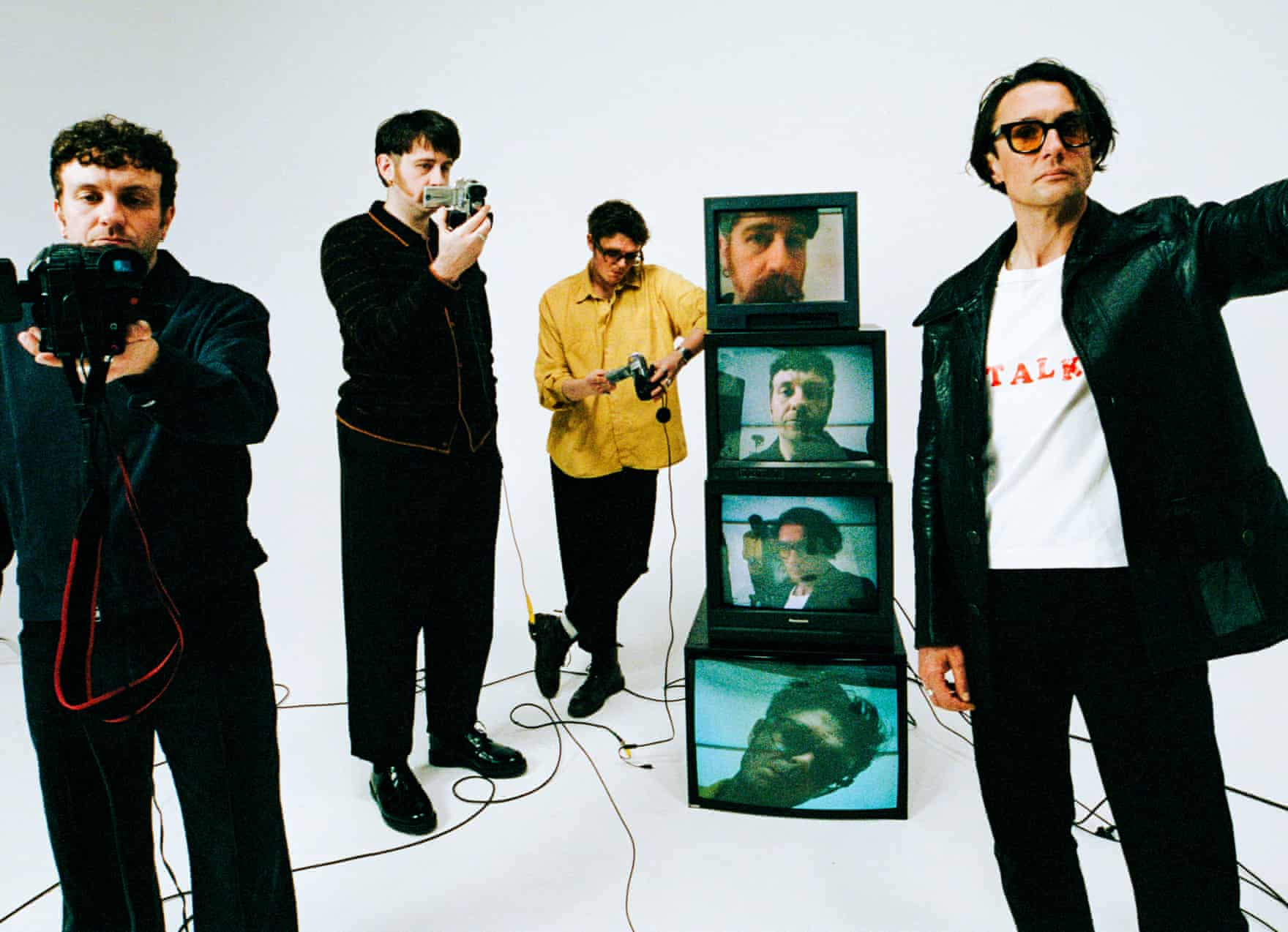
On the new record, Smith even invents an alter ego, Janey, for this very purpose. “Janey is that part of my brain that never stops thinking,” he says. “A part of me just wants to be content in the moment, but then Janey represents the part that thinks I should be dreaming bigger.”
It may be exhausting to be in Smith’s head, but this frazzled state of self-examination is surely why so many people connect with his band. Because let’s face it, who out there isn’t constantly fretting right now about their place in this unstable world? Being a singer in a rock band might not be the most relatable subject matter, but status anxiety, existentialism, impostor syndrome? They most certainly are.
“On our first two albums, we almost felt like competition winners or something,” says Needham. “And I think a lot of working-class artists feel like that these days. It took a lot of time to get over that and think, ‘No, we’re fucking good. We deserve a seat at the table.’” Then he quickly adds: “I don’t mean that in an arrogant way! It’s about having a bit of self-belief but, just for context, I had absolutely zero before!”
“It’s good to have a mix of self-doubt and self-belief,” says Smith. “It’s kept us on a steady path. Which is boring – because you want people to say they’re the best band in the world. Whereas actually I just think we’re really good. I guess it’s about having self-belief without going full fucking Kanye.”
Bands, you may or may not be old enough to remember, never used to speak like this. The perilous state of the music industry in 2026 is no doubt the reason: even pretty successful artists like Yard Act, who have had two Top 5 albums and collaborated with celebrity fan Elton John, worry about financial security. Yard Act’s magic is to write about it in a way that connects. “I think that’s because we still have a foot in both worlds,” says Smith. “I’m not segregated from society like some A-list celebrity. I think living in Leeds plays a big part in staying grounded.”
When Yard Act first burst out of the city during the pandemic, they were a frenetic ball of post-punk energy (guitarist Sam Shipstone and drummer Jay Russell complete the line-up), picking at the scabs of late capitalism. The writing was sharp and funny, drawing comparisons to Mark E Smith and Half Man Half Biscuit. By the second album, 2024’s Where’s My Utopia, they’d broadened their sonic palette and hit on a more personal style of writing, with Smith airing his fears around being a father and opening up about his own childhood.
You’re Gonna Need a Little Music marks another evolution. Written as a full band in the studio they built in Leeds (the first two were largely cobbled together on the road by Smith and Needham using a laptop), it navigates an eclectic array of influences – Blur, the Prodigy, disco house, desert rock-era Arctic Monkeys – while Smith explores a more surreal, impressionistic style of wordplay. “Flat out lies climb chaos spires / As Rapunzel lets down your tyres,” thunders new single Redeemer.

“I bought some oil paints on a whim,” says Smith. “That turned out to be a great way of unlocking my brain from doing all the things I’ve taught it to do over the years of being a musician. It stopped me from leaning on the tropes.”
Besides, he says, with their earlier song Blackpool Illuminations, a moving, seven-minute slice of childhood reminiscence worthy of Mike Skinner, Smith felt as if he’d pushed direct storytelling as far as he could. “I got tired of literal explanations of songs,” he says. “I wanted to hark back to when I first connected with music and didn’t need to have it explained to me because I would find something in it anyway. I thought, ‘Why wouldn’t you want to let your brain do the working out for yourself?’ Getting lost in words is just a really nice thing for me.”
Tracks including Tall Tales and Fiction deal with memory and the way we look back differently. “How we remember things is not necessarily how they happened for others,” says Smith. “Which makes me think, ‘Is anyone even on the same wavelength?’ We like to think there are universally agreed truths but time and time again we see how two people remember the same thing entirely differently. If two people can’t remember, how the fuck can an entire planet?”
Smith has direct experience of this. On a standout track on their previous album, Down By the Stream, he recounted an episode of childhood bullying. He was the bully – tormenting a lad called Jono who struggled with his hearing and speech. The lyrics reveal: “He spoke a little slow and I was a prick about it … ’Cause, well, I don’t know why, but I did and I’ve gotta live with it.” It felt like his most honest writing yet. I ask if anyone he sings about has been in touch.
“Oh, we’re all friends again!” he says brightly. Because of the song? “Yeah. All the lads from that song have been at the last three or four Manchester shows. I’m in a WhatsApp group with them now. They heard the album and figured out it was about them. What’s funny is that Jono didn’t even particularly remember me being like that. He didn’t remember it being that bad whereas I’ve always looked back, like, ‘Oh fuck.’”
It must have been hard opening up – but ultimately rewarding? “I probably wouldn’t have been able to do it at the time. With 20 years in between, it was easier. But I think ownership is important. We live in a society that immediately punishes and doesn’t want to open up a conversation about our flaws. But you can’t frame yourself as a singular entity of good or evil.”
A few days after we speak, I watch Yard Act debut their new material at a tiny London venue. It’s so packed I have to stand on a table on the balcony just to catch a glimpse. The energy of the new songs, and the climactic moshpit they build to, suggests that, for all their neuroses, the band are feeling fully refreshed.
Smith and Needham agree: while things are still fun, they’ll keep going. The minute that stops, they hope to do the decent thing and call it a day. “I don’t want to get into that megaband on the treadmill thing,” says Smith, “where it’s like, ‘We’ve got to put an album out just so we can tour.’ If the ideas aren’t coming, you shouldn’t do it. But we’ll keep going,” he smiles, nodding back to the new album’s opening lyrics, “because, ironically, we still have something to say.”