









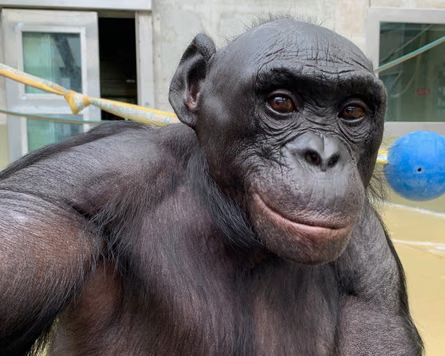
Clear plastic cups and pitchers adorned the wooden table in Des Moines, Iowa. Invisible juice was poured and presented to Kanzi, who enthusiastically chose the fake filled cup, playing along with the man who had come to visit. In many ways, it was the quintessential scene of a children’s imaginary tea party. Only Kanzi, at 44 years old, was a bonobo.
The experiment, carried out at the Ape Initiative facility in 2024, was the first to empirically test and document pretend play in a great ape species, with the results published in the journal Science in February. The study adds to an expansive repertoire of research over the past decade that has uncovered robust similarities between ape and human behaviours, upending long-held beliefs about how we distinguish ourselves from our closest kin.
“It seems to be a recurring thing in our field where people come up with reasons why humans are special and unique, and then scientists like me test it out, and we find that, actually, maybe we’re not that special after all,” says the study’s lead author, Amalia Bastos, a comparative psychologist at the University of St Andrews in Scotland. “That animals, too, are capable of secondary representations or imagination.”
Kanzi, who died last year, participated in several experiments with Bastos and her colleagues to test his ability to make believe. “We start all of these trials by saying, ‘Kanzi, let’s play a game. Let’s find the juice.’ That way we can at least verbally scaffold as much as possible,” Bastos says.
In one scenario, two cups were “filled” with juice, and then one was “emptied” into the jug. Kanzi was then asked to indicate which cup contained juice. He chose correctly in 34 out of 50 trials, suggesting he could grasp the concept of a pretend beverage. In another test, he was asked to choose between real orange juice and pretend juice. In 14 out of the 18 trials, he chose the cup containing real juice.
Kanzi’s ability to pretend – to envision a reality beyond the one in front of him – would have been unthinkable just a few decades ago. In the 1990s, scientists acknowledged that apes were intelligent, that they could solve puzzles and use tools, that they built strong social relationships and could learn symbols and sign language, and that they could pass the mirror test, recognising their reflections to suggest some level of self-awareness.
But primatologists and cognitive researchers were only just beginning to think about some of the more abstract and complex questions of culture, representation and theory of mind in great apes.
In recent years, scientists have unearthed dozens of stunning findings about great apes’ mental capabilities. Chimpanzees and bonobos can remember past groupmates for decades. When presented with stronger evidence, chimpanzees rationally revise their previously held beliefs.
Western lowland gorillas engage in kissing behaviours. Orangutans, bonobos, chimpanzees and gorillas playfully tease one another. Bonobos will cooperate across social borders with outsiders. And chimpanzees have a quirky and obsessive fascination with crystals, like human “New Age” folk.
In particular, scientists have made significant strides in understanding apes’ theory of mind. Once believed to be a distinctly human trait, theory of mind is the ability to understand that other individuals have their own thoughts, beliefs, desires, intentions and knowledge that may differ from our own.
“In the last several decades, we’ve seen transformative insights coming from a number of different research groups that all point to the idea that chimpanzees and other apes are extremely sensitive to their social partners,” says Christopher Krupenye, a cognitive scientist at Johns Hopkins University in Maryland, US.
“This is a case where 30 years ago the dominant view was there is no evidence whatsoever. And, today, the consensus is that there is an exciting capacity here.”
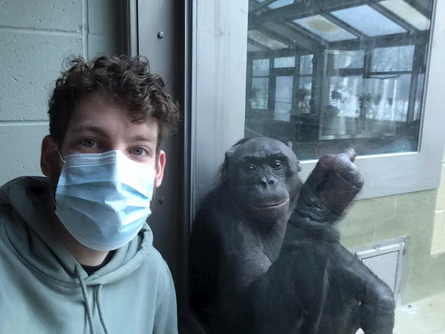
Scientists are still endeavouring to truly understand the cognitive potential of our fellow primates. Humans and apes diverged from a common ancestry between 6m and 9m years ago. But unlike Homo sapiens, which has surged to a population of 8 billion, the other seven great ape species are struggling to survive. The Bornean orangutan, Sumatran orangutan, Tapanuli orangutan, eastern gorilla, western gorilla, chimpanzee and bonobo are all listed as endangered or critically endangered. Time may be running out to fully understand their inner worlds.
“Part of the reason to study great apes is that they are our closest relatives, so we’re learning something about ourselves,” says Krupenye. “But we’re working with these remarkable creatures with rich mental lives that have so much more going on under the surface than people give them credit for.”
The rational mind
The Greek philosopher Aristotle once defined humans as “the rational animal”. People, he asserted, possessed a unique capacity for reason and deliberation that set them apart. “But what does it actually mean to be rational?” asks Hanna Schleihauf, a comparative psychologist at Utrecht University in the Netherlands.
One of the most significant advances in recent years is the finding that chimpanzees revise their beliefs as the strength of evidence changes. In a 2025 study of semi-captive chimpanzees at Ngamba Island chimpanzee sanctuary in Uganda, Schleihauf and her colleagues presented a group of chimpanzees with evolving evidence about the location of a food reward.
“If you hold a certain belief for a certain reason, and then you learn that your reason is wrong, you should actually drop your belief that you had,” Schleihauf says. “And this is what we tried to do with the chimps.”
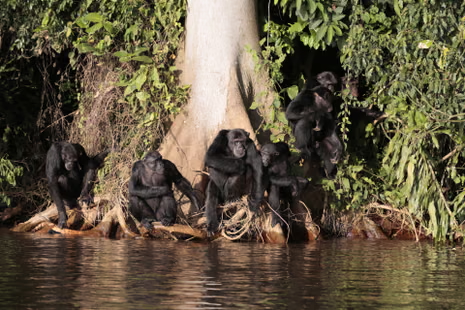
In a series of trials, researchers presented the chimpanzees with two boxes facing away from the subject. They rattled one box, indicating food might be inside. At this point, the chimp chose which box it wanted. Then, the researchers turned the second box around so that the chimp could see something inside that resembled an apple.
The chimp then had the opportunity to choose again, based on this stronger evidence. In this case, if a chimp was being rational, it would change its mind “because the first choice was based on weak evidence, and then you learn there is actually strong evidence on the other side,” says Schleihauf.
And the chimps did. Humans, it appears, are not the only rational ones.
Much of the cognitive research carried out on great apes has used individuals living in a zoo or sanctuary. That, researchers say, offers a different perspective from assessing animals in the wild. Scientists are able to draw on years of data for a particular individual, designing specialised experiments.
Recently, Krupenye, also a co-author on the Kanzi imagination study, tested the long-term memory of zoo-housed chimpanzees and bonobos – a feat only possible because of the documented history of past social partners.
Researchers held up an image of a former groupmate alongside an image of a stranger. “If they didn’t recognise them, you would think that they would just scan these two pictures equally,” Krupenye explains. But the chimps and bonobos spent more time looking at their former social partner, based on non-invasive eye tracking.
“The farthest back we could get to was one bonobo who hadn’t seen two individuals for 26 years,” he says. “[The bonobo] showed this really strong and pronounced looking bias across all of the trials that really makes us think it was able to recognise those individuals, even a quarter of a century later.”
Cultural diversity
Yet to truly understand the full range of great ape intelligence, we must look to the wild. “In the end, where we really see how their brains function is when they are in their natural environment. Not interacting with human researchers, but with each other,” says Schleihauf.
In the canopy of Indonesia’s Gunung Leuser national park, primatologists recorded a startling observation in June 2022. An adult male Sumatran orangutan in the Suaq Balimbing research area, known as Rakus, was chewing the leaves and stems of a liana vine into a pasty mash, then applying it with his fingers to a deep wound he had sustained on his facial flange.
The liana vine, akar kuning (Fibraurea tinctoria), is known locally for its antibacterial and pain-killing properties. Rakus’s wound soon closed over and healed completely a few weeks later.
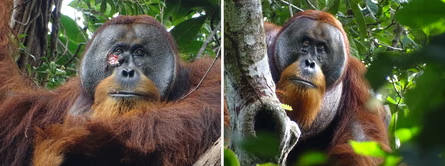
“Before this, there were no reports of active wound healing in animals with a plant,” says the study lead, Isabelle Laumer, a cognitive biologist and primatologist with the Max Planck Institute of Animal Behaviour in Germany.
Laumer has recently assessed playful teasing in four great ape species, and compared the exploratory behaviour of zoo-housed and wild orangutans, finding the former were more likely to explore objects. That makes sense, she says, because “in the wild, an orangutan has to hold on to a tree with at least one arm or one foot, because otherwise they will fall. But, in a zoo, they are on the ground and they have all their arms. It’s much easier for them to manipulate things.”
The differences between zoo-housed and wild apes can be vast. But so can traits between wild communities.
The work of Kristin Andrews, a professor of philosophy at the City University of New York, focuses on social cognition and animal minds. Like humans, she says, chimpanzees have their own unique cultures that differ between groups. In one community, for example, “chimpanzees would bite a little leaf, and it means play. But in another community, they bite on a leaf, and it means they’ll have sex.”
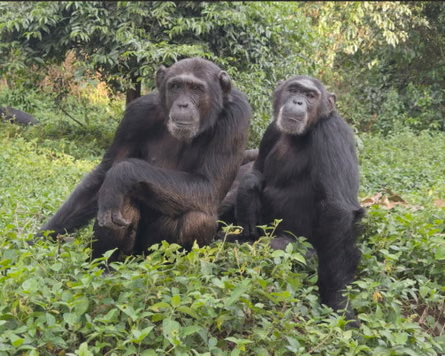
Similarly, chimpanzees in one community might use a wooden hammer whereas another group will use stone hammers. “It’s important to know the difference if a chimpanzee is travelling between these two communities. They have to learn the meaning of the same signal,” she says, in much the same way as human immigrants have to adapt to new countries.
Such cultural variations have serious consequences for conservation strategies of the threatened apes. “Conservation matters to chimpanzees themselves, as well as to us, because of these cultural differences,” Andrews says.
In a paper published in February in the journal Learning and Behavior, Andrews raises the question of whether protecting animal cultural diversity should become a new conservation goal, alongside simply conserving biodiversity.
“Should culture be an important consideration in prioritising populations for conservation? Should we be designating animal ‘cultural heritage sites’ for special protection?” she asks in the paper.
Conservation often focuses on the absolute number of a species, seeking to prevent extinction. But Andrews’ work suggests that even if a species is saved, unique cultures can still be lost forever if a particular group of chimpanzees is wiped out.
“If we preserve chimpanzee DNA somewhere, but that organism that gets created from that DNA doesn’t know anything about being a chimpanzee, that’s not a chimpanzee. That’s something else,” she says.
Find more age of extinction coverage here, and follow the biodiversity reporters Phoebe Weston and Patrick Greenfield in the Guardian app for more nature coverage