







Vladimir Putin has told Russians that victory against Ukraine is inevitable. But on Saturday no tanks or missiles will rumble over the cobbles of Moscow’s Red Square. For the first time in almost 20 years the annual celebration of the allies’ victory over Nazi Germany will take place without military hardware. The reason: the Kremlin is afraid of a Ukrainian attack.
The man who has arguably done more to spook the Putin regime this weekend than anyone else is Robert Brovdi, the head of a Ukrainian military drone unit, Madyar’s Birds, named after his call sign. In recent months it has carried out a series of long-range strikes against targets deep within Russia, including ports, oil refineries and missile factories.
Brovdi acknowledges that a “symbolic” attack on Red Square would generate headlines around the world but says Ukraine will probably deliver a “slap in the face” where Russia’s air defences are weaker. “Why waste drones on the ‘great wall’,” he said, referring to the enhanced security around Moscow. “If you hit the energy sector or military that’s the best strike, on the periphery.”
Crippling attacks from Brovdi’s elite 414th brigade have presented a huge challenge to the Kremlin’s war. The unit’s long-range drones have been knocking out enemy air defence systems more quickly than Moscow can rebuild them and, suddenly, everywhere within a 1,250 mile (2,000km) radius of Brovdi’s bunker looks vulnerable, including Putin’s palaces.
Ukrainian drones last month hit the Black Sea oil terminal at Tuapse four times in two weeks. “Practically everything there has burned,” Brovdi says. There were similar hits on the Baltic ports of Primorsk and Ust-Luga. Drones even flew to the Urals, hitting an oil refinery in Perm and fighter jets in Chelyabinsk, 1,050 miles from the frontline.
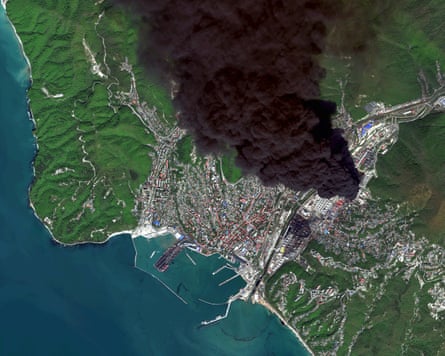
Smouldering infrastructure and dark oil-drenched clouds point the way to a Ukrainian victory, Brovdi suggests, by crashing Russia’s economy so it can no longer fund its costly war. Putin spends 40% of his $530bn annual budget on the military and Brovdi estimates that 100m tonnes of Russian oil, worth $100bn (£73.4bn), is exported each year from ports within range of his drones.
Brovdi also points to the Russian military’s casualties from drones; Ukraine claims that for the fifth month in a row the Kremlin has lost more soldiers than it can recruit, putting deaths at 30,000 to 34,000 a month. “This affects the combat capability of the Russian army, reducing its offensive potential. That is a fact,” he says.
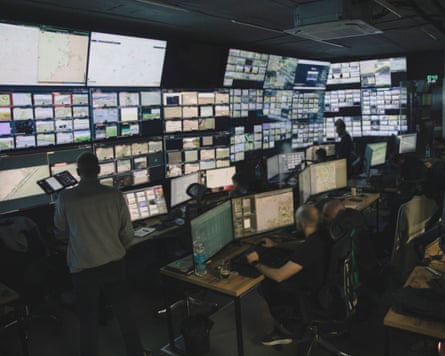
Meeting Brovdi, a former grain trader who last year became head of Ukraine’s newly formed Unmanned Systems Forces, involves elaborate security protocols and a mystery ride in a car with blacked-out windows. After Volodymyr Zelenskyy, he is Russia’s top assassination target. His operations centre is deep underground. A corridor lined with sleeping pods leads to a room filled with computer screens and live video feeds.
Drones hang from the ceiling. There is a library, a painting of a Ukrainian flag by the artist Anatolii Kryvolap, and contemporary sculpture. Video loops show the final moments of Russian soldiers and the grisly aftermath of explosions. Each death is filmed and verified, some of which are compiled into a reel for social media. (The clips, which might strike some as distasteful, are popular online and humiliating for Russia’s military.) An electronic table itemises enemy losses – personnel, armoured vehicles, radar systems – in real time.
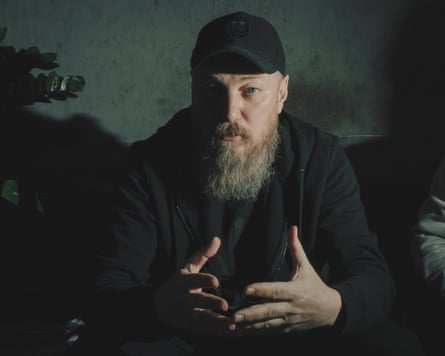
Brovdi sits on a sofa in a small private office, smoking and offering cups of tea. Next to him, goldfish wriggle in a tank. Once clean shaven and dressed in a suit, he wears a green military uniform and sports a long, priest-like beard. He speaks in Ukrainian, reeling off statistics at high speed. An accounting system means he has a record of every drone sortie, going back to the first day of Russia’s full-scale invasion in early 2022.
Several factors appear to explain Russia’s recent panic, and the growing mood of optimism within Ukraine’s armed forces. One is the latter’s new status as a drone superpower. Its counter-drone technology is being exported to Gulf states, who came under attack from Iran in response to US-Israeli strikes. Another is big data. A situational awareness system, Delta, logs every mission, including failures. Brovdi says he receives 12-15 terabytes of raw video footage every day.
Ukraine is also making tactical gains. Earlier this year it staged a small counteroffensive, taking back 12 villages in Zaporizhzhia and Dnipropetrovsk oblasts. In April, Russian forces lost more territory than they gained, for the first time since 2024, according to the Institute for the Study of War.
“Our troops are advancing and liberating our territories. The enemy suffers heavy losses. They are not doing very well in replenishing them,” says Capt Oleg Kopan, the deputy commander of the artillery reconnaissance division of the 148th brigade.
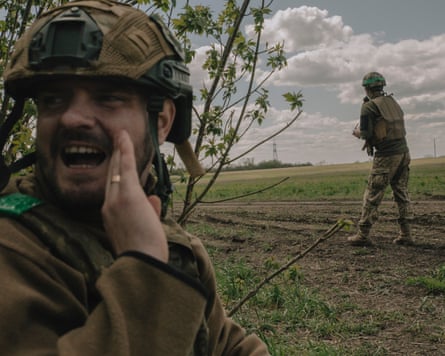
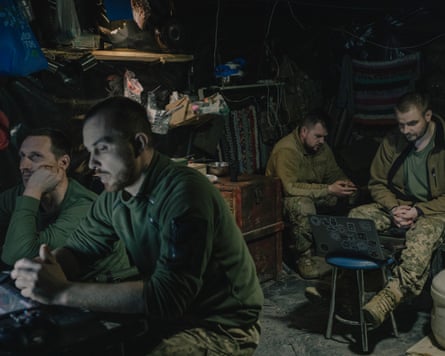
The brigade’s battlefield drone pilots live in a dugout hidden beneath a tree line. Inside are computers, camp beds and supplies of food and water. Every few hours they emerge to launch a Leleka reconnaissance drone, flung into the air with a catapult. Its camera offers a panoramic view of shell-pitted yellow fields and Russian trenches. There are periodic grey puffs of smoke from Ukrainian artillery strikes.
Kopan says Ukraine’s recent advances are “100%” down to rapidly evolving unmanned technology. “Drones allow us to inflict precise damage with fewer personnel casualties and greater efficiency,” he says. The Russians were also adapting. “They’re very good at observing what we’re doing, copying it from us and scaling it up quickly. They have factories and people,” he adds.
In Brovdi’s view, Ukraine has pioneered a “new doctrine of war”. Drones are responsible for 80% of destruction, he says, supplanting assault rifles and armour. “A blitzkrieg is now impossible. If Russia had a million tanks and tried to seize Kyiv again, it would be the biggest bloodbath in world history,” he says. “Two million drones would swarm over these tanks and burn them mercilessly.”
He adds that Nato countries have not yet fully grasped that they need to overhaul their armies. The generals in charge received their military training when “nobody gave a shit about drones”, he says. They need to emulate Ukraine’s example by setting up an ecosystem that marries video footage, photographs, coordinates and confirmed kills, he says. “Russia won’t stop. Neither we nor you have time.”
But despite successes, Ukraine is “a long way from victory”, he admits. “I’m under no illusions whatsoever an end to the war is possible in the near future. If anything, we’re talking about a pause linked to some sort of agreement, or to geopolitical circumstances.”
“The pause will merely give Putin the chance to regroup. He is afflicted with an incurable disease of power and the desire to build a dictatorship. He’s a sick man.”