




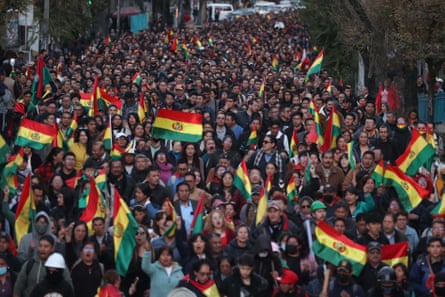
Protests blocking roads across Bolivia and turning the centre of the capital, La Paz, into a battleground between demonstrators and police have entered a second week.
It is the most turbulent moment of the centre-right president Rodrigo Paz Pereira’s mere six months in office since he ended nearly two decades of rule by the leftwing Movimiento al Socialismo (Mas).
In response to the protests, the president said later on Wednesday that he would carry out a cabinet reshuffle and would not “dialogue with vandals” involved in acts of violence, but would set up a council to allow Indigenous groups, farmers, miners and other workers who have been on the streets “to be part of the decision-making process”.
After taking office in November, one of the former senator’s first moves was to restore relations with the US, which now describes the uprisings as “an ongoing coup d’état” against Paz Pereira.
Alongside the domestic unrest, Bolivia’s president has triggered a diplomatic crisis after ordering the immediate expulsion of Colombia’s ambassador in La Paz on Wednesday, in retaliation for remarks by Colombia’s leftwing president, Gustavo Petro.
On Sunday, Petro reposted a video claiming that Paz Pereira was a “puppet of the US” and commented that Bolivia was experiencing a “popular insurrection” that was “the response to geopolitical arrogance”.
Announcing ambassador Elizabeth García’s expulsion on Wednesday, Bolivia’s foreign ministry said the decision was intended to “preserve the principles of sovereignty and non-interference in internal affairs”. Moments later, Petro told a Colombian radio station that Bolivia was “sliding into extremism”.
Later on Wednesday, Colombia’s foreign ministry said Bolivia’s ambassador would depart Bogota.
The protests have so far caused four deaths – one demonstrator reportedly killed in clashes and three others reportedly because roadblocks prevented them from receiving proper medical treatment – as well as dozens of injuries and more than 40 road blockades across the country on Wednesday.
On Tuesday, the US deputy secretary of state, Christopher Landau, claimed that the protests were “an ongoing coup d’état”. Riot police in La Paz on Monday fought running battles for hours with protesters calling for Paz’s resignation.
Speaking in Washington, Landau said: “Let us not make any mistake about that; it is a coup financed by this perverse alliance between politics and organised crime across the region.”
On Wednesday, the US secretary of state, Marco Rubio, echoed the remarks of his deputy, posting: “Let there be no mistake: the United States stands squarely in support of Bolivia’s legitimate constitutional government. We will not allow criminals and drug traffickers to overthrow democratically elected leaders in our hemisphere.”
Romer Cahuaza, a striking transport worker demanding improved fuel supplies, warned of “bloodshed” if Paz’s government did not step aside.
The foreign minister, Fernando Aramayo, accused the demonstrators of trying to “disrupt the democratic order”.
Bolivia is going through its worst economic crisis in four decades, with shortages of dollars and fuel and rising inflation dating back at least to the final years of the previous president Luis Arce’s term under Mas.
At a press conference on Wednesday at the presidential palace, Paz Pereira said: “We need to reorganise a cabinet that must have the capacity to listen.” Although he has not yet provided details of the changes he plans to make, the president said it would become a “more agile cabinet, closer [to the population]”.
He also announced the creation of an “economic and social council” to form a “joint government” and coordinate decision-making, to which “everyone who wants to participate” would be invited – except “vandals”: “Is vandalism valid? No, and I will not dialogue with vandals.”
Paz Pereira, the son of former president Jaime Paz Zamora, who governed from 1989 to 1993, took office promising an “economic shock therapy”, but conditions have not improved and some of his measures have proved deeply unpopular.
One of his first decisions was to end a two-decade-long fuel subsidy, promising that a free market would bring higher-quality fuel into the country. Instead, shortages continued and, shortly afterwards, the “dirty fuel” crisis erupted, after part of the supply was found to have been adulterated. The president said he had been the victim of an alleged “sabotage” by former officials supposedly linked to Mas.
The historic leader of Mas, the former president Evo Morales, also remains an uncomfortable shadow over the current administration. The country’s first Indigenous president has been entrenched since late 2024 in the coca-growing region of Chapare, where hundreds of farmers prevent police or the military from enforcing an arrest warrant against him for allegedly fathering a child with a 15-year-old girl in 2006.
Morales is currently being tried in another province on human-trafficking charges, linked to alleged political favours granted to the girl’s parents. He failed to appear in court and the judge issued a new arrest warrant.
The presidential spokesperson, José Luis Gálvez, said Morales was fuelling the unrest in order to “evade the trial”.
Morales denies this and said the uprisings were “against the implementation of the neoliberal model”, adding that “it is just and necessary for the thousands of victims of ‘dirty fuel’ to begin a civil action”.