







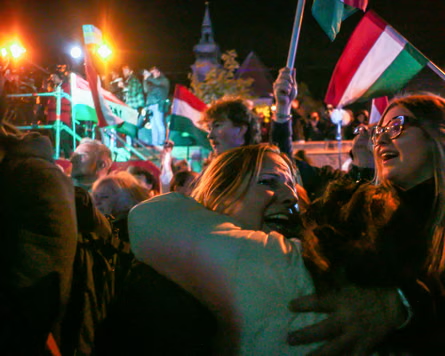
It was a bad week for Israel in Europe: the country lost its staunchest regional ally when Viktor Orbán was toppled from power in Hungary, and Italy suspended a key defence pact.
The shifts are likely to pave the way for long-delayed sanctions against violent settlers in the occupied West Bank, and add to broader pressure for the EU to reconsider its relationship with Israel over its wars in Gaza and the wider region.
“Hungary’s veto was the only thing preventing the package of sanctions against violent settlers,” said Maya Sion-Tzidkiyahu, the director of the Israel-Europe relations programme at the Mitvim thinktank and a lecturer at the European forum of the Hebrew University of Jerusalem.
“I expect once the [new] Tisza government is in place, that would be one of the first things the EU would like to push, and it should be easy for [Péter] Magyar to say yes. Netanyahu is on the wrong side of history from the perspective of many Europeans, and he is a symbol for Orbán.”
EU officials expect to revive sanctions targeting a small number of extremist settlers once a new Hungarian government takes office next month. Ireland, Spain and Slovenia – among the staunchest supporters of the Palestinian cause in Europe – have called for a discussion of Israel’s human-rights obligations under its association agreement with the EU, when EU foreign ministers meet on Tuesday.
“The European Union can no longer remain on the sidelines,” wrote the foreign ministers of the three countries in a letter to the EU foreign policy chief Kaja Kallas, referencing “unbearable” conditions in Gaza and “escalating violence against Palestinians” in the West Bank.
Although sanctions on settlers are seen as a mostly symbolic move against a small group with few ties to Europe, passing them could strengthen confidence to consider broader action, including suspending parts of the deal underpinning EU-Israeli ties.
The EU is Israel’s top trading partner, most popular travel destination and a vital source of research funding through the multi-billion dollar Horizon programme, but it has never managed to turn that economic power into significant political influence inside Israel.
“Now the discussion about leverage and pressure is back on the table,” said Martin Konečný, the director of the European Middle East Project, in Brussels. “If you take one step, and the situation doesn’t improve, then the pressure to take the next step actually rises very quickly again.”
Last week more than 390 former EU ministers, ambassadors and top officials urged the EU to suspend the EU-Israel association agreement in whole or part.
Signatories included the former EU foreign affairs chief Josep Borrell, the former Swedish foreign minister and UN weapons inspector Hans Blix, and the former European Commission vice-president Margot Wallström.
A public petition making the same demand passed a million signatories from all 27 member states, making it the fastest growing petition of its kind, supporters say.
Freezing all or part of the EU-Israel association agreement would require support from either Germany or Italy, because it must have the backing of a “qualified majority” of at least 15 member states representing 65% of the EU’s population.
An attempt to halt trade provisions last September, in response to the humanitarian catastrophe in Gaza, never passed that threshold. After Trump brokered a ceasefire deal in October, the plans stalled.
EU sources suggested forthcoming talks between Israel and Lebanon are likely to restrain any immediate EU action, because many European countries are wary of disrupting delicate negotiations.
Italy’s abrupt political shift, signalled by the decision to suspend the defence cooperation deal, means a renewed proposal may have a greater chance of passing.
Italy’s prime minister, Giorgia Meloni, had been among Israel’s closest friends in Europe, one of several far-right leaders to cultivate a close personal relationship with the Israeli prime minister, Benjamin Netanyahu.
She regularly defied public sentiment in a country that has had some of Europe’s largest protests against Israel’s wars, and a political climate where pro-Palestinian sentiment extends across the political spectrum, from the left to the centre right.
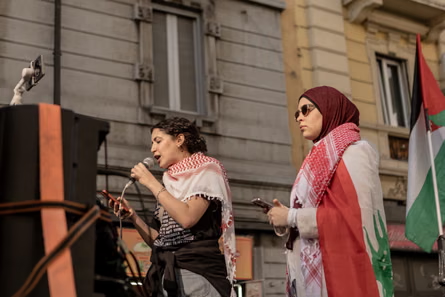
That was based on a separation between foreign and domestic policy that is no longer sustainable, said Lorenzo Castellani, a political historian at Rome’s Luiss University. “For the first time since the second world war, foreign policy has become a central concern for Italian public opinion,” he said. “The reason is simple: this is a conflict with direct geopolitical and economic consequences for Italy and for Europe as a whole.”
The suspension of the defence memorandum appears to be more symbolic than substantive, as it provided a framework for defence deals that will remain in place – but it served as a “clear warning” to Israel, one European diplomat said.
Israel has been effective at using its closest bilateral relationships to block or blunt hostile EU policy, in an approach that Sion-Tzidkiyahu describes as “divide and thwart”.
It can still count on support from longstanding allies, including the Czech Republic’s Andrej Babiš, and if Netanyahu loses power in elections due this year Magyar may build a closer relationship with his successor.
But political ties with Israel are increasingly costly for European leaders. The impact of regional wars has been amplified by Netanyahu’s close alliance with the US president, Donald Trump, who regularly attacks Europe, derides its culture and values, undermines its economy and has even threatened to invade.
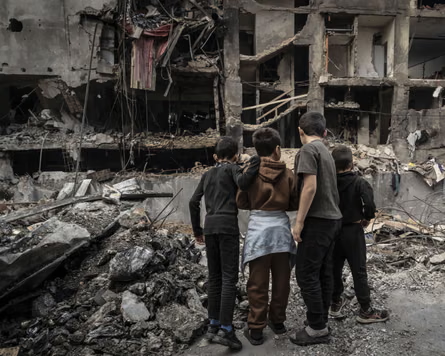
Many Europeans calling for stronger action against Israel say core European values are at stake, and failure to act will undermine the international rule of law.
“The absence of meaningful measures against Israel, contrasted with extensive sanctions imposed on Russia, has raised concerns about double standards and risks undermining the EU’s international credibility,” said Pasquale Ferrara, a former senior Italian diplomat and scholar.
Concern about maintaining Israel’s European alliances may have contributed to an unusual public spat last week, in which Israel’s ambassador to Germany, Ron Prosor, denounced Israel’s finance minister, Bezalel Smotrich, for attacking the German chancellor, Friedrich Merz.
After Smotrich posted a tirade referencing the Nazi regime, Prosor “unequivocally condemned” the comments, accusing the minister of eroding the memory of the Holocaust.
Sion-Tzidkiyahu commented: “When Israel is dependent on so few countries, and Germany is the main one because Meloni has turned her back, you have to protect that relationship.”
Since the war on Gaza, German public opinion, like in Italy, has diverged from the government’s staunch support of the Israeli government. Most voters are now critical of the Netanyahu administration, but Germany’s responsibility for the Holocaust means it would never lead criticism of Israel.
Merz has criticised violence and settlement expansion in the occupied West Bank and largely avoided his predecessor, Angela Merkel’s, formulation that Israel’s security is a “Staatsräson” or “reason of state” for Germany. However, he said in an interview last year that Israel’s security remained at the core of German foreign policy.
The loss of Orbán and Meloni’s distancing got limited attention in Israel, where wars in Iran and Lebanon and the relationship with the US dominate foreign policy discussion.
Few Israelis appreciate the extent to which ties with Europe underpin their standard of living. Two-thirds of Israelis see the EU as an adversary, and only 14% as a friend, an August 2025 survey carried out by the Mitvim thinktank found.
“All Israelis know that we are dependent on the US for security issues, but they don’t understand that we are dependent on the European Union for economic issues,” Sion-Tzidkiyahu said. “We have managed to diversify trade, but the EU is still the largest block we are exporting to and importing from.”