


Weddings can be complicated to organise, especially when the venue is more than 4,000 miles from home. But Andrea, a Londoner, was confident she and her partner, Josh, had thought of everything when they planned their dream wedding in Barbados for the beginning of May.
The British couple – Andrea of Nigerian and Josh of Bajan heritage – booked a stunning venue, with tropical gardens and spectacular views.
Invitations were sent out to 170 guests from the UK, Nigeria and Barbados, with pre-wedding parties and a black-tie ceremony bringing together generations of far-flung family and friends.
According to the island’s official tourism site: “You deserve a wedding beyond your imagination.” What happened next ticked the “beyond your imagination” box in a way the couple could never have anticipated.
Andrea invited her close friend Femi, a Nigerian hairdresser, to be her bridesmaid. Femi was beyond excited, her WhatsApp messages full of joyful emojis when Andrea confirmed the wedding plans and discussed booking her flight.
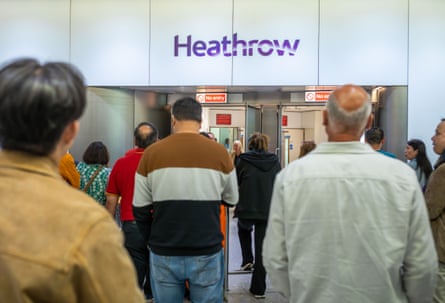
A friend of Andrea’s said a Direct Airside Transit Visa might be needed for Femi to walk across Heathrow, after flying in from Lagos, to board a connecting flight to Barbados. When Andrea called the airline to book the flight, she asked about the visa. An employee confirmed one would be necessary, but said it shouldn’t be a problem. Femi’s luggage would be checked through for the whole journey.
As Femi’s sponsor, Andrea assumed she would simply have to pay the £41.50 application fee and wait for it to be confirmed.
She knew that people sometimes had problems with the Home Office, but had had no direct experience of this herself. “I was so naive,” she says. “I knew about the hostile environment policy, but I genuinely thought everything would be OK.”
The requirement for the visa was brought in by the previous Conservative government in 2014. Not all international travellers need Home Office approval to walk from one part of a UK airport to another. Most of those who do are people of colour, including travellers from about 30 African countries.
The people who must obtain these visas are not going through immigration control, so never cross the UK border. But the Home Office has decided rigorous checks of who they are, the purpose of their journey and their financial situation must be carried out before the permission to step off one plane and on to another is issued.
In Femi’s case, Andrea had to provide a range of evidence: passport details; an explanation of why Femi was travelling and proof of booked travel tickets; proof of the funds both women had in their bank accounts; and proof that their friendship was genuine.
Andrea also provided the wedding venue booking contact after Home Office officials said the wedding invitation and RSVP were not proof enough. They asked why Femi’s business and bank account records showed two different addresses – she had moved house. “The whole thing is just so insulting,” says Andrea.

She has made four visa applications over a three-month period at a cost of £41.50 each, along with roughly £74 with each application for the booking of a premium biometrics appointment to take Femi’s fingerprints, to try to speed up the process. All four applications have been rejected. Sponsors such as Andrea are stuck in a catch-22 situation – she had to buy her friend’s flight ticket and hotel room before she could apply for the visa, as proof that the reason for the journey is genuine. She will lose more than £1,500 if the visa is refused.
Last year (2025) 20,108 of these visas were approved – 81% – with 4,744 refused.
A Home Office spokesperson says: “Passenger Transit Visas are a long‑standing safeguard to prevent abuse of the visa system, ensuring only genuine transit passengers can travel through the UK.”
Andrea says the four Home Office rejections have been littered with errors. At one point, officials misplaced a decimal point on Femi’s salary, making it £3.8K instead of £38K. “The Home Office caseworker states in one of the visa application refusals that my friend’s bank statement contains only four credit transactions over 11 months,” says Andrea, “and refuses her on that basis. This statement actually contains 164 inward credit transfers and 553 outward transactions with multiple transactions per day.” The account is in the name of Femi’s hairdressing business and shows payments to staff, suppliers and others, “exactly what you would expect from an active self-employed hair stylist. Not four transactions. Hundreds.
“How does a caseworker look at a bank statement with hundreds of transactions and record it as having just four? And more importantly, what accountability exists when they do things like this?” There is no right of appeal on a Direct Airside Transit Visa. The only route is a complaint, which, says Andrea, “in my case was partially upheld and led directly to another decision containing another serious error. The applicant simply has to keep paying, keep reapplying, and hope that eventually a caseworker reads the documents correctly.”
In one of the rejections, the Home Office said Femi could fly via Qatar instead of the cheapest and most direct route via London Heathrow. At the time, Qatar was a conflict zone as a result of the war between Iran and Israel and the US. This route would have taken a day and a half, whereas the route through London Heathrow takes less than 24 hours.
“My blood has never boiled more than with the visa rejection saying that my friend should travel through Qatar,” says Andrea. “That journey – going from Lagos to Qatar, Qatar to Miami, then Miami to Barbados – doesn’t have any logic.”
In the latest rejection on 21 April, officials once again suggest a more circuitous route, this time via Doha, saying the choice of the most direct route through the UK is not “reasonable and credible”. The more visa applications the Home Office refuses, the more of a “red flag” you become, says Andrea.
It is not easy to speak on the phone to a human being at the Home Office and you can end up paying quite a lot trying to do so. Calls are charged at 69p a minute; it’s likely you’ll be on the phone for a long time. “I paid £20,” says Andrea, “but it was a waste of time. He said there was nothing that he could do and that I should make a complaint.”
The Home Office’s mission statement is to be “a world-leading immigration service working for a safe and prosperous United Kingdom”. In one rejection letter, Home Office officials say they do not believe Femi and Andrea even know each other. Of the supporting evidence, the official says: “The documents do not demonstrate if you have ever met or have any form of contact between you and your sponsor and it is not clear why they are supporting your visit. I am therefore not satisfied that you have a genuine professional or personal relationship with your sponsor.”
Andrea’s wedding is now just days away. Femi is struggling to understand the situation. “Andrea is a very close friend and not being there will be heartbreaking for both of us. This trip is not just travel for me, it is about being present for someone very important in my life during one of the most meaningful moments she will ever have.”
Andrea believes the Home Office is unlikely to change their decision at the eleventh hour. “The flight I booked for Femi is non-refundable so, altogether, unsuccessfully trying to get my friend to my wedding has led to almost £2,000 down the drain. This is a money-grubbing exercise and the only winner is the Home Office.”
Names have been changed