








“As someone who has lost touch with reality, I like to hold a firm grasp on it now,” Mary Cain says while we walk through a palm-tree spotted campus in California.
She’s telling me why she insisted she write her own memoir, This is Not About Running, without ceding the narrative to a ghostwriter, as happens with many athletes. “My story is so complicated … there are so many bad actors that I think it forces the reader to embrace nuance, and I don’t think you see that very often.”
At 29, Mary Cain is a decade removed from her experience as the United States’ highest hope for a middle-distance track star since Mary Decker smashed women’s world records up and down the stat sheet in the 1970s and 80s.
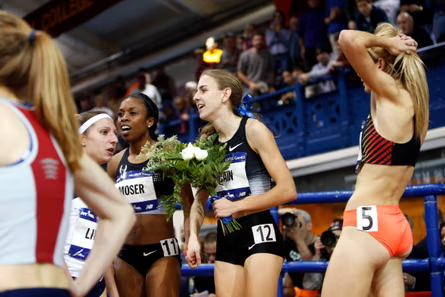
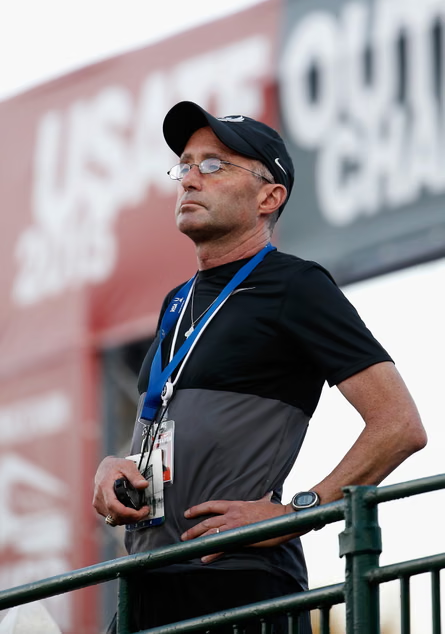
Cain set four different national high school records as a teen, and as a 17-year old made the world championships in the 1500m, finishing 10th in a field of pros. But instead of heading to college to run D-1, she was contacted by Alberto Salazar, a famed running coach at Nike’s Oregon Project, who convinced her to give up college track and go pro, with him.
What followed was, as she describes it in her memoir, a hellish four years for Cain during which, she says, Salazar became emotionally abusive. Cain details a coach who was obsessed with Cain’s weight, isolated her from her own parents, sent her to a sports “psychologist” who was not credentialed, and ignored her clear signs of suicidal ideation, disordered eating, and self-harm (Salazar has denied any wrongdoing and he and Nike settled a lawsuit brought by Cain in 2023 alleging the abuse).
While the media wondered what happened to Cain as her times got slower – assuming she’d lost her world-class talent because, as the stereotype goes, female runners flame out once they get hips – as she tells it, she was lucky to make it out alive.
The Cain who walks me through Stanford’s picturesque campus on an early spring day in Palo Alto, California, is almost unrecognizable from the young woman in the pages of her book, or the New York Times op-ed video in 2019 that gave her national exposure after she claimed Salazar was an abusive coach.
The second-year med student scootered across campus to meet me, wearing a bow in her long golden-brown hair, a flippy red skirt, and black Dr Martens boots. We go to the top floor of the building so she can show me the gym she goes to between classes. “I like to look out that window while I do squats,” she says, pointing at the view of the distant Santa Cruz mountains.
The day before, she’d taken a five-hour long exam – it’s finals week – but after, instead of going home to rest or study more, she met up with friends to watch Bridgerton. Staying up late and socializing instead of obsessing over school is a sign, she says, of her own growth. “I just think it’s really important to learn from what I went through and make sure that I never get sucked into the idea that this is everything, again.”
In This is Not About Running, Cain describes in an immersive present-tense her years as a teen phenom who says she was forced into an extremely unhealthy mentality. The tale begins, surprisingly, not with Salazar, but with a high school coach and teammates (and their parents) who bullied and ostracized Cain for her talent. When Salazar called, offering to start training her when she was just 16, she gladly dove in for a change of scenery.
At Nike, Cain describes a team of people who seem to have been fully aware of Salazar’s tactics but allowed them to flourish.
She writes scenes in which the performance coach for the Nike Oregon Project, who she was told was a sports psychologist, allegedly ordered Cain to toughen up when she revealed she was cutting herself. Salazar’s boss and the then vice-president of marketing also allegedly told Cain cutting her hair would help her lose weight but he wouldn’t let her, because then she would “not look good”, and that she needed a different bra because everyone could see how huge her breasts were. The woman who measured her body fat percentage asked Cain to submerge herself in water for at least 30 seconds four different times, because Salazar wanted the most accurate reading possible, and ignored her pleas that she felt panicked under the water.
Her teammates, she writes, were just as ungenerous. Once, on the way to training, one took a phone call while she sobbed in the backseat of the car on the way to a training run because she was suicidal, another described her depressive episodes as “acting like a child”.
Cain left the Nike Oregon Project in 2016 while suicidal, self-harming regularly and suffering from a severe eating disorder, but she spent the next three years thinking: “I hope Alberto still loves me … I am the failure. I was bad. I was fat.”
From there to here has been a long journey of healing mind and body. She kept running in those first years after leaving Nike, and kept getting injured. “I was still so deeply depressed and confused about my body.” The stress fractures common among women athletes who have experienced disordered eating and underfueling while overtraining (medically known as Relative Energy Deficiency in Sport, or Reds) were one culprit, but there was another, more mysterious ailment, too. Cain’s lower right leg and foot were experiencing numbness that got increasingly worse if she ran for too long, and eventually, even after walking shorter distances.
The narrative that Cain had been saddled with by the media and her coaches as a phenom was a familiar one for a young woman runner: that her career could end at any moment from injury, puberty, or burnout. “That really gets in your head and I think it really damaged me more in the years where I was going through this really chaotic physical health issue where I couldn’t feel my leg,” she says. “I was desperate not to fulfill this prophecy.”
Then, in 2019, the United States Anti-Doping Agency released a 270-page report on Salazar that ultimately banned him from track for doping violations for four years.
Cain read the entire report in one sitting, and finally realized Salazar had not been honest with her about certain medications she had seen him give other athletes, like L-carnitine infusions in higher than allowed doses. The report also cited him for trafficking testosterone and attempting to tamper with doping results. It made her think about the thyroid medication and diuretics she says he often pushed on her.
The lightbulb went on: her coach, whom she was desperate to please between the age of 16 to 20, had not been who she thought he was. Weeks later, while texting Alexi Pappas, an Olympian and friend, about processing all of this news, Pappas sends her the contact information for a New York Times editor, who says she could write something up. Within hours, the editor asks Cain to come to the offices, where they shot a video of her describing her experience with Salazar.

Within days, Cain’s op-ed went live and lit the running world on fire. “The New York Times piece was almost more of a start versus an end,” she says.
The Nike Oregon Project disbanded shortly after. And, by 2021, Salazar earned a lifetime ban from SafeSport because of sexual and emotional misconduct.
But Cain emphasizes that Salazar’s ban does not solve the issue of athletes’ abuse in running. In fact, she says, it’s more akin to “cutting off the head of a hydra”.
For running to change, she says, it will take far more than her speaking out. And she knows her story will ruffle some feathers, as she has no hesitation calling out just how deeply the system’s flaws allow actors like Salazar to flourish – and names names in doing so.
“I feel very deeply that if you were unkind to a child, you should work on that … and if you feel uncomfortable with my perspective, I hope this gives you the opportunity to really sit with some of those things,” she says.
Shortly after the op-ed came out, the numbness in her leg got bad enough that Cain stopped running for two years. She played rec soccer on Pier 40 in New York City, did pilates, and engaged in intensive talk therapy.
By fall 2022, Cain decided to take the MCAT – she’d dreamed of being a doctor since she was a little girl, when she idolized Marie Curie. She felt like a running career was probably off the table by then, but if she was going to be a doctor she’d like to know if she could walk and stand for long periods of time.
Dismissed time and again by doctors because, she felt, she was a female athlete who had mental health problems on her chart, she’d almost given up seeking a diagnosis. But her mother finally asked her father, an anesthesiologist, to hit Cain’s knee with a reflex hammer and take a look himself.
When he realized one of her legs looked larger than the other, he surmised the problem could be vascular, so her mom entered the symptoms into Google along with “vascular” and came up with a possibility: popliteal artery entrapment syndrome (PAES).
The problem – a muscle that grows too quickly in the back of the calf can start to cut off blood flow to the rest of the leg – is rare, but can be caused by overtraining in young athletes. She went to two different doctors with the possibility, but they both did an MRI while she was laying down that gave a false negative report. This frustrated her even more. “I’m medically literate,” she says, “and of course an MRI isn’t going to show anything if this is a vascular condition in the way that they had me do it.”
Cain finally reached out to a well-regarded sports medicine doctor she knew, Trent Stellingwerff, who sent her a list of three specialists who treated PAES, particularly in athletes. Only one was in the US. Cain flew out to see Jason Lee at Stanford in February 2023. “I had trained myself not to cry in front of doctors, because it felt like a death sentence”, she recalls But as soon as she sat in Lee’s office, she crumbled and immediately apologized.

His kindness shocked her. “He said: ‘This is so upsetting, you just told me you were a professional athlete and you can’t do the thing you loved to do any more, that’s a normal response.’”
Her test for PAES came back positive, and Lee called her with the news. “He said: ‘I always save a couple surgery openings, I call them my Golden State Warrior openings. You’re a Golden State Warrior to me, do you want to come in?’”
The way Lee treated her changed her perception of what a doctor could and should be. She was amazed not only that Lee believed her, but that he had been so kind and willing to treat her so quickly, even as a female professional athlete who hadn’t competed in years.
Two weeks later, Lee operated. Six weeks after that, Cain took the MCATs.
She applied to and got into Stanford and Harvard, but her experience with Lee – and her successful surgery – swayed her fully toward Stanford.
That summer, she prepared to move to Palo Alto to start medical school. While she still hasn’t ruled out a competitive comeback, Cain is focused on a different physical goal for the time being: rewiring her body.
That means a lot of intensive PT type exercise, and trying her best to take it easy on runs. “I went for a run this morning and it was nice. You know, the whole time I was like, I’m really thirsty, but that was my only complaint.”
And she’s seeking that kind of nuance and groundedness in all parts of her life. She doesn’t see medical school, where she lives on campus and gets to enmesh with a small cohort as a do-over of her painful undergrad years.
“I’ve had a lot of people ask me if I regret things … I was abused. I can’t regret that. The people who did it should regret their actions.” Instead, she is immensely grateful for the people in her med school class. “After going through the experience I did, [I thought] ‘Am I deeply unlikable? Am I being abused because I am a problem?’”
Now, she says, having friends who know her deeply has been healing. Intensive CPT (cognitive processing therapy) helped, too.

The idea for writing the book in present tense took root in some of the CPT therapy assignments she did that helped her reframe those years. “What I developed was such a sense of self-hatred. Ultimately that’s why I self-harmed, why I was suicidal, why I had an eating disorder . At its core I hated myself … because of the actions of others. But the problem was that I therefore developed a self-hatred.”
Undoing that self-hatred has been a long process, as has undoing the suppression of her own feelings she learned while working with Salazar.
“I did not realize until three years ago what hunger felt like. Because I had been convinced by Alberto [Salazar] that that sensation was not hunger and that it was like mittelschmertz (the pain of ovulation), which doesn’t make any sense biologically.”
She explains this while we eat tofu wraps and sip iced coffees at an outdoor picnic table. “It was really wild to one day wake up one day and be like, ‘that’s hunger’.”
Today, Cain seems hungry for the future. While she has been working with Lee on PAES research – they hope to publish a paper soon – she’ll start her clerkships in different specialties this summer. “I’m honestly so curious to see what happens, to find something that I ultimately realize I really want to do.” She laughs. “I’m kind of just happy to be here.”