




Moving house has a more literal meaning on Hatteras Island, the slender hook of land that juts off the coast of North Carolina. After a slew of houses toppled spectacularly into the Atlantic Ocean recently, entire buildings are now being lifted on to wheels to flee the rapidly eroding coastline.
Since September, 19 homes have been lost to waves that tore them from their pilings, sending them crashing into other structures like bumper cars before breaking up in the ocean. Spooked homeowners have turned to the unusual services of Barry Crum, a lifelong Hatteras resident who has become the island’s main house mover.
More than a dozen homes are set to be moved or raised higher on stilts by Crum and his small crew, who on a recent balmy April day were jacking another large dwelling on to girders, ready to be carefully wheeled a few hundred feet back from the crashing waves to tenuous safety. The house, aptly, is called Cape Point Retreat.
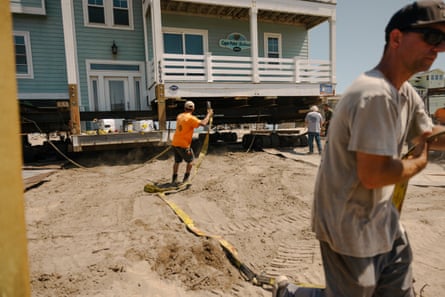
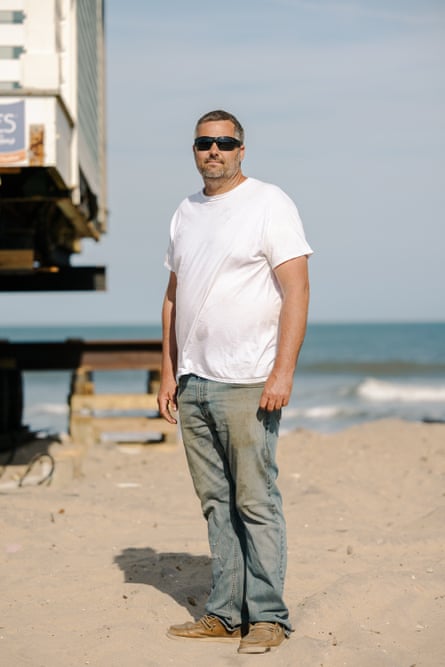
“It’s never been this busy,” said Crum. “I’ve seen a lot but I hadn’t seen this kind of erosion this quickly before. I’m glad I can do this to help, but it stinks what’s happened in the community.”
Coastal erosion has long been a feature of life on the Outer Banks, a string of constantly shifting sandy barrier islands that includes Hatteras, with some hotspots here losing more than 10ft of land a year to the seas.
This has always been a tempestuous landscape to settle on – even the Cape Hatteras lighthouse had to be moved, by a team including Crum’s father, in 1999 after losing more than 1,000ft of land in front of it.
But longtime locals were still staggered by the recent erosion, which wiped out the entire beach and sand dunes of Buxton, a town on Hatteras, and swallowed up part of a neighborhood. On some days, hefty waves downed homes like dominoes at an astonishing rate – on 30 September, five houses collapsed within just 45 minutes.
“I could see the house leaning and then you could hear a crackling sound, like lightning,” said Hunter Hicks, a resident who took a video of one of the four houses that fell into the ocean during the first two days of February. “There were 10ft waves hitting it and then it started to fully fall and it sounded like a bomb went off. It’s hard to even describe the sound.”
“The island is just getting smaller and smaller,” Hicks added. “If we don’t move these houses we will probably lose 20 more by the end of the year.”
How to respond to such galloping losses is an immediate challenge for parts of the Outer Banks but also a looming one for other low-lying US east coast communities, too, as the climate crisis relentlessly pushes up sea levels.
“Things are changing and they’re changing rapidly,” said Laura Moore, an expert in coastal change at the University of North Carolina. The increasing pace of sea level rise means the Outer Banks coastal areas are “kind of the canaries in the coalmine” for other communities along the east coast, she added.
“What we are seeing is a real scramble to try to address these changes,” Moore said. “But there is no easy solution. Sea level’s rising, we’re on a mobile landscape, there really is no long-term way to hold things in place up and down the entire eastern seaboard.”

Since 2020, 31 houses have been lost on Hatteras Island, but this hasn’t triggered obvious despair here. Resilience and ingenuity have long been required to live on the Outer Banks, the bow-shaped string of barrier islands, barely a mile wide in places, that bend into the unforgiving Atlantic Ocean.
The Wright brothers made their first controlled flights at Kitty Hawk, in the northern reaches of the Outer Banks, while the many pirate-themed stores here hark back to an age when Blackbeard hid out on Ocracoke Island, a sliver of land at the southern end where today sandbags stretch along a chunk of the only highway in an attempt to prevent it from flooding.
The occasional severance of this road, Highway 12, by onrushing water or sand can leave people along the Outer Banks marooned from the mainland, save a lengthy ferry ride. Visitors can buy T-shirts here poking fun at the situation or get a coffee from the aptly named Swept Away Cafe. This isn’t a place lacking self-awareness, or pluck.
But problems were inevitable once roads, homes and businesses were bolted on to a naturally dynamic environment. In the 1930s, the US government started building up human-made sand dunes on the ocean side of the islands to hold the beaches in place, subsequently declaring 70 miles of this coastline to be the Cape Hatteras National Seashore.
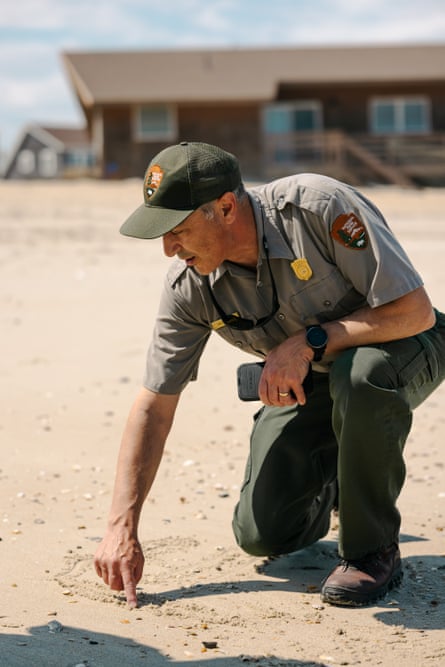
As David Hallac, of the National Park Service (NPS) and the current superintendent of the seashore, illustrated by jabbing a finger in the sand to draw lines, the artificial dunes prevented the natural progression of sand across the islands, ironically worsening erosion.

“Erosion on a barrier island is not only normal, it’s important,” Hallac said. The pounding surf pushes the sand towards the mainland, morphing the islands’ shape rather than drowning them. But large barriers prevent this transfer of sand, so the beach is instead carved away, to the point at which onrushing water swamps houses and roads.
“We have what’s called coastal squeeze – the islands are getting narrower,” said Hallac as he gazed at a large, derelict house on stilts that stands in pristine isolation on Rodanthe’s beach, the water lapping its bowing legs.“There was probably a gorgeous beach in front of it when it was built,” he said, guessing that the house dates from the 1980s. “You wouldn’t even see the water from the ground because there was a dune in front of it.”
The climate crisis may accelerate the beach’s future retreat but isn’t at present, according to Hallac. “We have a highly eroding beachfront, which is totally natural,” he said. “There’s nothing unusual about it.” The Trump administration, which oversees the National Park Service, has routinely dismissed the impact of global heating, including sea level rise, which the president has said will create “more oceanfront property”.
The advancing seas, though, have shrunk the amount of federal land on the seashore, with erosion in the towns of Buxton and Rodanthe leaving behind abandoned structures that warp and lean at precipitous angles, their exterior staircases contorted to nowhere like an Escher print.
Once they do fall, the National Park Service is responsible for cleaning up debris that’s now strewn across a couple of the exquisite beaches found here. In Buxton, the gouged beach is littered with sandbags and the ephemera of houses that splintered and broke apart over the winter. Shards of glass await bare feet, loosed septic tanks sit in the water and the concrete bowls of grand swimming pools lie broken in the sand, a modern Ozymandian wreck.
Many of the remaining houses standing on the oceanfront in Buxton are vacation rentals – most locals choose to live at slightly higher elevations in the wooded interior – but even before being swept away the houses become unlivable once the water knocks out the septic system.
“The timeline of the collapses has shortened dramatically,” said Brianna Castro, an expert in climate impacts at Yale University who has studied the Outer Banks. “Everyone here is worried about it and people are saying for the first time to me they don’t know how long they can hang on.”
Residents are hanging their hopes, though, on further interventions. There is a plan to replenish the lost beach with new, imported sand, as has been done twice before only for it to be washed away again within a few years.
Dare county, the local government body, is also rebuilding a rocky outcrop, known as a groin, that was part of a former naval base in Buxton. The re-established groin will anchor the eroding beach, proponents say, and cause sand to build up around it rather than wash away. Some locals want Highway 12 to be raised or have bridges added to it, too, to prevent it from becoming submerged.
“It was heartbreaking to see those houses fall,” said Natalie Kavanagh, who runs fishing charters and works at the Frisco Rod & Gun store on the island. Her father’s family first came to the Outer Banks in the 1700s.
“I’m hoping the groin replacement and beach nourishment will really help build and stabilize the beach so we don’t lose any more,” she said. “We need to be able to get people here so we can survive here. I think we’ll all keep trying until we can’t.”
But, like much here, the repair will only be temporary and may just nudge the problem elsewhere. A groin will capture sand moving from north to south but also worsen erosion on the other side of it. “So then what does the next person do?” said Moore. “They put in another groin, their beach builds up a little bit. But then the person downstream from them sees erosion. It’s redistributing the problem, it doesn’t fix it.”
In many ways, Hatteras Island faces a sped-up version of the dilemmas set to plague places around the world menaced by the rising seas – should towns and cities spend billions on new sea walls, raising streets and installing pumps? Or replenish lost ecosystems such as mangroves or oyster beds as buffers?
A third option, often called a “managed retreat” away from the coast, is the most painful to consider. “I hate that term because it’s managed and nobody wants to be managed,” said Moore. “Also it’s a retreat, which is like defeat.”
For places like barrier islands, though, moving seems unavoidable. “There’s no silver-bullet solution,” said Hallac. “When we’ve had development, whether it’s a parking lot or a restroom, our experience has been that it’s better to work with Mother Nature than to try to fight her. Because she seems to win.”
The ocean “sets the terms and there is no negotiating”, Stanley Riggs, a coastal geologist who has studied North Carolina’s barrier islands for decades, stated bluntly in the state’s Daily Reflector newspaper this month. “We moved the lighthouse. We must now move an entire community in the same way.”
Places like Hatteras aren’t just valued for languorous golden sands, kite surfing or locally caught mahi-mahi. They also forge longstanding communities and a sense of home that people cling to far longer than cold logic would dictate. It’s this connection that has fostered a cottage industry of house moving here, to pull homes back from the brink of destruction so they can hang on a little longer.
Lat Williams’ shoreline home somehow survived what he called a “nonstop assault” of storms that hit in September, causing the destruction of three of his neighbors’ properties.
“I’ve never seen anything like it – houses were falling one after the other and bumping into the next house. It’s traumatic to watch and listen to these houses break up,” he said. “It got close to taking out our house, too. I just stood on the deck and held up my hand and said, ‘No!’”
Williams and his wife, whose family has had property here since 1980, decided to move their house 600ft back from the beach, renaming it “Answered Prayers”. “We feel for our lifetimes we will have no problems,” said Williams, who is retired. “We love being by the ocean, but the people made us stay. The whole community was pulling for us. It’s a special place to us and we want to stay.”
Moving a house does take some time – and cash. Barry Crum’s latest project, to shift Cape Point Retreat, took several weeks for electricians and carpenters to prepare the house and its new site before Crum could get things rolling.

Crum, seated in an excavator, pulled the house on chains at a stop-start ambling pace, steel plates placed underneath the wheels of the huge jacks to give them purchase on the sand. The owner of Cape Point Retreat, which has three levels and seven bedrooms, has already moved another house and is set to fund the relocation of a third, with each of these projects costing as much as $300,000.
Once the houses are moved, the owner, a structural engineer based in Washington DC, is set to build two new swimming pools on site and rent them out, for as much as $10,000 a week. Money can eke out a little more time on Hatteras Island, as long as there’s someone willing to pay.
Crum is optimistic he won’t be moving Cape Point Retreat again when the next storms hit. “This is a bad situation right now, but I’m hopeful the jetties will stabilize things,” he said. “The island has been here for a long, long time. I think we will be OK.”
-
The Guardian receives support for visual climate coverage from the Outrider Foundation. The Guardian’s coverage is editorially independent