










Graham doesn’t remember his mother ever sharing her political views. He’s not certain she even voted until she met his father, who was a big Labour supporter. She went along with that, only once voting Tory as an act of spite towards the end of their relationship. She later married a farmer who was more conservative, and leaned towards leave in the Brexit referendum. “But, honestly, beyond that, she would never even speak of politics. She just wasn’t interested.”
Graham, who works in the transport industry in the Midlands, noticed a big change in his mother during the Covid pandemic. “I remember walking home from work one day and I got this phone call and all of a sudden she was listing off these conspiracy theories at me.” He now realises how much time she was spending online, on her phone and iPad, cut off from friends, family and the church life that had always been so important to her.
Five years later, Graham’s mother, who is retired and in her 60s, supports the hard-right agitator and convicted criminal Tommy Robinson with what her son describes as a religious fervour. She has told him Keir Starmer is a communist trying to “replace us all with Muslims” and Covid was a hoax. He says she spends hours on social media and uses her TV only to stream YouTube videos.
“I went to see her a few nights ago and everything started off as normal and then the conversation just switched,” Graham says. “All of a sudden it was about Muslims in prisons forcing others to convert at knife-point, then somehow Starmer became part of it, and I just had to leave. I’ve been trying to help her, but I don’t really understand politics and I end up making it worse. We’ve always been close but I feel like I’m losing her.”
Graham has never had a clear idea of what, exactly, his mother is consuming on her screens, or how she has become radicalised. But he is far from alone in grappling with the sometimes extreme rightward political drift of an older relative. While so much research and concern has focused on radicalisation in young people – particularly young men – less is understood about the effects of a fragmenting political and media landscape on increasingly online boomers, the generation now aged from about 60 to 80.
Polls have long indicated that, on average, we get more conservative as we age. And the generation gap shows signs of growing. YouGov polling in the 2024 general election showed the traditional fall-off in the Labour share of the vote with rising age was steeper than in previous elections, dropping from 45% for those aged in their late 20s to 20% in those 70 or older. Meanwhile, recent analysis of US and UK survey and polling data by the Financial Times shows that, whereas the cohorts now aged over 46 are on traditional, rightward political trajectories, millennials – those now aged 29-45 – appear to be resisting it after two decades of economic turmoil.
I spoke to dozens of people about the painful faultlines opening up in their families, where these rightward shifts are becoming more marked. They painted a picture of alienation driven by misinformation.
N adine’s parents separated when she was in her teens. Like Graham’s mother, hers hadn’t previously expressed political views. But in the past few years, she and her new partner have become fixated on race and immigration, frequently “launching into tirades” about small boats. “Mum is on her iPad on the sofa, while her partner is usually at his desktop computer, shut away in another room,” says Nadine, who is in her early 40s and lives in northern England. “I’ve no idea what forums or YouTube channels and other platforms he’s on, but I know they’re both on Facebook a lot.”
Sara Wilford, an associate professor and specialist in computer ethics at De Montfort University in Leicester, has been trying to chart the online waters in which her own demographic now swims (she’s 61). The founder of Smidge (Social Media Narratives: Addressing Extremism in Middle Age), an EU-funded research project, she says older people are spending an increasing amount of their free time online. In 2025, the industry regulator Ofcom found that Britons aged over 65 now spend a record three hours and 20 minutes a day online.
At the same time, the moderation of networks such as X and Facebook has become more relaxed, potentially bringing traditionally fringe messaging into ageing hands. Ofcom’s survey found for 75% of social media users over 65, Facebook is their “main” social media app; for a third it’s the only such platform they use.
Wilford identifies “nostalgia porn” as a common first step on a radicalisation pathway. Good old-fashioned “back in my day” content is now getting the AI treatment. A rash of social media accounts with names such as Nostalgia Cat, Purest Nostalgia and Maximal Nostalgia pump out soft-focus clips of fresh-faced (almost always white) youngsters unsullied by the bleak realities of the 21st century. “I had one the other day that was a boy walking around the streets in the 80s saying how much better everything was,” Wilford says.
The 1980s or 90s setting of much of this generative content reveals its origins in the hands of gen Z creators. They are feeding demand for nostalgia among fellow young digital natives who fetishise a pre-smartphone era of mix tapes and Blockbuster stores; think Stranger Things without the monsters. But their videos are hitting a nerve among older cohorts becoming accustomed to a diet of “boomerslop” – clips that range from weird AI twists on traditional cat content to the kinds of unhinged videos being shared by rightwing influencers including boomer-in-chief Donald Trump.
Wilford keeps an X account as a window into what can happen next. When she started it, she followed a few right-leaning but fairly mainstream accounts, and says, “I now get a very interesting ‘for you’ feed.” She started getting content from several rightwing accounts, including the MP Rupert Lowe, who lost the Reform whip last March and has pursued a particularly hard line on immigration. “I also get a lot of Maga people, then random posts that are smothered in misinformation. But they’re also clever. In three well-written lines, they’ll say something about immigrants and rape gangs or benefit cheats, and if you don’t have the inclination to do some checking, you’d swallow it whole.”
Wilford is concerned older online users don’t always recognise how vulnerable they can be. “These are people who haven’t grown up as digital natives,” she says. “But I’ve had so many conversations where people say, ‘Oh no, I’m not being influenced by anyone’ and they’re blithely pottering along, not factchecking anything. Or they say they’re not online, or don’t do social media, but then you ask and they’re on neighbourhood apps and local forums. They go there to check when the bins go out, but these apps can be full of rightwing content.”
A spiral of misinformation and distrust of government and the mainstream media can lead people who might not have joined a hard-right organisation into pretty dark places. Data analysis by the Guardian last year identified a network of far-right Facebook groups from the profiles of some of the people who were charged with online offences in connection with the riots after the murder of three young girls in Southport in summer 2024. The 51,000 posts analysed as part of the project revealed patterns of anti-immigrant rhetoric and conspiracy theories.
While, traditionally, these ideas have flourished on platforms with a younger user profile, including 4chan, Parler and Telegram, sites such as Facebook and X are making them more accessible to a wider – and older – demographic; the more than 40 administrators or moderators of the three biggest Facebook groups in the Guardian’s research were men and women over 60.
Wilford says the mainstreaming of racism on these platforms is emboldening people who might previously have kept a lid on offensive views. She believes participation in these communities can offer a powerful sense of recognition at a stage of life when people can feel socially redundant, or even invisible. “They go into these chatrooms or forums and they’re actually listened to and taken seriously,” she says. “For somebody who feels society doesn’t care about them any more, this is a revelation. They feel they’ve got a community again.”
Last year, Smidge produced A Family Tea, a six-minute film made to reflect the potential impact of this within families. A mother looks at anti-immigrant propaganda on her laptop while her husband reads a newspaper and their grownup son looks at his phone. The mother, a nurse, gets angry about losing out on a promotion to a foreign colleague. Tensions flare and soon she’s repeating lies about the white-nationalist “great replacement” theory. Her son, whose partner is an immigrant, walks out. “If you go on like this, you might not see your grandchildren grow up,” the father says.
S arah, who’s in her 60s, almost became that mother. She recalls voting for the Liberal party, aged 22, in the 1979 general election, when Margaret Thatcher swept to power. “Their policies seemed more gentle to me, they seemed to be considering more people,” she says of the Liberals. “But when my brother found out, he said, ‘What are you doing? Dad votes Conservative, I vote Conservative, you must vote Conservative.’
“I wasn’t really that into politics. I thought, well, if they think that, I’ll follow them, which is a bit pathetic but I was very young. There weren’t the sources of news you get now, so I changed to voting Conservative.”
Sarah, who lives in rural East Anglia, thinks buying a home aged 24 also helped shift her politics. She came to admire Thatcher, and tolerated John Major. It wasn’t long after Tony Blair’s victory in 1997 (“Terrible!”) that Sarah says concern about Europe inspired her to vote for Ukip. “I liked what they stood for and I thought they were more patriotic,” she says.
As she grew up, Sarah’s daughter, now in her mid-30s, developed very different views: “I can’t think of anyone on either side of her family who would ever have voted Labour, but perhaps it was the influence of her teachers and schoolfriends. By her teens she was saying, ‘Mum, I don’t understand why you’re supporting these people. You’re a really nice person. It doesn’t make sense.’”
The gap widened as Sarah began campaigning for Ukip. Then came Brexit. “My daughter valued her freedom of movement and believed the hype that people who didn’t want to lose their sovereignty were bigots and racists. We had extremely heated arguments, which we’d never had before. Our relationship was at breaking point.”
Sarah now votes for Reform. She admires Nigel Farage and Donald Trump, and says “the Muslim way of life worries me on a daily basis”, a view she recognises as racist. Yet she also resents the idea that people over 60 are clueless about the internet or desperately seeking purpose and recognition online. She says she gets most of her news from GB News and the Telegraph. She only uses Facebook to stay in touch with friends, says X isn’t really for her, and that she knows how to factcheck.
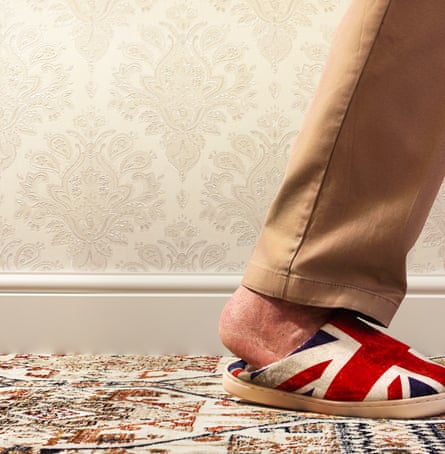
Sarah isn’t the only person who told me about their own rightward shift. A man in his 60s from Surrey said he had considered himself “solidly on the left” until a decade ago. His views have also put him at odds with his grownup daughter. “It’s impossible to have a sensible debate … As soon as [the left] are presented with facts and logic, they get angry, use insults, then walk away.”
Andy, an academic in his early 50s, says his parents, who are in their 80s and live in the home counties, have needed no exposure to extremist X accounts or conspiracy-filled Facebook groups to drift heavily to the right in a way that has created a big family rift. “I think the worldview they get from the newspapers they’ve always read is far more dangerous,” he says via Zoom. “We can still argue about the way-out conspiratorial stuff on the basis that it’s just crazy, but the things they’re reading are just seen as normal … It’s basically the same worldview expressed in a more polite manner.”
Andy, who now lives abroad, says his mother was once a Lib Dem voter, while his father was always an “old-fashioned Tory”. They respected his environmental activism as a student in the 90s. His mother even once voted Green in sympathy. But in the past 25 years – most noticeably after 9/11 – “the discourse on immigration has radicalised them”. When Andy married an immigrant in 2005, “It was always, ‘Well, we don’t mean her.’”
Their views have grown more extreme since Brexit and the rise of Reform, which they now support. “When leaving the EU came up, it was impossible to have any kind of conversation about it. Brexit broke everything.” During one row about Europe, fuelled in part by alcohol, Andy says his father threatened to punch him.
His parents live comfortable lives, Andy says, largely unaffected directly by the issues they get most agitated about, including immigration. “But it’s like they’ve lost the ability to think critically, so they’re in this sort of self-reinforcing cycle of ignorance. But they also can’t imagine they’re ignorant because they’re educated people who know about the world. They fundamentally believe people of different races don’t mix and foreigners shouldn’t be living in Britain.
They’re very Islamophobic, but these aren’t seen as extreme views any more by a lot of people. Zack Polanski and the Green party have been talking about making hope normal again. I think we also need to make prejudice strange again.”
Andy blames centrist politics for failing to offer people such as his parents a more positive worldview. “Nobody has defended civility and multiculturalism, or a liberal vision of Britain as a humanist power that supports human rights and the rule of law,” he says. “That’s the natural place where my parents should be, but when parties like Ukip started to rise up, there was just this collective panic about losing voters to them.”
A lison, whose brother has shifted hard to the right, thinks social media has taken such a hold that it is radicalising people who may never have had an X or Facebook account. “I don’t even know if my family are on social media, but the fact that it surrounds us, and that people are getting this polarising information on the front pages of their newspapers or on the radio, means it almost doesn’t matter any more,” she says.
She grew up in a working-class family in London. Her brother, who is in his 60s, runs a pub. When he mentioned at a recent family wedding that he was now a Reform voter, she was surprised and asked him why. “He said, ‘We’re losing our identity.’ I asked what he meant by ‘identity’ and he just exploded and told me to fuck off, that I’m naive and ridiculous and don’t understand what it’s like. Then he stormed off. Everyone stood there shocked, because he’d never said anything like that, so full of anger and hate. It was really upsetting.”
Now a corporate coach, Alison says an education gap in her family has made it harder for her and her brother to see eye to eye. She has found reasoning with him and other relatives who have drifted to the right only seems to make them angrier. But she wonders if the rage is misdirected. “It felt to me that because I had asked a question he couldn’t answer, the anger was actually not at me, it was at himself. And then I felt sorry for him.”
Alison’s brother apologised and they have managed to continue their relationship, even if it is now damaged. But dozens of other people I heard from talked of family ties that have snapped. “My family are now pretty much estranged from my aunt due to her far-right views on Facebook,” a woman in her 40s from Hampshire says. An American says only duty to care for a sick relative has halted her estrangement from her family since her parents “shifted so far to the right as to be almost unrecognisable … It’s hard to see glimpses of the loving parents I remember, only for them to disappear into cult-like nonsense the moment social media spins them up.”
A mong hundreds of responses to a Guardian callout about older relatives shifting to the right politically, there was a noticeable subset: those bucking the trend and becoming more leftwing as they age. One woman says she and her friends have become more liberal: “Living longer gives us a chance to see things aren’t as simple and dichotomous as we once thought.” A retired publisher in his 70s also describes a leftward drift: “It’s partly to do with guilt at our comfortable postwar lifestyle, and feeling we owe a debt to society.”
Tracey Laszloffy, who has worked in the US as a marriage and family therapist for more than 35 years, says opposing values have always been a feature of her work. “But politics itself has exploded in the past few years. And here, it’s really where they line up on Trump and Maga. I’ve never seen anything this divisive.”
The strength of feeling can make it hard for Laszloffy to unearth root causes, often tied up in old resentments. “I only use politics as an opening, because conversations about Trump are not going to go anywhere,” she says. She saw one older couple whose marriage was threatened by differing views of Trump (he was a fan). As it turned out, the man, who had a manual job that paid much less than his wife’s, had since become angry because Trump’s promised economic resurgence had not materialised. “He was struggling with issues around masculinity and identity, and acknowledging that vulnerability created the ground they needed to re-engage in a meaningful way.”
Janet Reibstein, a psychologist at the University of Exeter, says she’s reminded of her own background in the US, from where she emigrated to the UK decades ago. “My whole family was against the Vietnam war, but I had one cousin in the army who used to come and deliberately provoke us,” says Reibstein, the author of Good Relations: Cracking the Code of How to Get on Better. The solution was the one she still prescribes: give up on the idea that you’re going to change anyone’s mind. Instead, draw boundaries around the minefield, and retreat to common ground. “I told him he couldn’t visit if he talked about the war, and he respected it. The problem is, when the dominant discourse is one of divisiveness, it’s harder to have those conversations.”
Family estrangements, promoted on social media and Reddit accounts as “going no contact”, have apparently mushroomed. Data here is scant but a YouGov poll in the US last year suggested more than a third of adults were estranged from a parent, child, sibling, grandparent or grandchild. Separate research just after the 2024 election by the Harris Poll suggested half of all US adults were estranged from a close relative, with 18% citing political differences as the reason.
Even if older people are moving faster and harder to the right, Joshua Coleman, a psychologist specialising in family estrangement who created the survey with the Harris Poll, argues that their children are also becoming less tolerant of difference. “Perhaps in the past, people thought, ‘Oh, Mum or Dad is getting more conservative, that’s really annoying’ but now it becomes this huge value signifier,” says Coleman, the author of Rules of Estrangement: Why Adult Children Cut Ties and How to Heal the Conflict. “Associating with them is somehow out of sync with one’s own identity and aspirations.”
While Coleman, 71, acknowledges cutting contact is the only way forward in extreme family breakdowns, he thinks younger people are more likely to see politics as a reason to justify, and even boast about, drastic action. “It’s seen as a virtuous act of protecting your identity and mental health,” he adds. “All of that’s pretty new.”
He sees the same instinct in millennial parents to shelter children from their grandparents’ views. Nadine, the reader whose mother and her partner have become fixated on small boats, now thinks twice about taking her child to her mother’s house. “I still invite her to family occasions, but I do feel nervous she might say something offensive. I know her views don’t reflect my own, but I worry others might think they do.”
Largely, though, Nadine says she has been able to swerve politics and maintain relations with her parents. As for Sarah, the Reform voter with the despairing daughter, “We agreed we weren’t going to change, so we had to stop talking about anything political. I have to be so careful because we don’t agree on anything, but it works and the main thing is she knows I love her.”
Graham has also made the decision to stop engaging with his mother when she shares her views or the latest conspiracy theories she has consumed online. He also recognises something in Wilford’s view that many older online radicals are motivated by a sense of redundancy and isolation. “Provided I keep my mouth shut, I think the relationship will survive,” he says. “But I feel I need to help her somehow. When she’s saying this stuff, she sounds almost panicky, like she’s trying to convince me. But I also think she’s now worried, because of what I have said, that some of the things she’s read aren’t true.”
He has suggested therapy, but she shuts down the idea. At first it was the political views that troubled him, challenging his own values as well as his understanding of who his mother was. But now he just wants her to be OK. “I don’t know what her political beliefs would be if she could be healed from this,” he adds, before admitting that his tolerance could only go so far. He thinks for a moment. “I suppose it wouldn’t bother me any more if she wanted to be a member of Reform or support Tommy Robinson, just so long as it wasn’t because she was believing lies.”
此内容由惯性聚合(RSS阅读器)自动聚合整理,仅供阅读参考。 原文来自 — 版权归原作者所有。