






It’s a damp Venice morning. In the middle of the lagoon, art world luminaries with dripping umbrellas are climbing on to a boat with raked seating to witness a one-off performance. Stationed opposite them is a barge fitted with a large crane, its boom extended high above the water, its heavy anchor chain plunging into the turbid depths.
Women, naked but for tattoos and boots, emerge on to the deck of the barge. Directed by a bandleader in rubber waders, some pick up instruments and create an intense wall of sound. The electric guitarist clips herself on to the slippery crane, climbs to a vertiginous height and rocks out while straddling a steel bar. She is joined by a vocalist who screams and squalls like Yoko Ono. After 20 minutes of heavy drone, the boom rises, hoisting a cast-iron bell from the frigid water. Suspended upside down within it is a long-haired woman. As the bell rises above the Venice skyline, she begins to slam her body from side to side, sending a ringing out across the water.
Welcome to the world of Florentina Holzinger: dancer, artist, choreographer, leader of Europe’s coolest performance girl gang, and the woman most likely to rekindle childhood dreams of running away to join the circus. Representing Austria at the Venice Biennale, Holzinger arrives with a reputation. Over the last decade, her performances in European theatres and opera houses have provoked fainting epidemics, and furnished the tabloid press with ample manufactured outrage, whether provoked by nudity, blasphemy, sex, body-piercing or human waste (fake or otherwise).
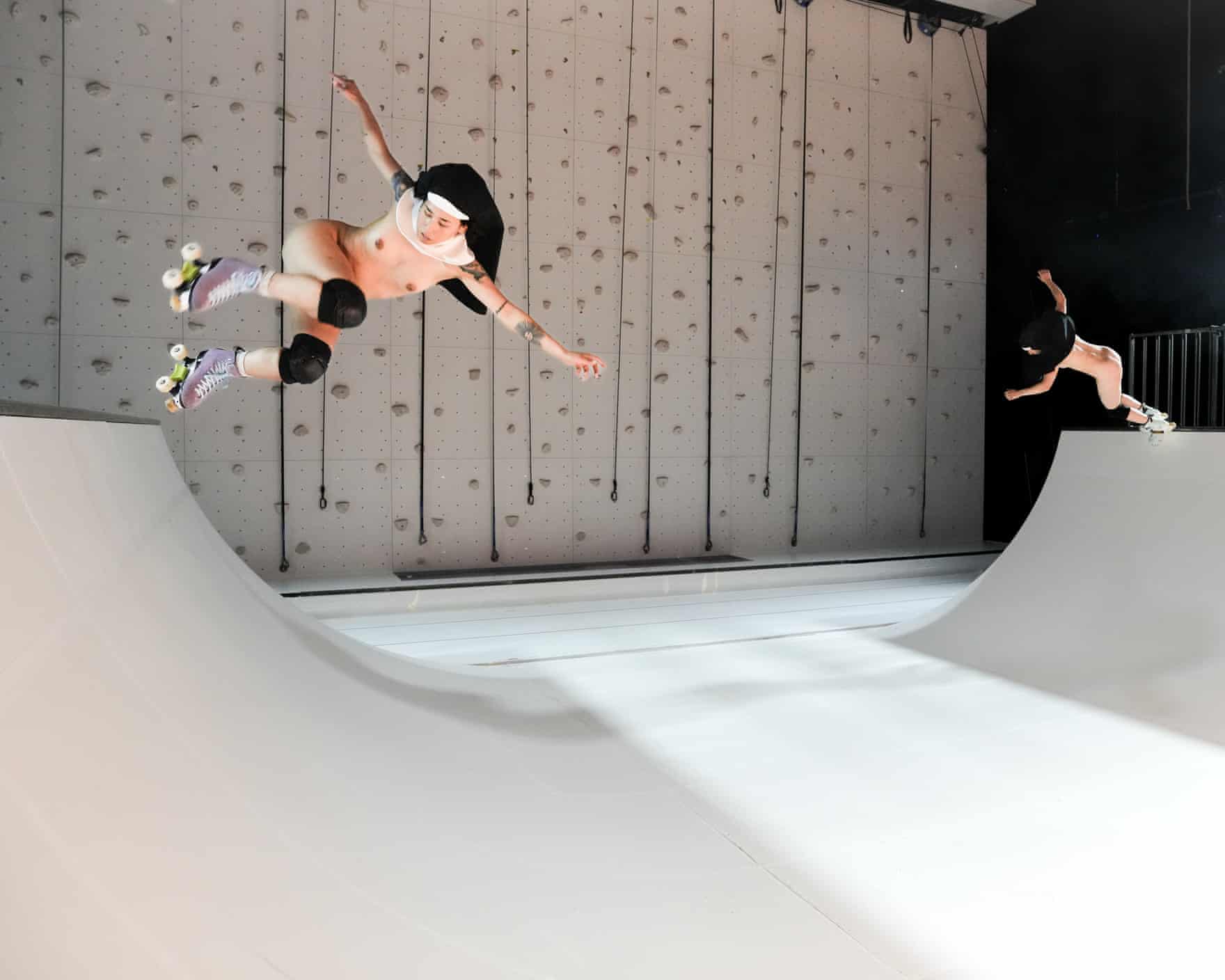
On stage, Holzinger is otherworldly. Earlier this year, at the climax of the opera Sancta, I watched her fly high in the air suspended by bolts piercing the skin of her back, slamming her body against a thunderous metal sheet like an angel of the apocalypse. Sancta has been touring European opera houses for the last two years. Opening with a 30-minute performance of Paul Hindemith’s short 1921 opera Sancta Susanna, it features a vast climbing wall as its backdrop, from which performers in harnesses suspend themselves like spiders, swarms of demons, and crucified bodies.
Much of Sancta takes the form of an alternative mass, one dedicated to liberation and acceptance, and features a close-up magician delivering miracles, a pregnant pope hoisted up on a robot arm, and nuns performing rollerskate tricks. For Holzinger, installing a half-pipe on stage answered the question about how nuns – elevated, otherworldly figures – should move on stage. “They are not going to be walking on the floor in a mundane way, but they are, of course, floating, skating: somehow this ramp made sense for us.”
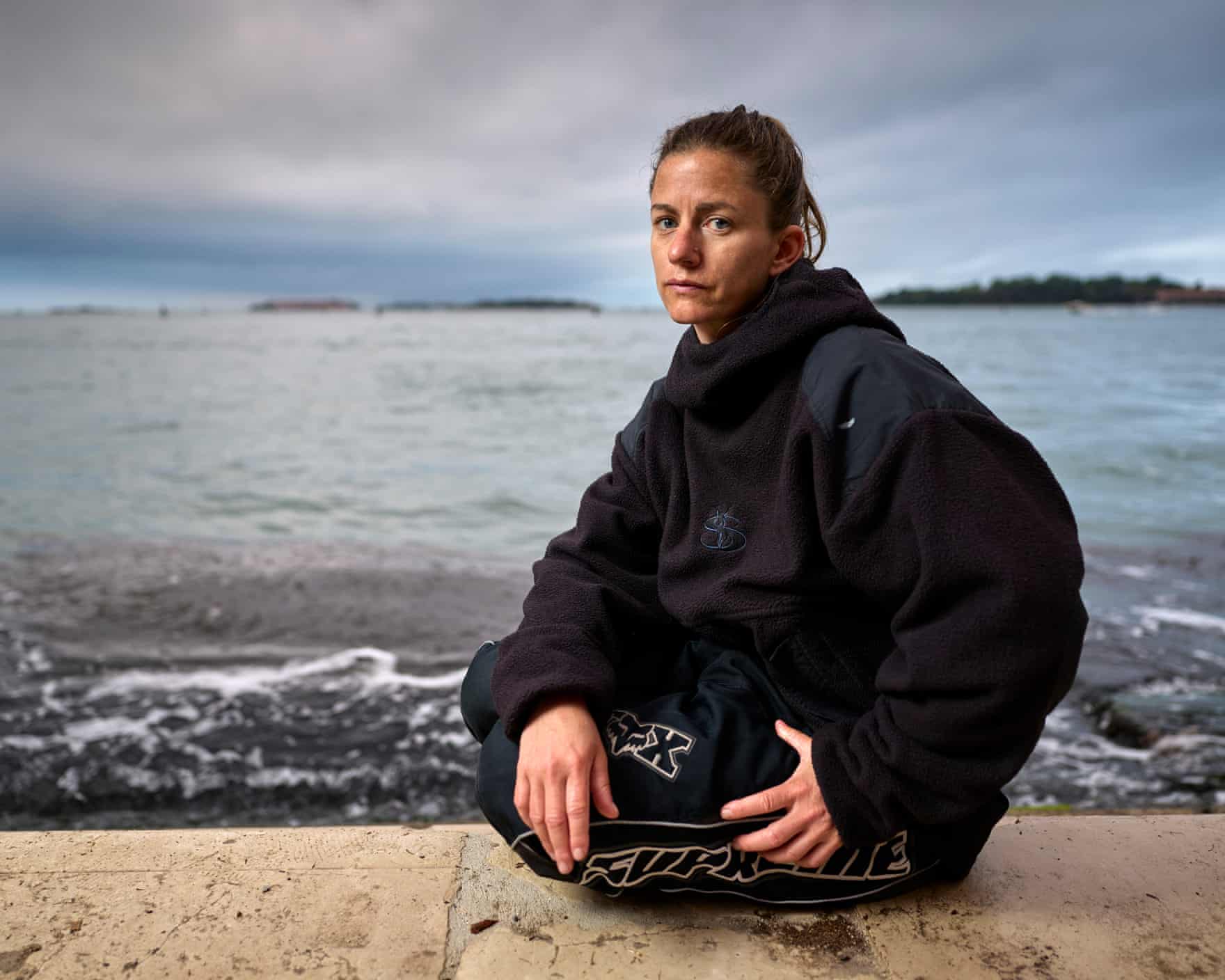
It was Holzinger, too, who was hoisted naked from the Venice lagoon, hanging from the bell. In performance, she appears Amazonian: muscular, impervious to cold and, crucially, pain. In person, she is bright and mischievous, her conversation zipping between research at the Vatican, the late performance artist Valie Export and skate-training in Barcelona. Her slight frame is coddled in thick fleece, as though recharging her core temperature after hours of exposure.
Transforming her work into a performance installation for the biennale has taken some adjustment. Away from the protection of the theatre, mishap is a constant threat. “We are always in a ‘brace, brace’ position when it comes to performance,” she says, speaking just after Seaworld Venice opens. “We are not naive. We know what the reactions can be. But nothing could have prepared us for this. I wake up in the morning thinking, ‘What will this day bring?’”
Her company is performing eight hours a day, in all weathers, with their audience milling freely around the Austrian pavilion, many unprepared for a display in which full nudity is merely the baseline. Venice, Holzinger explains, “is really the birthplace of the reclining nude: the horizontal, erotic depiction of women. How can this nudity be deemed so provocative when it comes to real bodies?”
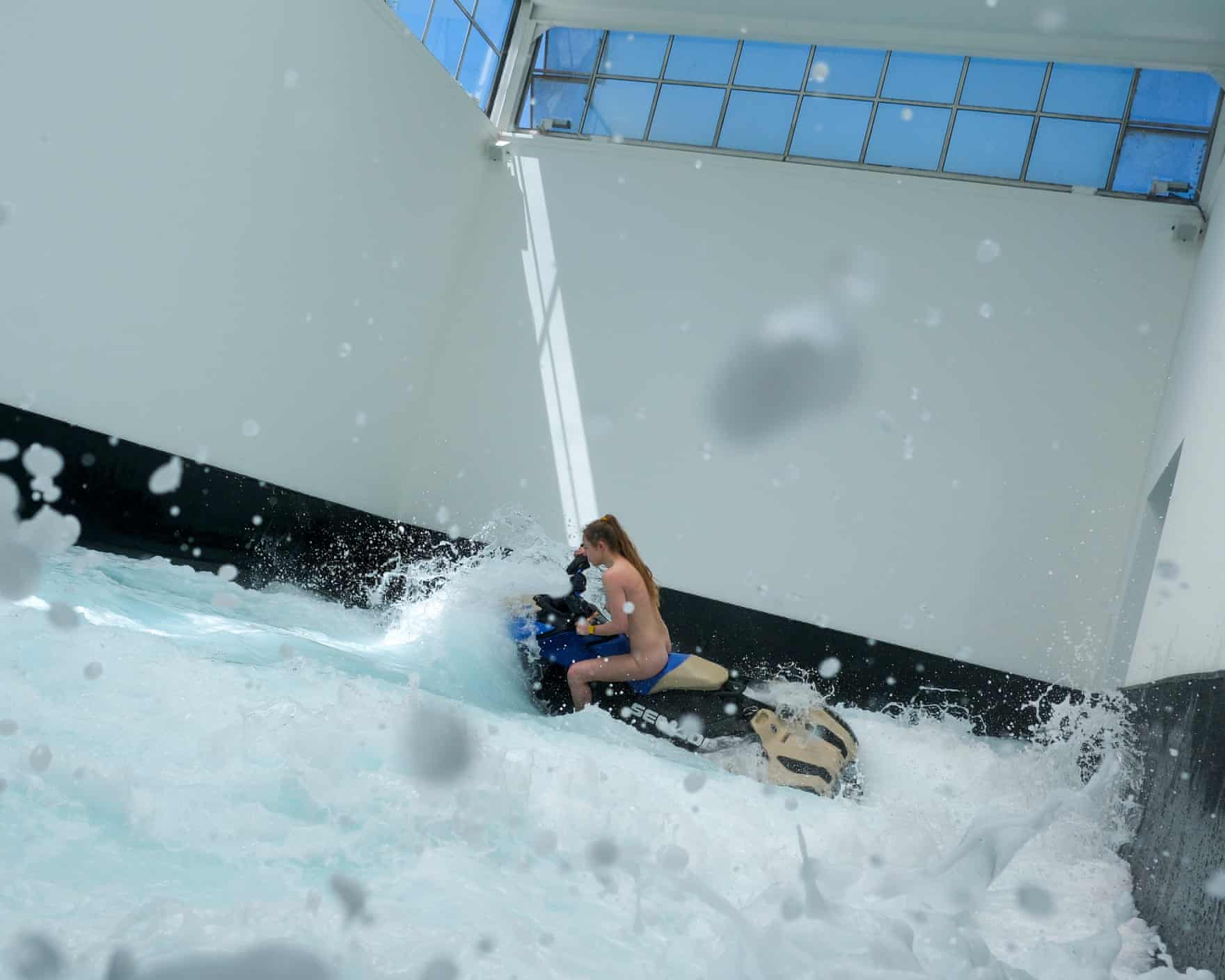
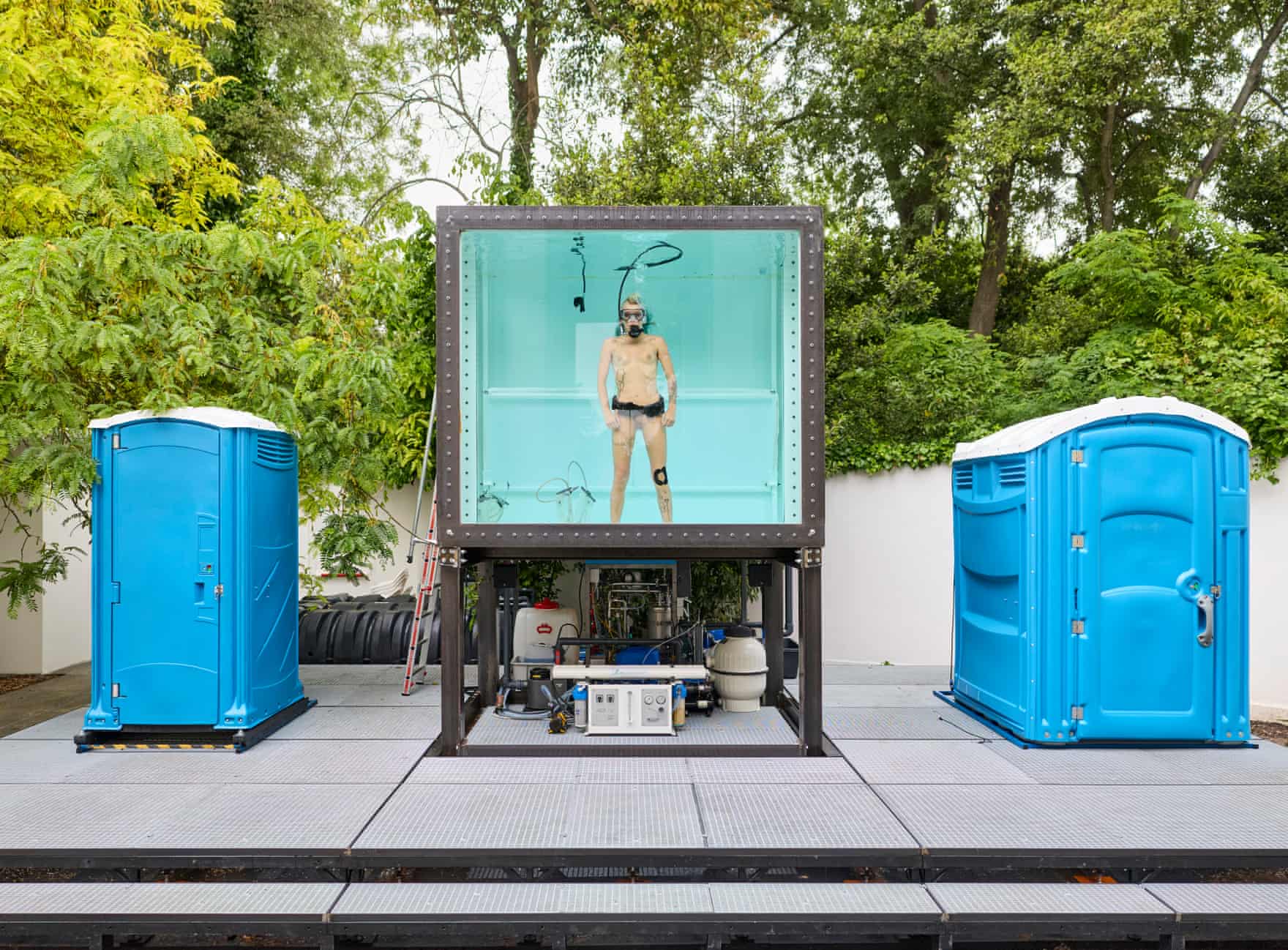
Seaworld Venice is part temple, part gallery, part theme park, part sewage processing plant. Sections of the pavilion hold pools in which Holzinger’s company perform jetski stunts, contortion acts, and pose suspended from climbing harnesses like a Renaissance altarpiece brought to life. In the central courtyard, a performer in a scuba mask stands submerged in a glass tank for four hours at a stretch. The water around her is the filtered product of two adjacent Portaloos.
During the biennale preview, august art world visitors treated the pavilion like a human zoo. I entered behind a globally famous museum director, apparently blind to the “No photography” sign, who filmed the entire jetski performance then posted it to Instagram. “It’s really not my style or my ethics to police people,” says Holzinger. “But it’s still outrageous that nobody seems to be able to perceive art without the screen.” As a result of visitors flooding social media with the performances, her Instagram account was temporarily suspended.
Holzinger’s performers rotate through roles. One day, they might be doing jetski stunts, the next tending the lavatories and instructing visitors on how to use them (please, no solids, people!). “I didn’t realise how important the role of the toilet women would be,” says Holzinger, “but also how people treat the performers – thinking they are ‘just’ toilet women.” She thinks it speaks volumes about the value afforded different kinds of labour. “Is it more difficult to spend eight hours under the water or be a toilet woman?”
Why install these lavatories in the Austrian Pavilion? Holzinger recalls her application form for Venice – a whole page about sustainability, but only a little space to describe the content of the Pavilion. “That made it clear: for us, the content is the sustainability concept.” And truly, few things drive home the precarious environmental relationship between water and waste than having to face a woman submerged in your own filtered urine. (Yes, reader, I did.)
Bodily functions are where the highbrow art world is forced to face base practicalities: frequently, and inconveniently, as it happens, in the poorly provisioned grounds of the biennale. “The Austrian pavilion was always the unofficial toilet,” grins Holzinger. The pavilion is at the back of the site. By the time you reach it, you’ve been through “two, three hours of art in the Giardini and you have a full bladder. Everybody pees behind the Austrian pavilion. It always smells like a toilet. And we thought, ‘Why not make a nice, clean, functioning toilet?’”
Holzinger’s work can feel dark and heavy. She tackles big subjects, including the control the Catholic church has had over women’s bodies. The performers she collaborates with have backgrounds in circus, stunt work and body-piercing as well as contemporary dance. Their commitment is literally inscribed on their bodies. I recognise the performer immersed in the tank from her performance in Sancta, during which she had a small wound-like incision carved in her abdomen. She now has 25 such scars – one for each performance of the opera. Another performer, who works with body-piercing, has done “maybe 200 suspensions already in shows of mine”, says Holzinger. “Her back really carries this: she calls it a book.”
Yet the shows are also entertainment,s and a crucial ingredient is the absurd. Sancta featured a stoner Jesus, Seaworld Venice has a slapstick fake sewage system that “engineers” struggle to restrain from excremental explosion. “Comedy is an essential part of art-making for me,” says Holzinger. ‘Of course, I want to take on substantial existential questions. But I cannot do it without also trying to laugh it away. There always needs to be a suggestion of hope: a motivation to move forward and actively change things.”
She pauses then adds: “At the end of the day, I’m really not an artist who takes themselves so seriously.” And perhaps I can believe that of her – she is happy to be hurt, to be ridiculous. But art? That, I think, Holzinger takes very seriously indeed.
-
Florentina Holzinger’s Seaworld Venice is in the Austrian Pavilion at the Venice Biennale until 22 November