








Steven J Ross’s new book, The Secret War Against Hate, is a sequel of sorts to Hitler in Los Angeles, his bestselling Pulitzer-prize finalist from 2018. That book told the story of Leon Lewis, a Jewish attorney, and others in the 1930s who foiled Nazi attempts to cause havoc in the City of Dreams. Now Ross looks south and east, to Atlanta and New York after the second world war, where activists and agents worked to infiltrate and defeat new Nazi groups.
The distinguished professor of history at the University of Southern California said: “With Hitler in LA, Leon Lewis hid the spy codes but once I figured it out, I realized, ‘Oh my God, I’ve got a historian’s dream here,’ which is an unknown story that’s really important. All I had to do was not get in the way, not be overly author-ly, just be the guide taking you through the story. I knew the beats. I knew how spy stuff and detective stuff goes. I changed my writing style.”
The Secret War Against Hate is more complex in structure but similarly direct in style, writerly but punchy. Ross described the immersion of writing – “in the zone” working late, “waking up in the morning, still in 1941 or 42” – as an “enormously satisfying” process. “So I thought it would be great to do it again. Could I find anything? I’d be very lucky. One of my graduate students, who was working on the history of surveillance, said, ‘I think I found some stuff at Columbia [University in New York]. It looks like spy reports in the post-war era.’
“I said: ‘If it checks out, I’ll buy you and your wife dinner at any restaurant in LA.’ Sure enough, I came back and I said: ‘Where are we going to dinner?’ Because it was the Non-Sectarian Anti-Nazi League (NSANL), and they were running undercover operations since around 1940, and then I discovered the Anti-Defamation League (ADL) and the American Jewish Committee (AJC) were also running spy operations.”
The Nazis those organizations worked against are mostly forgotten: the Columbians and the National Renaissance Party, leaders such as Emory Burke, Jesse Stoner and James Madole. The American Nazi party left a more lasting footprint, thanks to George Lincoln Rockwell’s showmanship, Madison Square Garden rallies and all. But Rockwell died squalidly, murdered by one of his own.
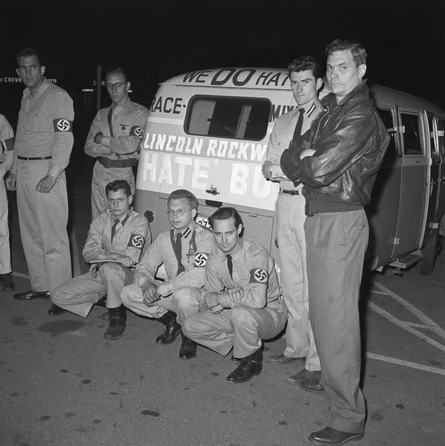
Those who fought back have never been known to many. Organizers on whom Ross focuses, Arnold Forster (ADL), George Mintzer (AJC) and James Sheldon (NSANL), never gave much away. Some records are still closed. There are more colorful characters among the agents who went undercover, risking all. Stetson Kennedy worked to weaken the Ku Klux Klan before turning his attention even further right. Immanuel Trujillo, aka Mana Truhill, was a part-Apache, part-Mexican, German-speaking Communist from Washington Heights who ended up in the Arizona desert, running the Peyote Way Church of God.
Of the forgotten Nazis such forgotten agents fought, Ross said: “There will be reviewers who will write, ‘Were these people ever really a danger?’ And the answer is, look at the bombings that went on in the south in the 1950s and 60s, against civil rights campaigners and the Jewish and Black communities.
“There are two levels. There’s the actual physical threat. Jesse Stoner is the most important [Nazi leader] in terms of violence, in terms of bombing churches, synagogues. But the other thing people don’t understand is that fear is enough. To make you afraid to go into your church or synagogue, to a Jewish community center, to a Catholic school, because somebody might bomb it. If somebody calls you the N-word, that might be the last thing you hear in your life. Living a life in fear is an assault on life, liberty and the pursuit of happiness, and the far right have won on that front, because over the years they have made people scared shitless.”
Ross worked on his book amid a resurgence of that far right, Donald Trump propelled into power, out of it and back again with extremist support. Some historians are reluctant to draw parallels between their work and the present, to answer the age-old question: what does your work tell us about today? Not Ross.
Under Trump, more people have come to know deep fear. Ross said: “I can tell you, even my students at USC, I’ve been here 48 years now, and for the first time I’ve had Jewish students come to me and say, ‘I don’t want to show anyone any Jewish identification.’ That’s never happened in my lifetime.”
The Nazis of the 1940s and 1950s sought power. To Ross, that they didn’t get close to it, forever splitting, reforming, then splitting again, should not lessen the fear they instilled and the effects it had.
“People don’t take that into account,” Ross said. “Were these post-war Nazis more than Keystone Cops? Yeah. They were that, but they were also a lot more.”
There lies another parallel to the present day. The president is a buffoon, but he’s president. And for his supporters, as has been pointed out, those who attacked the US Capitol on 6 January 2021 had as much chance of overturning Trump’s 2020 defeat as the hippies did of levitating the Pentagon in 1967 while protesting the Vietnam war. But that does not lessen the importance of the attempt.
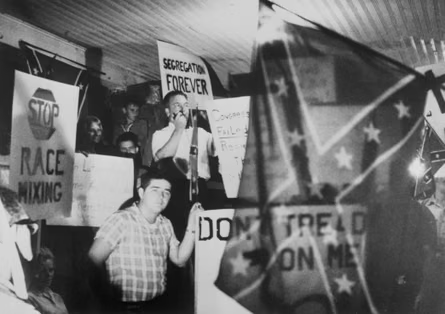
In The Secret War Against Hate, Ross stresses the economic and social resentments that drove some Americans to the far right after the second world war – again, currents that run strong today. In his epilogue, Ross focuses directly on such links.
“There’s a continuity I was able to trace from the Nazi groups of the 1940s and 50s into the militia movement,” he said. “Once they realize they can’t change American politics in one fell swoop they isolate themselves. If they can’t isolate Blacks and Jews, they go up to Lake Hayden [in Idaho] and create the Aryan Nations, and then those people go on and create other militias, and those militias in turn create other militias till we get to the Proud Boys, the Three Percenters, the Oath Keepers. As I write, my subjects are the grandparents, the parents of those people. The people who began the fight, and they’re now continuing it. That’s probably the most critical part of the story. It’s not a story that’s over.”
To such groups, Ross contends, Trump is a “führer of convenience”, a vehicle for power, the same quality that allows evangelical Christians and establishment Republicans to back him. Trump “represents the interests” of the far right, Ross said. “They know he’s not a true believer but he talks as though they’re the great ones. So if this is who helps unite you and everyone can rally around a single figure who’s now in the White House, all the better.”
Parallels are plenty. In central passages of The Secret War Against Hate, Ross considers the rise and fall of the National States Rights party, which ran presidential candidates in 1960 (Orville Faubus, segregationist governor of Arkansas) and 1964 (extremist John Kasper, Stoner as his veep). Its political positions – white supremacism, anti-immigrant bile, supposed isolationism – are unpleasantly familiar.
“That’s because their politics have not changed that much,” Ross said. “At the core of the politics is a white Christian, probably Protestant America, where people of color are welcome if they stay on the margins, just don’t make noise … what struck me was I had no idea about the Christian Identity movement, which is so powerful because it really justifies extreme positions.”
Emerging in the mid-20th century, Christian Identity was from the start strongly antisemitic, racist, millenial and anti-secular, linked to violent crime. It remains widespread.
Under Trump, there’s a Christian extremist (if not outright Christian Identitarian) in the cabinet: Pete Hegseth, a former TV host accused of alcohol abuse and sexual assault, preaching the word of his god from the Pentagon podium.
Ross’s study of the American far right might bear more fruit. Hitler in Los Angeles may yet make it to the big screen, though Ross talks ruefully about a lapsed project with Universal studios, Sacha Baron Cohen to star. A script is being written, a stage version too. In the meantime, Ross advocates readers of his books turning, as he does, to the world outside their windows.
“At the end of every talk” about his work on the far right and its threat, he said, “the first question is: ‘So, what can we do now?’”
Ross has two suggestions. First, vote, and make sure anyone who usually doesn’t vote, votes too. Second, learn about the far right, its history and the threat it poses.
America, Ross said, needs “an educated citizenry that isn’t necessarily left or right but that is against insane people. The insanity can happen on the left as well as the right but the difference is that the Nazis want to kill people. People say far left, far right, there’s an equivalency. No, there isn’t.”
-
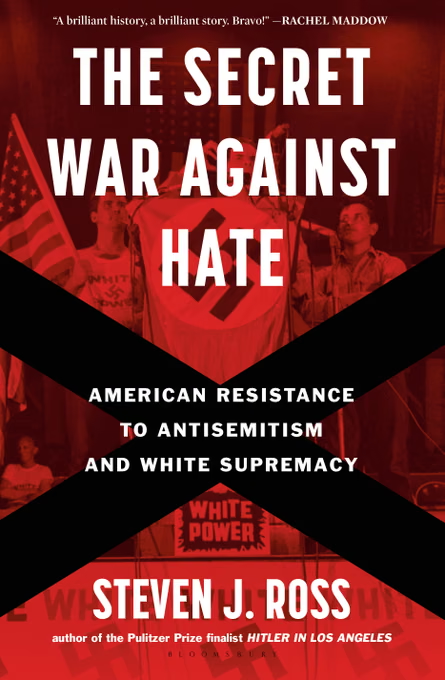
The Secret War Against Hate is out now