










When Guillermo del Toro goes to the cinema, he buys three seats. “I’m an expansive fellow,” he says, occupying one end of the sofa in the library of a London hotel. “Between the popcorn and my elbows and my girth, I need more than one seat. But I also like the feeling of being in company and yet alone. Everyone says how great the cinema is as a collective experience, and I agree. At the same time, I enjoy it the most when it’s not packed. I like being semi-alone.”
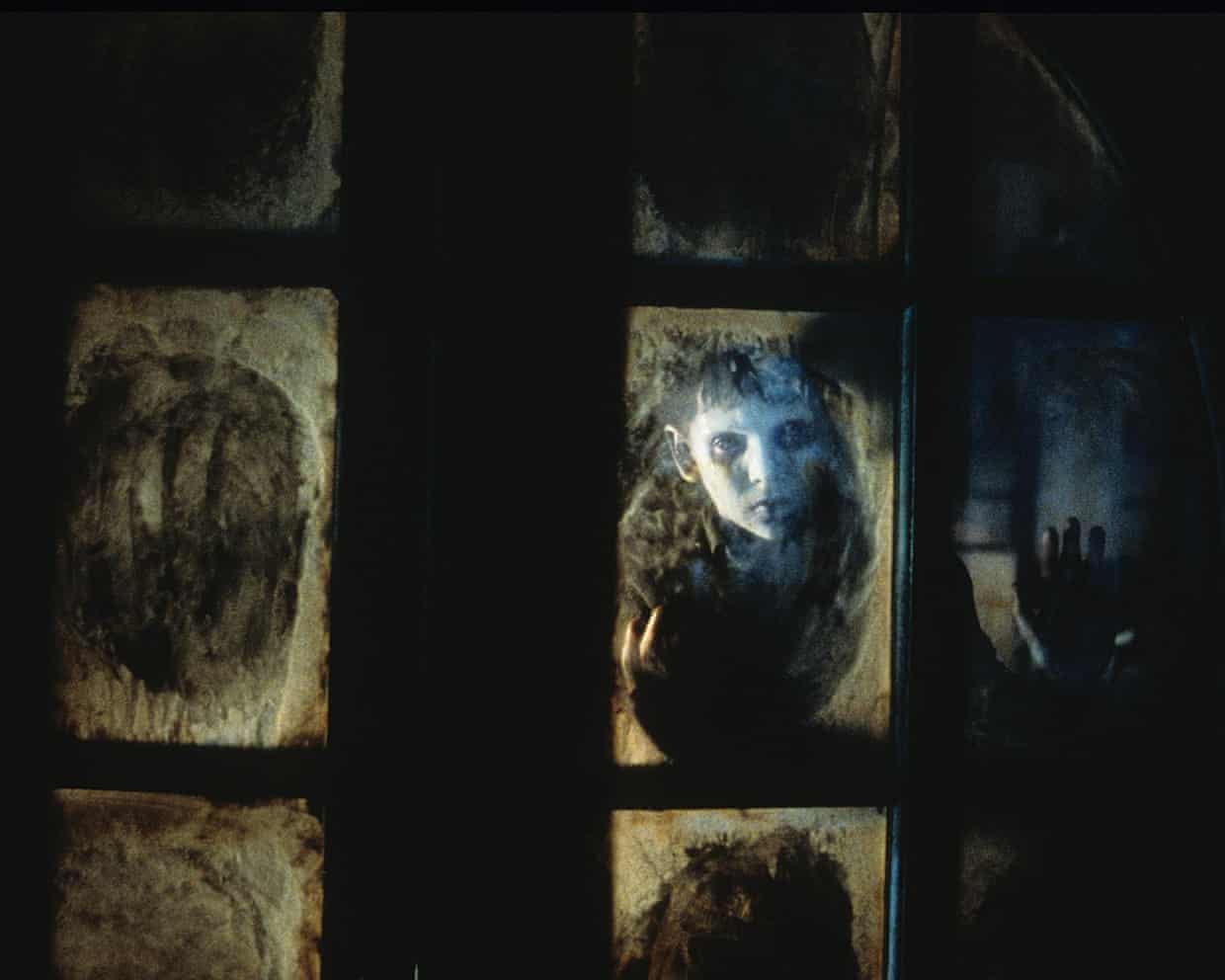
Those vacant seats must come in handy, too, if there are any ghosts in the vicinity. Ghosts and Del Toro go way back. The multi-Oscar-winning director was 11 when he first sensed a spectral presence at his family home in Guadalajara, Mexico. He insists this was his late uncle, who, before his death, had promised the young horror buff that he would pop back and tip him off if there were anything on the other side. Del Toro later heard a persistent sighing in his dead uncle’s room – a detail that inspired Santi, the sighing ghost-boy in The Devil’s Backbone, his 2001 horror set during the Spanish civil war. Decades later, when Del Toro was in New Zealand scouting locations for The Hobbit (which he co-wrote), his hotel room was filled with the cacophonous uproar of a murder in full swing, audible in a kind of surround-sound. And though there was no ghost as such when he stayed in an early-19th-century hotel in Aberdeen while filming Frankenstein two years ago, he felt “an oppressive vibe” about which he duly live-tweeted to his two-million-plus followers. Currently, he is looking to buy a haunted house in the UK. Presumably via Frightmove.
But why here? “There are certain magical lands for me,” he explains. “And the land of ghosts is England.” Dressed in black trousers and a black Ralph Lauren jumper, and sporting a bedhead of tufty grey hair, the 61-year-old film-maker tucks into a full English breakfast to go with all the English ghost-talk. “Anyone who knows me knows I’m a sceptic. But there are experiences that are so outsized they can dislocate your sense of self.” Into that category, he also places the UFO he saw at the age of 14. “I had a friend with me as a witness,” he points out, as if I might doubt him. “When these things happen, it causes a crack. You feel the mystery of the universe come rushing toward you. It’s like when you do mushrooms: the world seems a little bigger.”
His wife Kim Morgan– with whom he co-wrote the 2021 noir thriller Nightmare Alley starring Bradley Cooper and Cate Blanchett – needn’t worry about having any ectoplasmic housemates. “The haunted house will just be for my collection,” he says. “Right now, I have a house for all my stuff and another house for family. Every morning, I come in and say hello to my silicone figures and spend the day there. Then I go back home.” He sinks a fork into a piece of sausage. “The first few times I stay in the haunted house will be scary,” he says blithely. “But I’ll get used to it.”
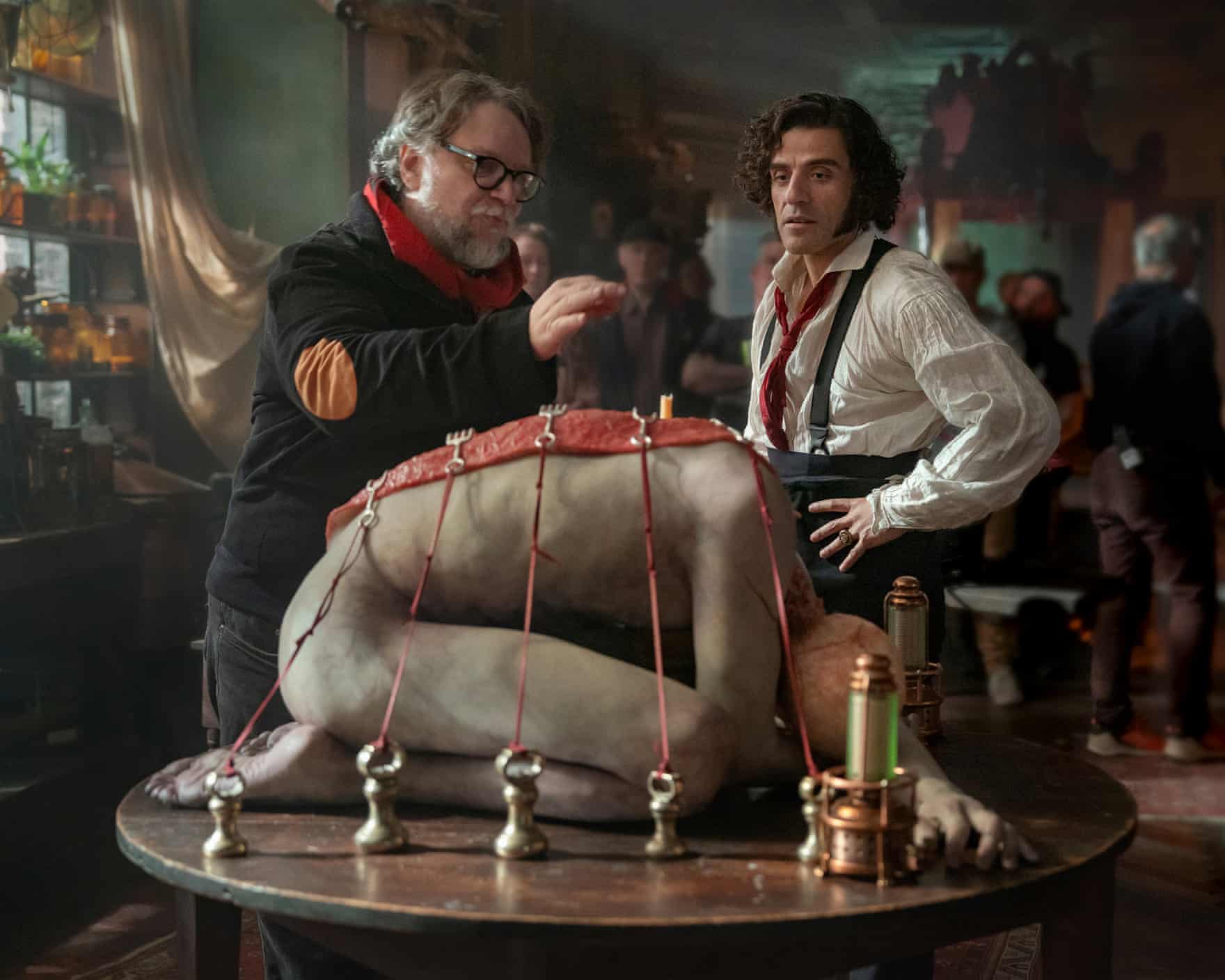
There are more highfalutin reasons for Del Toro’s presence in the UK this month than mere house-hunting. He is receiving a BFI fellowship, an honour that is especially meaningful to him given the influence of British cinema on his work “from the reveries of Powell and Pressburger or Ken Russell, whom I idolised growing up, to Terence Fisher and the whole Hammer legacy”.
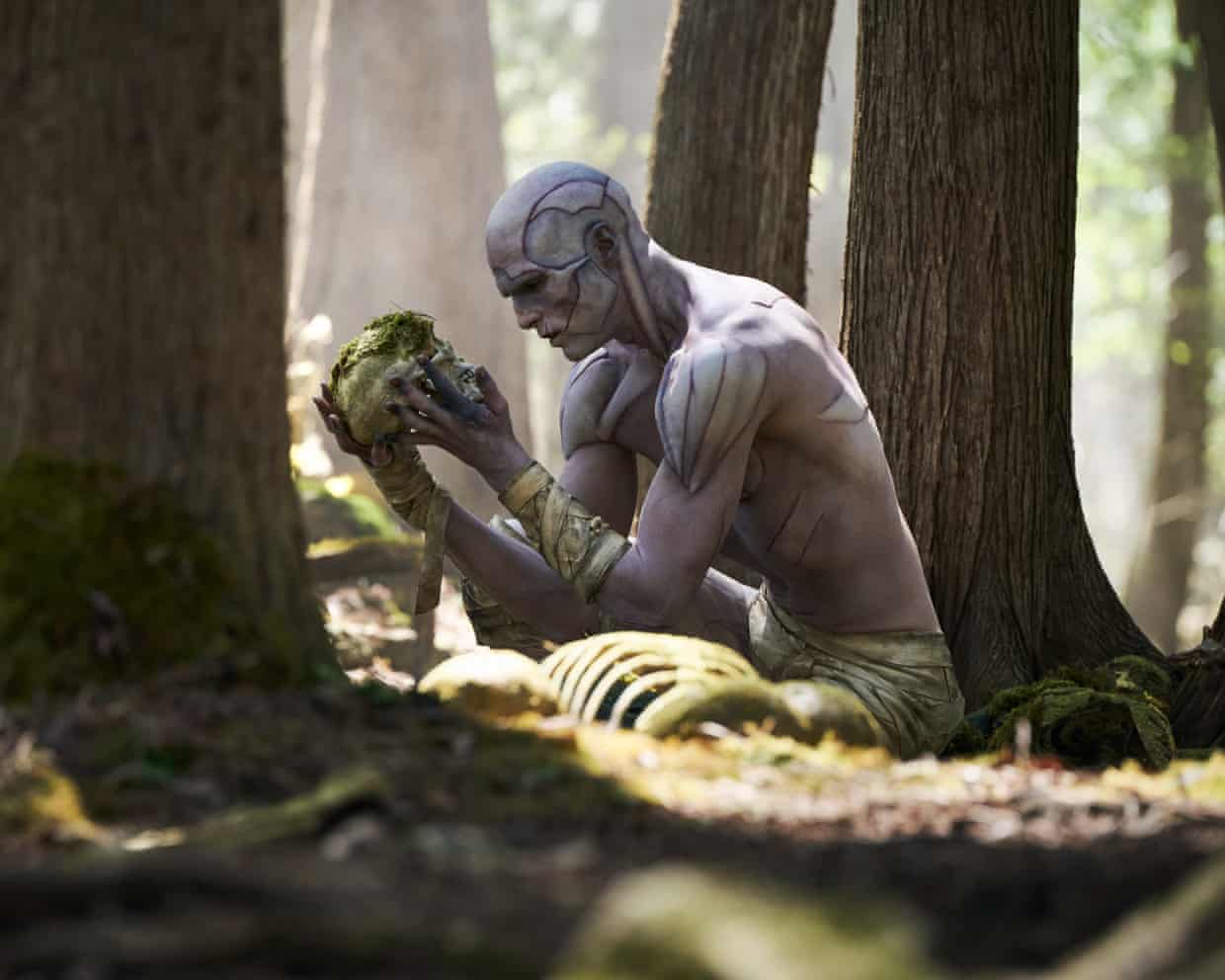
It was Fisher’s Frankenstein pictures that partly informed his own 2025 adaptation of Mary Shelley’s novel, for which Jacob Elordi was Oscar-nominated for playing the Creature as a woebegone patchwork hottie in skimpy bandaged underwear. “The 1974 Hammer film Frankenstein and the Monster from Hell had the worst makeup but the most delicate Creature,” says Del Toro. “As the movie progressed, the Creature became more of an innocent and the Baron more of a pure villain.”
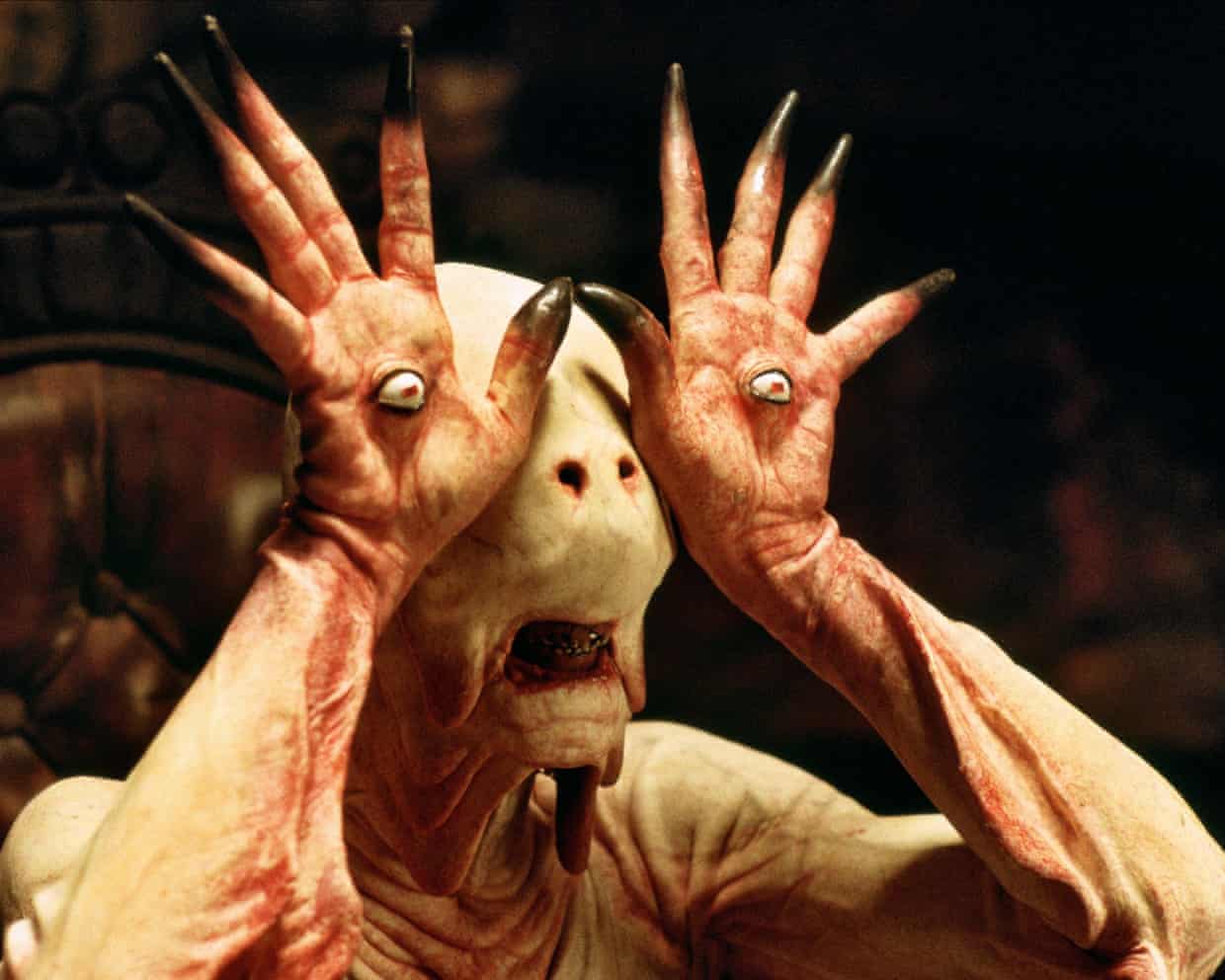
Monsters have always been wondrous and misunderstood in his world, capable of tenderness as well as immense violence. Precisely like us, in fact, which is why Del Toro identifies so closely with them; it’s superheroes that are alien to him. Other artists, in turn, have found themselves in concert with his sensibility, Taylor Swift for one. Already a fan of The Shape of Water, Del Toro’s romantic retooling of The Creature from the Black Lagoon which won the best picture Oscar in 2018, the singer dug into his back catalogue during the pandemic. She declared herself “dazzled” by The Devil’s Backbone and his other near-masterpiece, Pan’s Labyrinth, about a young girl who flits back and forth between two parallel realms, one brutal and realistic (Spain in 1944), the other a seething, sticky wonderland with its own hazards. A year or so later, Swift was invoking Del Toro-esque imagery in her hit single Anti-hero, picturing herself as “a monster on the hill … slowly lurching toward your favourite city”.
Never mind Tay Tay: the BFI fellowship places Del Toro in a lineage with titans such as Martin Scorsese and David Lean, Akira Kurosawa and Orson Welles. It is striking, though, that only a handful of previous BFI fellows, such as David Cronenberg and Tim Burton, have done more than dabble in horror and fantasy. Del Toro never doubted the scope and potential of those genres. As a teenager, he ran a film society in Guadalajara for which, for example, he sourced from the BFI a print of Powell’s scandalous 1960 serial-killer classic Peeping Tom.

“I was the projectionist, the ticket seller and the debate master,” he recalls. “I would introduce the movie then project it and be back afterwards for the Q&A. I was only young but I was already a film critic on the radio.” A harsh one? “You know, it’s impossible not to be a moron in your teens. You hyper-compensate. At that age, you’re declaring who you are, talking more about yourself than the movies.”
Who was he? “Well, I believed vehemently that it was possible for horror and fantasy to be a language of audio-visual poetics. That they could do more than function as scare-inducing or escapist genres.” This approach put him out of step when he came to make his 1992 debut, the scuzzy-elegant, scary-sad vampire horror Cronos, which is being re-released this month. “It was very unfashionable. You read about ‘elevated horror’ now but when I was preparing Cronos, somebody told me: ‘Beware. You may be pegged as a genre film-maker.’ It was like a dire warning.”
Give or take the lukewarm response to his oddball robots-versus-monsters spectacular Pacific Rim (2013) and his 2015 Gothic love story Crimson Peak, Del Toro has enjoyed an easy, even reverential, ride from critics. He never reads reviews – “I avoid them studiously, good or bad” – though they can’t always be escaped. “Somebody will say, ‘I don’t agree with the New York Times. I think your movie is fabulous!’ Then you get the sense you’re being stalked by it.” Talk about an oppressive vibe.
At least he has never suffered the kind of critical mauling meted out to Powell for Peeping Tom or John Carpenter for The Thing. (When Del Toro enthused to Carpenter over dinner in 2016 about how wonderful it was that The Thing had now found its audience, the senior film-maker replied: “What fucking good does that do to me?” Fair point.) “But I have still had my vicissitudes,” Del Toro says. One tormentor – a bit awkward, this – is another BFI fellow, the producer Bob Weinstein, who tried to fire Del Toro from his first US film, the 1997 giant-bug horror Mimic. (Weinstein’s brother Harvey was stripped of his own BFI fellowship in 2017 for obvious reasons.)
“The Weinsteins almost destroyed me,” says Del Toro, the ever-present sparkle in his eyes dimming abruptly. “I was on the verge of being unbankable and unhirable. But I would have died for Mimic. I have always made it a point to never make a movie I don’t absolutely adore. I’ve been offered a lot of work for hire and I’ve refused it.”
That includes entries in the X-Men and Fantastic Four franchises, as well as The Chronicles of Narnia, which he declined because, as he said in 2006, “I didn’t want the fucking lion to be resurrected. What is the worth of that sacrifice if he knows he’s coming back?” He also passed on Harry Potter and the Prisoner of Azkaban, instead persuading his friend Alfonso Cuarón to direct it; the pair met in the 1980s while working in TV on a kind of low-rent Mexican Twilight Zone that Cuarón referred to as “The Toilet Zone”. Del Toro later said he would personally be interested in making a Harry Potter movie only if he could kill off one of the kids.
Any conversation with him risks straying into a discussion of the projects he hasn’t made, including a gritty Jabba the Hutt origin story in the style of The Godfather. There were even plans a decade ago for a Broadway musical of Pan’s Labyrinth, with a score by the genius songwriter Paul Williams (Phantom of the Paradise, The Muppet Movie), which eventually came to naught. Despite having written more than 40 screenplays, he has made only 13 films. Some unrealised projects, such as his adaptations of The Count of Monte Cristo and HP Lovecraft’s At the Mountains of Madness, have been gathering dust or teetering on the brink of production for decades. “But I still have hope,” he says.
Now he is in a strange place. Having spent his entire life gearing up to make Frankenstein, it is suddenly behind him. He is already hard at work on a stop-motion animated adaptation of The Buried Giant, Kazuo Ishiguro’s novel set in a post-Arthurian Britain where ogres roam the land. “I want to push the medium,” he says. “It’s not for kids, it doesn’t have any songs. It’s going to be an R-rated movie.” He sounds passionately invested in it, and in the idea of animating what he calls “inefficient” micro-gestures, our natural fidgets and stumbles, to create a new kind of realism in stop-motion. That philosophy lent his 2022 Pinocchio, set in Mussolini’s Italy, an impressive, bristling twitchiness.
But there is a new feeling now that he is done with Frankenstein. Is it emptiness? “Yes. But not a bad emptiness. There’s a serenity. All pain comes from desire. And if you simply want to breathe, that’s a very good place to be.” These days, he is thinking about regret as a theme. “The questions you get when you feel it’s almost over, you know?”
It was once the father-son dynamic that obsessed him – the result not only of his Frankenstein fixation but his relationship with his own father, whom he has described as a “mystery” to him. “I think he was also a mystery to himself,” he says. In one sense, his father seemed blessed – in 1969, he won $6m (£2.5m) on the lottery, which Del Toro is fond of pointing out was the entire budget of Planet of the Apes including Charlton Heston’s fee. “But I think when you cannot name what drives you, then it’s impossible ever to get a grasp. When you ‘have everything’ but you’re still restless, then you are obviously after something unnameable. And my dad was a bit like that.”
What about Del Toro himself? “I think I’m reaching the point where I can name it. I see my interest in life growing and I understand that we can’t solve …” He pauses. “Look: Steven Soderbergh said, ‘If the collected works of Shakespeare can’t prevent genocide then, really, what is it for?’ I think art cannot make huge lateral changes but we can correct each other’s lives by small degrees. I believe that. And I believe there is something art does that nothing else can. What Powell and Pressburger’s Black Narcissus does to my soul is beyond what is happening in the story and characters; it elates me. What David Fincher does in Zodiac is beyond my understanding – I have had dinner with him, I’ve discussed it with him, I don’t know how he does it. There is a mystery to cinema.” The sparkle is back in his eyes again. “I hope it never goes away.”
-
Cronos is in cinemas from 15 May. A season of Guillermo del Toro’s films runs at BFI Southbank, London, until 31 May.