Senate passes short-term extension of surveillance law – ...
Shrai Popat ·2026-04-18·via The Guardian
From
Closing summary
This concludes our live coverage of the second Trump administration for the day. Here are the latest developments:
The Senate passed a 10-day extension of section 702 of the Foreign Intelligence Surveillance Act (Fisa).
Iran’s foreign minister said that passage for all commercial vessels though the strait of Hormuz is “completely open for the remaining period of ceasefire”.
Donald Trump addressed young Republican activists at Charlie Kirk’s megachurch in Phoenix, Arizona, ostensibly on the upcoming midterms, but the president was unable to stick to the subject, veering wildly from topic to topic, including the race car driver Danica’s Patrick supposedly beautiful widow’s peak and UFOs.
Trump told supporters in Phoenix he had some “good news” to share. “Would anybody like to hear about Iran?” the president asked. Trump went on to outline what he said were the terms of his tentative deal with Iran, which essentially replicates the terms of the 2015 Iran nuclear deal struck by his predecessor Barack Obama.
In his Phoenix address, Trump also joked about the US military carrying out a series of extrajudicial killings of suspected drug smugglers in the Caribbean and eastern Pacific.
Samuel Alito and Clarence Thomas, the oldest and most rightwing supreme court justices, both plan to stay on the court rather than retire, CBS News and Fox report.
Trump’s childhood pastor, Norman Vincent Peale, was an anti-Catholic who orchestrated an effort to keep John F Kennedy from becoming president in 1960.
Trump's childhood pastor, Norman Vincent Peale, was an anti-Catholic who tried to defeat JFK
Somewhat lost in the discussion this week of Donald Trump’s attacks on Pope Leo, for his criticism of the US attack on Iran, and the president’s decision to post an image of himself as Jesus Christ on social media, is the fact that Trump, while not currently a churchgoer, did attend services as a young man at the Marble Collegiate Church in Manhattan, which was led at the time by an openly anti-Catholic pastor.
That church’s pastor in Trump’s youth, Norman Vincent Peale, who would later officiate at Trump’s first wedding, is best-known today as the author of the Christian self-help book The Power of Positive Thinking, but when Trump was 14, Peale made national headlines as the leader of a group of Protestant churchmen who loudly objected to the presidential candidacy of John F Kennedy, on the grounds that he was a Catholic.
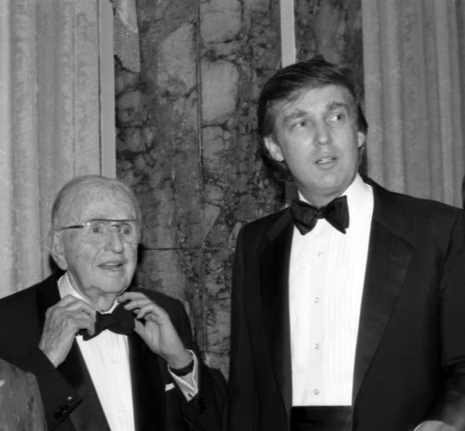
In 1988, Donald Trump attend a 90th birthday celebration for Norman Vincent Peale at the Waldorf Astoria Hotel. Photograph: Tom Gates/Getty Images
As Time magazine reported in September 1960, Peale “a longstanding Republican whose Protestant following rivals Billy Graham’s as the largest in the US,” was one of the most prominent leaders of a group of “150 Protestant clergymen and laymen, calling themselves the Citizens for Religious Freedom,” who met that month in Washington’s Mayflower Hotel to agree on a statement objecting to the notion that a Catholic could be president.
Peale presided over the meeting, according to two reporters from the Washington Post and Long Island’s Newsday. “Our American culture is at stake,” Peale warned his colleagues. “I don’t say it won’t survive, but it won’t be what it was.”
“At the close of their session,” Time reported, “they issued a 2,000-word manifesto that more than any other statement thus far in the campaign served to make religion the most emotional issue of the 1960 election.”
That statement, which was printed in the New York Times, along with Peale’s photograph, on 8 September 1960, is a reminder of how recently virulent anti-Catholic sentiment was entirely acceptable for the nation’s Protestant establishment.
From the perspective of today, what is most interesting is that the anti-Kennedy screed issued by Peale and other Protestant clergymen in 1960 focused mainly on their claim that a Catholic would refuse to uphold the separation of church and state.
“Brotherhood in a pluralistic society like ours depends on a firm wall of separation between church and state. We feel that the American hierarchy of the Roman Catholic Church can only increase religious tensions and political-religious problems by attempting to break down this wall,” Peale’s group wrote. “Much depends upon strong support for this well tested wall of separation by Americans of all faiths.”
Kennedy responded to the objections of the Protestant clergymen by delivering a speech on religion and politics to a group of Baptist ministers in Houston, Texas the following week.
“I believe in an America where the separation of church and state is absolute; where no Catholic prelate would tell the President - should he be Catholic - how to act, and no Protestant minister would tell his parishioners for whom to vote; where no church or church school is granted any public funds or political preference, and where no man is denied public office merely because his religion differs from the President who might appoint him, or the people who might elect him,” Kennedy said in the address.
The Tablet, a Catholic newspaper in Brooklyn, responded to the statement from Peale ‘s group by describing its aims as “akin to that of the Ku Klux Klan.”
“Sophisticated bigotry is no better than any other kind,” it commented.
The central concern expressed in the statement from Peale’s group was the same one spread by anti-Catholic conspiracy theorists in 1928, when Al Smith was the first Catholic nominee for president: the idea that the pope would secretly control a Catholic president.
As the historian Robert Slayton has explained, in 1928, “The Ku Klux Klan became actively involved in preventing a Catholic from ever getting near the White House, going all out to defeat Smith. One Klan leader mailed thousands of postcards after Democrats nominated the New Yorker, stating firmly, “We now face the darkest hour in American history. In a convention ruled by political Romanism, anti-Christ has won.”
The year before that election, Donald Trump’s father, Fred Trump, was arrested at a Memorial Day parade in Queens, where 1,000 robed members of the Ku Klux Klan rioted after the Irish-American-led police force tried to prevent them from marching. The focus of the Klan’s anger at the time in New York was rage at the Irish Catholic police force.
A Klan flyer passed around Jamaica, Queens after the riot, included in contemporary reports, featured the headline: “Americans Assaulted by Roman Catholic Police of New York City!” The text flyer began: “Native-born Protestant Americans clubbed and beaten when they exercise their rights in the country of their birth.”
US extends waiver allowing countries to buy sanctioned Russia oil
Adam Fulton
The Trump administration has issued a waiver permitting countries to buy sanctioned Russian oil and petroleum products at sea for about a month, seeking to control global energy prices that have shot higher during the war on Iran.
The US Treasury department allowed purchases of the oil loaded on vessels as of Friday until 16 May, an extension of an original 30-day waiver that expired on 11 April, according to a document posted to the department’s website.
The extension comes two days after Treasury secretary Scott Bessent said Washington would not be renewing the waiver that allowed countries to purchase Russian oil without facing US sanctions, Reuters reports.
Russian presidential envoy Kirill Dmitriev had said the first waiver would free 100m barrels of Russian crude, equal to almost a day’s worth of global output.
The reprieve on sanctions could temporarily boost world supplies of oil but has not prevented petroleum prices from spiking due to the effective closure of the strait of Hormuz.
Alito and Thomas reportedly defy calls to retire from US supreme court
Samuel Alito and Clarence Thomas, the oldest and most rightwing supreme court justices, both plan to stay on the court rather than retire, CBS News and Fox reported on Friday, citing unnamed sources close to them.
Speculation has been rampant that Alito, 76, and Thomas, 77, might retire before the midterm elections, to give Donald Trump a chance to replace them with younger nominees while Republicans still control the Senate.
Trump told the Fox Business host Maria Bartiromo this week that he was “prepared” to name two new justices if necessary.
“In theory, it’s two — you just read the statistics — it could be two, could be three, could be one,” Trump said. “I don’t know. I’m prepared to do it.”
Colleagues alarmed by FBI director Kash Patel’s drinking – report
Podcaster turned FBI director Kash Patel “is deeply concerned that his job is in jeopardy,” multiple current officials and former officials close to him told Sarah Fitzpatrick of The Atlantic for an article published on Friday. “He has good reasons to think so—including some having to do with what witnesses described to me as bouts of excessive drinking.”
According to Fitzpatrick’s reporting:
On multiple occasions in the past year, members of his security detail had difficulty waking Patel because he was seemingly intoxicated, according to information supplied to Justice Department and White House officials. A request for “breaching equipment”—normally used by SWAT and hostage-rescue teams to quickly gain entry into buildings—was made last year because Patel had been unreachable behind locked doors, according to multiple people familiar with the request.
By going to the media with their concerns, officials around Patel who want to see him fired could be appealing to Donald Trump’s well known horror of alcoholism, which led to the early death of his older brother, Fred Trump Jr.
Trump veers wildly from topic to topic in rambling speech, moving from Danica Patrick's widow's peak to UFOs
Donald Trump’s speech to young Republican activists in Phoenix, Arizona, which just concluded, was supposed to improve his party’s chances of retaining control of Congress after the upcoming midterms, but the president, buoyed by the wildly supportive crowd, was unable to stick to the subject, veering wildly from topic to topic.
Even as he attempted to recite what he calls his accomplishments, which he called “the best of Trump”, and attack Democrats with wild false claims, the president seemed to be distracted by a desire to cram in as many familiar talking points as possible.
At one stage, Trump called out the race car driver Danica Patrick, who was present, but got distracted by his own weirdly specific musing on the beauty of her hairline.
“Danica… Where is Danica? I love Danica. I love her hair. I always like to, I like the little widow’s peak… Danica. Where are you? Danica? So great. Thank you.”
Moments later, the president moved on to UFOs.
“As you remember, I recently directed the secretary of war- how good is Pete Hegseth doing? – to begin releasing government files relating to UFOs and unexplained aerial phenomena,” Trump said.
“I figured this was a good crowd, because I know you people. You’re really into that,” he added. “So I’m pleased to report today - I thought I’d save it for this crowd because you’re a little bit out there, you know, a little bit- that this process is well underway. And we found many very interesting documents. I must say. And the first releases will begin very, very soon.”
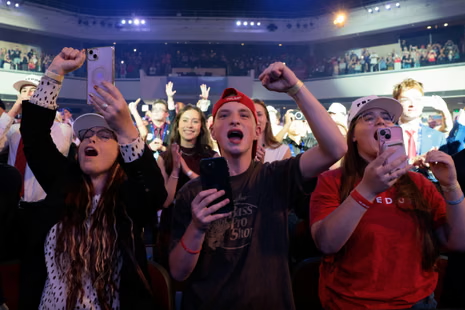
Young Republican activists cheered wildly during Donald Trump’s rambling speech at a Turning Point USA event at Dream City Church in Phoenix, Arizona on Friday. Photograph: Evan Vucci/Reuters
The president also repeated the false claim he has made dozens of times in the past year that “the king of Saudi Arabia told me, when I was in Saudi Arabia… he looked at me, he said, ‘You know, Mr President, a short time ago we viewed the United States as a dead country. We thought it was dead. And now you have the hottest country anywhere in the world.’”
In fact, Saudi Arabia’s elderly king did not meet Trump during his visit to the kingdom last year. The president was instead hosted by the crown prince, Mohammed bin Salman. And the comment about the US being “the hottest” country in the world was not made by the prince to Trump, but by Trump to the prince.
Trump repeats false claim white South Africans face "a genocide"
In his speech to young supporters in Phoenix, Arizona, Donald Trump returned to his familiar racist rhetoric about immigrants, focusing on the grisly killing of a woman in Florida he recently shared graphic video of, by an immigrant.
“We’re making your family safe. We’re making you safe,” Trump claimed. “So if you want a poor and weak America, a country that’s riddled with crime and death, disease and nothing but problems, you should immediately vote Democrat.”
Trump also repeated his false claim that the US has to give refuge to Afrikaners, because he said that there was “a genocide” against white South Africans.
“We stopped third world migration. We suspended all refugee resettlement except for persecuted South Africans that are being persecuted in South Africa,” Trump said.
“It’s a genocide. It’s a horrible thing,” the president said, repeating a debunked claim he made last year to South Africa’s president, before veering into a confused boast that Black Americans agree with the conspiracy theory. “And we made it possible for these people to come into our country. They kill people if they’re white. If you’re a white person and I’ll tell you what, I did great with the black vote, the African American vote. And they understand this better than anybody.”
In a Phoenix church, Trump jokes about extrajudicial killing of suspected drug smugglers
Speaking to young supporters in the Dream City megachurch in Phoenix, Arizona, Donald Trump just joked about the US military carrying out a series of extrajudicial killings of suspected drug smugglers in the Caribbean and eastern Pacific.
“As you probably noticed, if you watch the news, illegal drugs coming in by ocean or sea are down by 97%,” the president said. “And we’re trying to find out who the 3% is because I consider them to be perhaps the bravest people anywhere in the world,” he added, to laughter from the crowd.
The president then made a downward hand gesture to indicate that he was talking about airstrikes on boats from above, and said “Boom!” to more laughter.
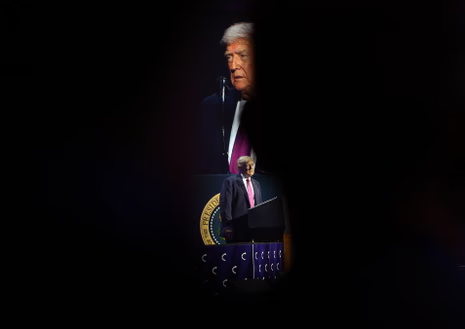
Donald Trump addressed a Turning Point USA event at the Dream City megachurch on Friday in Phoenix, Arizona. Photograph: Win McNamee/Getty Images
Trump is speaking in the same location where he made a racist joke about Covid-19 in 2020, calling it the viral disease that emerged in China, the “Kung Flu”, to wild applause from that young Turning Point crowd.
Donald Trump returns to Dream City, Charlie Kirk's megachurch, bearing the 'good news' about Iran
After praising Charlie Kirk and then himself for winning the 2024 election, Donald Trump teased his audience of young conservatives by saying that he had some “good news” to share.
“Would anybody like to hear about Iran?” the president asked.
“Iran has just announced that the strait of Hormuz is fully open and ready for business” he said. He then recited the text of a social media post he shared online earlier, saying that the US naval blockade would remain in force until the “transaction” with Iran was complete.
Trump went on to outline what he said were the terms of his tentative deal with Iran, which essentially replicates the terms of the 2015 Iran nuclear deal struck by his predecessor Barack Obama. The 2015 deal was achieved through diplomacy, not rounds of bombing by the US and Israel that killed hundreds of civilians in Iran and Lebanon.
The president then attacked Nato, riffing his earlier social media post in which he wrote:
Now that the Hormuz Strait situation is over, I received a call from NATO asking if we would need some help. I TOLD THEM TO STAY AWAY, UNLESS THEY JUST WANT TO LOAD UP THEIR SHIPS WITH OIL. They were useless when needed, a Paper Tiger!
“I told them I would have liked your help two months ago, but now I really don’t want your help anymore,” Trump told his supporters of Nato countries that have made plans to secure shipping through the strait after the conflict. “Because they were absolutely useless, what we needed them. But actually we never needed them. They needed us.”
Erika Kirk accuses leftwing influencers of 'spreading negativity, all to get clicks'
In her remarks introducing Donald Trump, Erika Kirk suggested that it was not her late husband, Charlie Kirk, who used the internet to drive a divisive message, but his leftwing antagonists.
“They love to start fights dividing us all against each other, spreading negativity, all to get clicks and influence the algorithm to maximize profits,” Kirk said.
“Meanwhile, building is hard, getting out the vote, talking to real people, spiritual revival. That’s actual work that is actual work.,” she added. “And my husband Charlie gave his life for that work and what gets built last for generations long after the noise has run out of one liners.”
Kirk’s critics have suggested that his college tours were designed exactly to start fights with students and make viral content to demean his political opponents.