





Former BBC editor and presenter
Director general, we need you to give us a dream. At the moment we only seem to have business plans, which is not surprising since your board is stuffed with businesspeople. Not many creative dreamers there. Your predecessor needed to slim down the organisation, to try to find new sources of revenue and prepare for a digital future without the licence fee. All this at a time of massively increased competition, from Netflix to GB News; the flight of children and young people to YouTube; increasing opposition to paying the licence fee; and while working under the critical eye of unsympathetic ministers, ever-ready to put the boot in.
Tim Davie was not well served by some of his executives who let him down, but because he tried to do everything, he had to take the rap. I think he was an outstanding chief executive, but a director general needs to be more than that. They need to be a visionary.
You need to win the public service argument with your critics even more than with your supporters, and, so far, the BBC’s contribution to the charter debate has been a disgrace. Far from leading it, the corporation has been largely silent, letting others make the political weather.
It is no longer tenable, in my view, to say you should give everyone something. With diminishing income, that would mean giving everyone less and less, and some minorities nothing at all. You need to prioritise in favour of public service, and spell out what that is.

Guardian columnist and BBC social affairs editor from 1988 to 1995
It takes bravery to step into so many dead men’s shoes. Hold on to that and be ready to fight the BBC’s enemies every step of the way. Refuse to be blown off course by any error made in some part of the vast output: blunders will happen, of course. Luckily, Labour, drawing up the new charter, is in essence a friend, but explosive political rows erupt often under Labour governments, vis Harold Wilson and Tony Blair.
Be brave inside W1A. Give people their head, allow risk, remove too many layers of nervous scrutiny and speed up commissioning where delays leave an industry for ever awaiting BBC decisions.

Make mincemeat of anyone claiming US streamers can compete with the extraordinary value of iPlayer, BBC online, eight domestic national TV channels, 10 UK national radio stations, two children’s channels plus BBC Bitesize education, sport, the Proms, five orchestras, a World Service in 43 languages, BBC Verify challenging the mythosphere and, above all, world-trusted news, all ad-free for less than 50p a day. The director general is there to glorify all that: no cringing to critics, no nonsense about elitism (we need more arts) when The Traitors, Strictly … and Race Across the World are popular triumphs and global exports.
“Punching above our weight” is Britain’s misguided postcolonial fantasy – except for the BBC, which is a cultural, news and information beacon of democratic, social and artistic values far more powerful than anything any government can convey. Be proud, you represent the best of Britain. When some explosive zinger of a scandal blind-sides you from left field, be brave.

Professor of politics at Strathclyde University
First of all, congratulations. However, this is also a highly risky position. Three of the past five permanent holders of the post have resigned prematurely because they could no longer withstand a media storm.
You are taking on responsibility for an organisation whose future has never looked more uncertain. On the bright side, you will at least be negotiating with a government that feels there is still a strong need for a national public service broadcaster.
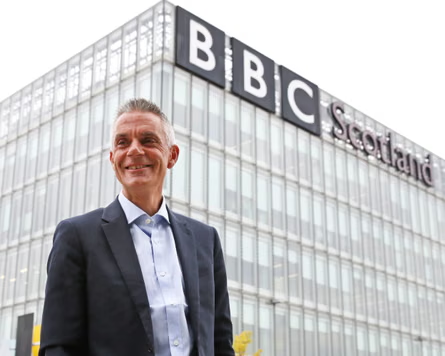
Perhaps it is time for the BBC to consider joining forces with its fellow (equally challenged) public service broadcasters and between them argue for a new UK broadcasting subscription that would be payable by anyone – including those living abroad – who wishes to access the services of any of the UK public service broadcasters, be that live or on-demand video or audio, or their online textual provision. It does, of course, mean that the BBC would have to take the bold step of sharing revenue with fellow public service broadcasters. But this already happens in the case of the Welsh language service, S4C, and the Gaelic television service, MG Alba.
Doubtless there would be arguments and debates about how to do so. Doubtless too, bold leadership would need to be married with careful negotiation on your part. But as someone who has previously helped bring about the disruption that now threatens the legitimacy and efficacy of the 100-year-old licence fee, perhaps you are better placed than anyone to persuade the BBC and the government that it is time to leave that legacy behind.

Writer, activist and Channel 4’s commissioning editor for multicultural programmes from 1984 to 1997
Apart from the programming tasks, you have inherited a political one. The wolves are gathering around your chicken hutch. However clandestine, the BBC now needs an internal fightback forum – I hesitate to call it a survival committee.
Impartiality doesn’t mean following the ephemeral results of public opinion polls. Whatever these say, it shouldn’t induce the BBC to, let’s say, give a favourable review to a republished Mein Kampf. By and large Auntie was, and should continue to be, a unique, independent, impartial, balanced, representative voice of politics and culture.
For me, the licence fee is the price for impartiality, democracy, freedom, fun, intrigue. You see it. Let’s save it. Sorted!

Professor of journalism at City University, and former BBC news and current affairs journalist
Making BBC income dependent on audiences owning a piece of equipment is a parlous model. When I ask students (who consume BBC content on their devices) if they are paying a licence fee for the privilege, many just respond blankly. What a previous generation regarded as a civic obligation, with failure to comply resulting in a criminal fine, is morphing into a payment of choice – on a par with a Netflix or Spotify subscription. And, for some older people, not paying the licence fee is a way of protesting at BBC content. The result has been a dramatic drop in income for the corporation.
We need a serious consultation on how consumers pay for high-quality and universally available public media that serves the UK. There may be an ingenious technical solution to this. We also need to discuss adequate funding (by government) of international services – a crucial tool of soft power in a world of uncertain truth.

Chief executive of the Film and TV Charity, and former head of current affairs BBC Scotland
I spent 24 years working at the BBC and a further six years working for other media organisations in the UK and across the world. During that time I came to understand, in a very real and physical way, what this industry can do to a person.
The BBC has long been known as Auntie, a nickname that reflects how many of its employees, me included, came to see it not merely as an institution, but as a family. Today, that model has not just changed. It has flipped. About 80% of the workforce is now freelance.
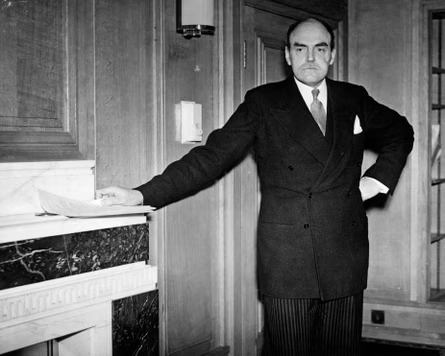
That single shift explains much of the crisis we are now facing. At its best, freelancing should be a source of creative freedom. It should allow talent to move between projects, to innovate, to collaborate widely. But what we have today is not a healthy freelance ecosystem – it is a precarious one, a system where insecurity is baked in, and where the absence of support is not an oversight but a defining feature.
The BBC’s greatest asset is its people – and that must include the freelance workforce who makes its content; the writers, producers, editors, researchers, directors, technicians and crews who turn ideas into programmes; the people who carry institutional knowledge, creative instinct and hard-won expertise; and the people whose skills cannot be downloaded, automated or replaced overnight.
If those people leave the industry, the BBC does not simply lose capacity, it loses quality. It loses distinctiveness, it loses the very thing that justifies its existence as a public service broadcaster. And they are leaving – not in dramatic waves, but in steady, cumulative numbers.
A thriving BBC requires a thriving workforce. Look after the people who make the programmes, and everything else follows. Fail to do so, and nothing else will be enough.
此内容由惯性聚合(RSS阅读器)自动聚合整理,仅供阅读参考。 原文来自 — 版权归原作者所有。