





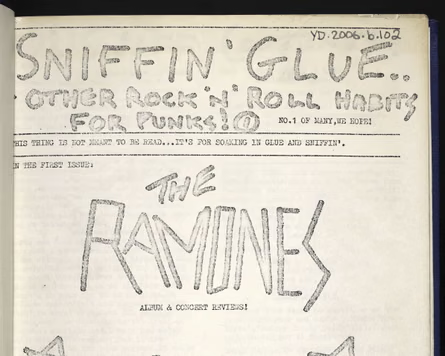
The self-published zine has long been central to cultural revolutions, from queer activism to Black feminism and the riot grrrl punk movement, producing titles such as Sniffin’ Glue and Sweet-Thang along the way. But now the traditionally analogue art form faces a new shift: artificial intelligence.
AI may seem incompatible with the these cult DIY booklets, but some creatives, designers and artists have begun to experiment with the technology, causing alarm in parts of the underground publishing world. It has been their Dylan-goes-electric moment.
“AI is eliminating a lot of people’s ability to think critically for themselves,” says Rachel Goldfinger, a Philadelphia-based video editor and illustrator who has published an anti-AI zine.
“Of all art forms that I partake in, I feel like zines are the ones that make the least amount of sense to use AI for. They’re supposed to be handmade and scrappy.”
Zines are typically self-published on ordinary paper with much smaller print runs than traditional magazines, and are often hand-illustrated.
Jeremy Leslie, founder of the magazine retailer MagCulture, has observed AI creeping into zine culture. “The zines using AI that I’m aware of have used the technology knowingly, as an experiment and often to make a point about its inability to match human creativity,” he said.
Notably, most zines using AI are online-only, where it has been employed to help design layouts as well as to generate artwork, and to make the creative experience more efficient.
The product designer Jesse Pimenta and the writer Cheyce Batchelor produced a 97-page 90s-inspired zine using Figma’s AI tools, praising the fact it allowed them to “reorder things without a lot of mental bandwidth”.
In 2023, Steve Simkins, an IT engineer, used AI to help produce an online photo zine while working at a US tech startup. He used AI to code and publish the website hosting the zine, but produced the content himself.
“I asked ChatGPT to help create an online zine with HTML and I provided the image links. It would give me some HTML, I would open it in my browser, then ask ChatGPT to adjust bits and pieces until I had something I liked.”
At the time he viewed AI as a “democratising software” that offered opportunities for artists lacking technical skills, “where AI could help enhance [their] pieces while still keeping the primary art itself”.
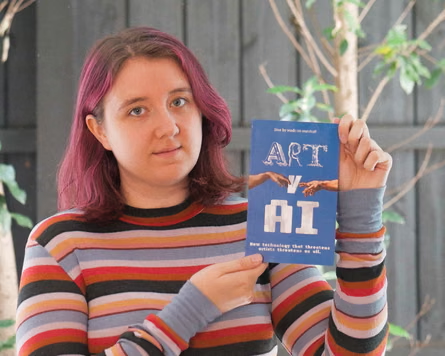
Zinemakers are among the most vocal critics of using AI to create art. Some are creating anti-AI zines in protest. Maddie Marshall spent a year working on a 92-page zine opposing the technology that she now sells on Etsy, the online craft marketplace. Marshall, a Melbourne-based video editor and illustrator, was inspired to create it after facing pressure to use AI at work.
“I felt the urge to spread the word about my opinions on it and get people to question why these technologies are being pushed on us so heavily,” she said.
Goldfinger created her counter-AI zine, I Should Be Allowed To Think, – named after a 1994 song by the American alternative rock band They Might Be Giants – as she feels AI is making it harder for artists to secure jobs.
She said using AI to streamline her work goes against her creative principles. “I don’t respect it on any level,” she said. All of her zines are handmade. “I don’t want to expedite the process. That ruins the point for me,” she added.
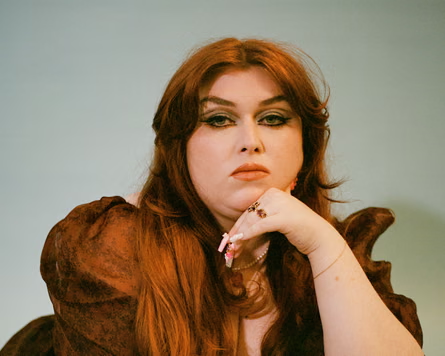
Ione Gamble, the London-based founder of Polyester zine, a feminist arts and culture publication, adds that AI is “not something that we use or support the use of. Whether that’s through image generation or writing. We run all of our submitted articles through an AI checker now to ensure that we’re not publishing AI writing”.
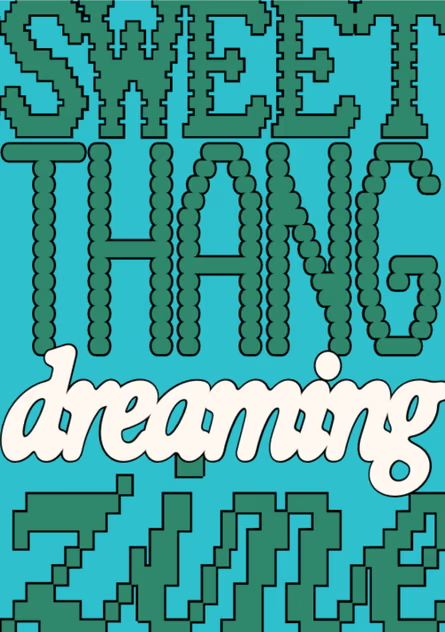
Zoe Thompson founded Sweet-Thang zine, a community print zine that publishes work by Black creatives globally, in 2017. To her, the desire to create art is an important feeling, which she feels using AI directly counters.
“It kind of feels like you’re experimenting with a tool but there’s no artistry there, which is kind of sad. I feel like the beauty of art and creation lies in that slowness,” she said.
Can AI and zine making coexist? “I mean, it has to because AI exists. But I’m not sure it will be harmonious,” says Gamble. “I think zine making in particular is such a grassroots process. All you need is a bit of paper, a pen, and some things to collage with. There’s a low barrier to entry.”
It has been three years since Simkins made his photo zine and his perspective on AI has changed since then. “In the realm of zines I think it [AI] can be used as a tool to produce”, but fundamentally he believes thatart is “made by people and for people”.
He said there need to be more conversations about the use of AI in art. “I can see two sides of the coin. Most importantly, I think you can get really exhausted getting caught up in trying to police what everyone else does when it comes to art,” he said.
Should a day come when AI zines are being pitched to distributors, MagCulture’s Leslie is relaxed about bringing them into the mix.
“We’re not interested in whether or not a zine has been produced using AI,” he says.
“We want to see interesting, innovative, and engaging zines. If one has been created using AI and is intriguing in its own right, then great, we will support it.”