










Këmituxwe Éhènta Wehikiyànkw
You are walking in our old homeland
After spending 12 years backpacking some of America’s wildest trails as a wilderness ranger for the US Forest Service – and then losing that job to politics – last spring I set out for the Appalachian Trail (AT), the longest hiking-only footpath in the world.
My heart was heavy with grief from recent losses in my family, and I hoped that spending some time in my homeland’s ecology might bring some healing.
The hike was also a way to reconnect with my Indigenous homeland. My Lenape (AKA Delaware) ancestors walked these landscapes at the end of the last ice age, and many of today’s roads and hiking trails still follow these ancient routes.
We Lenape call our homeland Lenapehoking. It encompasses the Delaware River watershed, reaches into the lower Hudson, and runs along the Atlantic coast. We define homeland not by political borders but by the ecological systems that have always sustained us.
For Indigenous peoples, relationships with land and water give geography its meaning. Those ties carry responsibility rather than ownership; they are familial. When communities are torn from the ecologies that formed them – as we were through ethnic cleansing carried out by colonial governments – it is a kind of family separation.
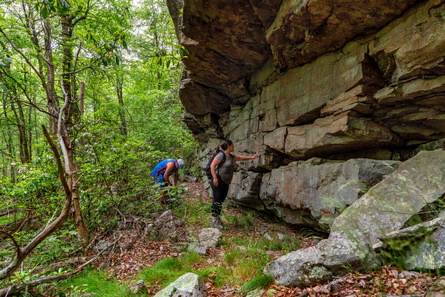
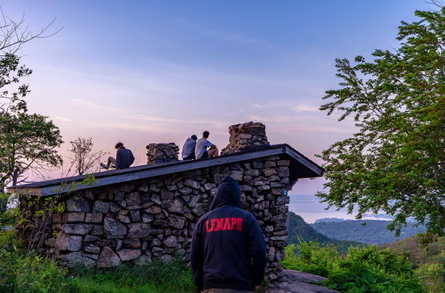
’The coolest part about seeing that rock shelter is knowing that our ancestors used to walk the same trails that ended up becoming the Appalachian Trail, and they took shelter at that exact spot during their travels,’ says anthropology graduate student and Delaware Nation of Oklahoma tribal member Derek Tippeconnie, also pictured.
That history runs deep. In 1624, the Dutch West India Company claimed we had sold them the island of Manhattan, so they built a wall to keep us off it – Wall Street’s namesake. Which they decorated with Lenape heads. In 1682, Chief Tamanend signed a treaty with William Penn; his sons later engineered the treacherous Walking Purchase, more than doubling the land we had agreed to cede.
And in 1778, my sixth great-grandfather, Chief White Eyes, negotiated a treaty promising the Lenape representation in Congress and a 14th state in exchange for our alliance in the Revolutionary war. Officials said he died of smallpox, but he was most likely murdered by militia members. The first treaty the United States signed with an Indigenous nation went unhonored.
By the early 1800s, all of the Lenape communities were driven from our homeland by disease, war, scalp bounties, bad-faith treaties and waves of forced removals. Today we’re federally recognized in the US and Canada as six separate nations – two in Oklahoma, one in Wisconsin, and three in Ontario – still bound by blood, history, culture and identity.
Carrying that history with me, I set out for the trail last May.
My first stop in Lenapehoking was to spend a day traversing New Jersey’s highest mountain, which sits on the Kittatinny Ridge – long used by our ancestors as a travel route. The name comes from the Lenape word kitahtenink, meaning “place of big mountains”.
The summit was paved over by a parking lot for tourist access; atop the highest point stood a 220ft concrete obelisk. I questioned the hubris that would construct an additional monument on top of the grandest monument in the state – its highest mountain.
Outdoor recreation often slips into what I call an achievement-based relationship with nature. I’ve been guilty of it myself. Whether it’s “bagging peaks”, racing to finish the AT, or stamping the land with machines and monuments, the focus shifts from ecology to ego.
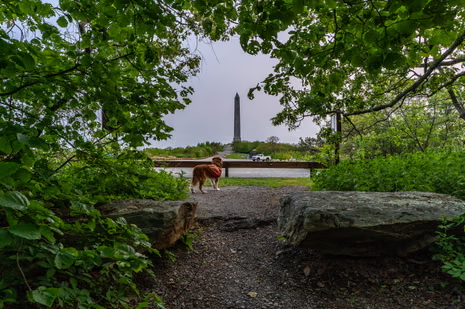
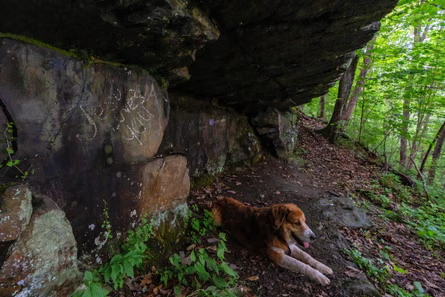
Dogs are considered sacred to Lenape’ok. They protect us from physical and spiritual harm, and guide us to our Creator in the afterlife.
In 2022, I spoke at the Appalachian Trail Emerging Leaders Conference and urged thru-hikers to end their hike a few miles before the terminus, to test how much their hike was guided by achievement-driven relationships with nature.
When personal conquest becomes the point, it bypasses not only the importance and complexity of ecosystems, but also the Indigenous peoples who have long cared for them.
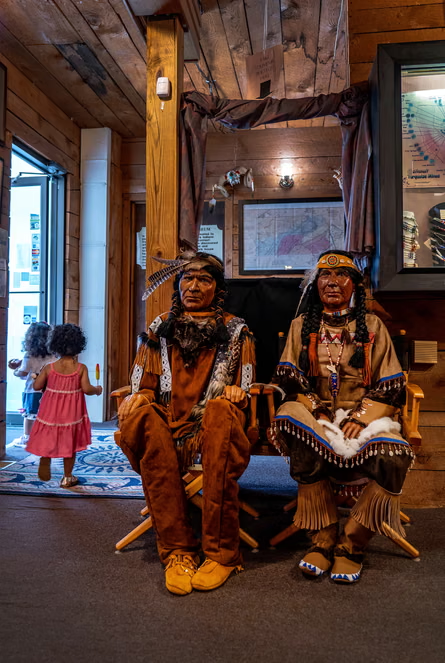
Nowhere was this theory more obvious than when I stopped to investigate a roadside shop calling itself an “Indian museum” and advertising Native-made crafts for sale. Walking through its threshold, my blood ran cold when I was met by two wooden “Indians” bedecked in generic stereotypical costumes. It’s always disturbing to see wooden Indians, but these were particularly corpse-like.
Accessible by fee in a separate room was an exhibit claiming to interpret Lenape history and displaying a trove of Lenape artifacts. I refused to enter as it probably contained funerary objects, which would create “bad medicine” according to my beliefs. The second floor held a sporting goods department serving AT hikers and tourists.
I hadn’t expected such a literal illustration of the outdoor industry participating in Indigenous erasure.
It’s important to consult with representatives from the federally recognized Lenape nations about any Lenape matters, because one can be assured they have proven they are Lenape, and as such, should always be included and deferred to.
Appropriation has a long history in American outdoor recreation. For example, Scouting America, formerly known as the Boy Scouts, founded the “Order of the Arrow” in Lenapehoking, naming their first lodge, Unami, after us and modeling it on romanticized notions of Lenape culture. Such practices emerged in the cultural vacuum left when Indigenous peoples were forced from their homelands. The land still calls for its people, and in their absence settlers have answered with hokey “vision quests” led by pretend shamans, knockoff crafts and faux ancient wisdom spread by impostors.
For some, it goes as far as faking it entirely. They’re called “pretendians”, and they falsely claim Indigenous identity. Pretendianism is the ultimate form of colonialism: once all of the land and resources are stolen, there is nothing left to take but our identity. They try to take that too.
Legitimate Lenape nations have had to issue proclamations condemning such groups, reiterating the excruciatingly well-documented history and removals of Lenape’ok (Lenape people) that make it impossible for any “lost tribes” to have remained behind, magically hidden for centuries in the most densely populated area of the country. That mythology is an absurd form of holocaust denial. No Indigenous community willfully abandons the homeland that defines them. If staying was an option, we would all still be there.
The only proven authentic Lenape communities representing Lenape culture and sovereignty are the Delaware Tribe of Indians in Bartlesville, Oklahoma; the Delaware Nation Lenni Lenape in Anadarko, Oklahoma; the Stockbridge-Munsee Mohican Community in Bowler, Wisconsin; the Munsee-Delaware Nation at Muncey, Ontario; the Delaware Nation Eelūnaapéewii Lahkéewiitat, at Moraviantown, Ontario; and the Delaware of Six Nations at Grand River, Ontario.
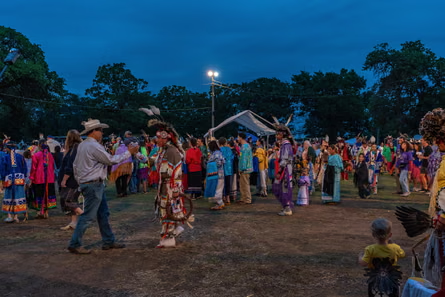
Later, we allied with the US once again when an entire company of Delaware warriors fought for abolition in the civil war, helping to free Missouri from slavery.
Returning to our reservation afterwards we found our women and children murdered and our farms stolen by white settlers, which led us to relocate to Oklahoma when the US wouldn’t enforce its own laws protecting our rights.
Unsurprisingly, the most disturbing examples of appropriation I saw were supposed “ceremonial” items for sale at the “Indian museum” labeled as Lenape and made by someone from one of the denounced groups.
The fact they were for sale is an immediate red flag, as we don’t sell ceremony or ceremonial items. It was also immediately obvious they were fake: when we use certain animal parts in our regalia and ceremonial items, it is with a very specific purpose and method.
What I saw included a macabre mix of random dead animal parts mashed together in an arbitrary way. It looked more like something a serial killer would make than Lenape culture. One item contained hawk feathers, even though it’s illegal to sell them, and for non-Natives to possess them. It’s also a violation of well-known Indigenous protocols to commodify anything sacred, such as raptor feathers. Equally disrespectful from a Lenape perspective was the inclusion of sacred wampum, or quahog shells.
I felt physically ill.
Angry and sickened, I began photographing the items. Suddenly the lights flickered. I kept shooting. They flickered again, longer this time. The upstairs clerk came down to check the breaker – nothing wrong. He stepped outside, came back puzzled: the power was fine everywhere else.
“Old wiring?” I asked when the lights returned.
“No,” said the other clerk, unnerved. “This never happens.”
The room went dark again. When the lights snapped back on, both clerks looked rattled. A sharp thud broke the silence. One of many dolls fashioned into grotesque caricatures of Native Americans for sale on the shelves behind them had launched itself on to the floor at the upstairs clerk’s feet. His face went white.
That was enough. I felt the message as clearly as if it were spoken: my ancestors wanted me out of there.
I quickly exited the building with my heart pounding in my throat. I then made a tobacco and wampum offering outside and prayed for the ancestors connected to those artifacts to be at peace. I felt their anger, grief, gratitude and love. Afterwards, I went to a nearby lake and smoked myself off with cedar and sweetgrass so that no bad medicine would follow me.
After my experience at the “Indian museum”, I knew I needed to recenter myself and take a detour to where Lenapehoking begins – at its kitahikan, or ocean, waters.
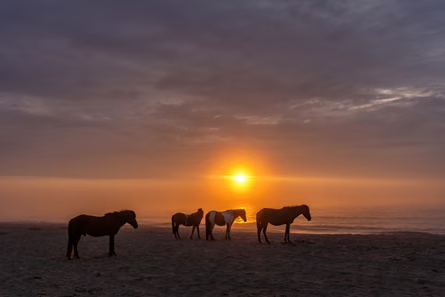
I used modern highways to follow an ancient trail my ancestors followed called the Minsi Path to the mouth of the Delaware River, and from there down to Assateague national seashore. It’s the only undeveloped coastline left in Lenapehoking, and you can backpack and camp there.
Driving through Lenapehoking seeing signs with misappropriated Lenape names like “Conshohocken” on them was surreal. I recalled a recent trip to Ireland with my mother to celebrate her 80th birthday, and how impressed I was that the signs were also in Irish, not just English. Seeing bastardized Lenape language used in Lenapehoking is the opposite of that. It would be like seeing those signs in Ireland, without any Irish people living there. It’s a homage to ethnic cleansing, not to us.
Other names such as Savages Ditch, Indian River Bay and Conquest Beach jumped out at me. I visited the last location for the first time last year and met an elderly man combing the beach who shared that he descended from the first settlers there. After learning I’m Lenape, he also confessed he had excavated thousands of our artifacts as a hobby, including taking home a skull from a burial ground. He said after a few decades he felt guilty having it, so he “returned it to a local chief”. (Who was, of course, fake.)
In Oklahoma, where I currently live, it’s easy to forget we are coastal Natives. Most Lenape’ok have never even seen Lenapehoking, let alone her kitahikan waters. Yet, things like sea turtles and wampum shells remain icons of our culture. The sound of a campfire crackling under a moonlit sky, joined by a chorus of kitahikan waves dancing on the shores of Lenapehoking, is a lullaby my ancestors knew well – and it was exactly what I needed to recenter my journey in a good way.
Leaving the park to rejoin the trail, I felt steadier, as if something inside had been set right.
I picked up my friend Derek Tippeconnie at Westchester University. Derek, a member of the Delaware Nation of Oklahoma, was there working on his master’s in anthropology and attending a three-week archeological field school that trains tribal members to monitor archeological sites.
I wasn’t expecting to see any other Lenape’ok on my journey, but coincidentally Derek and my friend Martina Thomas, who is the tribal historic preservation officer for the Delaware Tribe of Indians, were both there. Derek agreed to spend a night camping near the AT, and Martina would join us the following morning to investigate an archeological site in the Delaware Water Gap national recreation area.
During the drive, Derek told me a disturbing story about a museum he had visited. It held Lenape remains that staff had previously “consulted” with pretendians about – who then encased them in a plastic container.
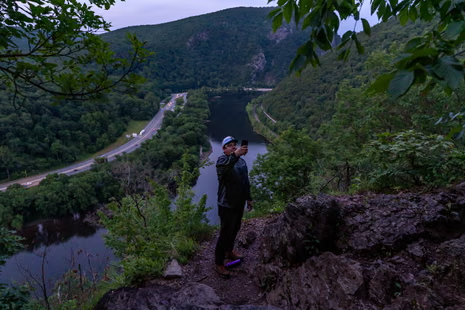
For us, that is an abhorrent violation. I can’t share the details of how we prepare our dead, but suffice it to say: sealing ancestors in plastic is another gross offence. Pretendian mythologies are so ingrained in Lenapehoking that not only have museums fallen prey to them, but even academic and esteemed historical institutions have given pretendian groups a platform to rewrite our history. Arriving just before dark, we decided on a quick hike up the AT to a viewpoint overlooking the water gap, which is where the Delaware River – the lifeblood of our identity – cuts through the kitahtenink on its way to feed the kitahikan.
As Derek stood there for the first time, I heard him say in a reverent tone: “Everything just makes so much sense now …”
Studies show that Indigenous homeland reconnection has exponentially positive health impacts. For Derek, it brought his life’s direction into focus. After his first visit in 2023, he went back the following year to view some artifacts at Princeton with other Lenape’ok.
In the 1700s before Lenape people were forced entirely from Lenapehoking, our various regional communities such as the Pompton, Canarsie, Nanticoke, Rockaway and many others, coalesced in this area after being removed from their locales, then amalgamated into what became known as the Delaware Nation or Tribe.
When school representatives talked about the need for Lenape guidance in their work, Derek immediately knew he could do that. “Something just sparked inside my brain,” he said.
Being in our homeland for the first time can awaken part of our identity that lies in our subconscious, perhaps as a yearning for something missing we don’t quite understand. So Derek decided to pursue a graduate degree in anthropology, and got to work bringing our voices and history to light.
After hiking back in the dark, lost in conversation, we made camp near the intersection of the AT and the old Minisink Trail. That trail runs from a 10,000-year-old village site on Minisink Island in the Delaware River, east to the kitahikan, and west across the Appalachians on a route that became Interstate 80.
Our conversation continued by the fire that night – the first time either of us had shared a campfire in Lenapehoking with other Lenape people. It felt comforting and familiar, like an experience that was already woven into our being. The next morning we met Martina to document a rock shelter just a few dozen meters off the AT that had been vandalized. For thousands of years, such shelters offered travelers protection, and probably a chance for camaraderie and trade. The AT echoes that tradition with its lean-tos, but the original version remains invisible to most – or, too often, disrespected by graffiti and theft.
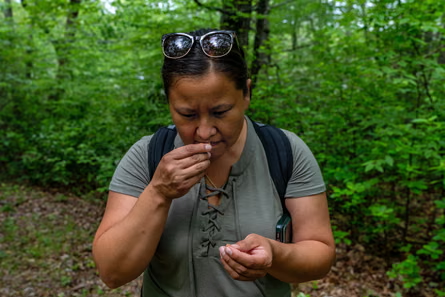
Our hike began at a mountain lake where our ancestors swam and fished soon after the glaciers carved it. Not far along we came to a beaver pond with a large lodge. Aside from the faint hum of traffic through the trees, the place seemed much as it must have when our ancestors lived there. We stopped to examine the previous year’s chestnuts scattered on the forest floor, and marveled at how food literally fell from the sky to feed our ancestors.
Derek and I jumped into the lake at the end of our hike. Its refreshing and welcoming waters wrapped around us like the arms of our ancestors who swam there before us. Derek remarked it was a good feeling seeing the beaver activity, knowing that at least some wildlife survives in the populated areas.
“My favorite thing about the trip was reconnecting to that area,” Martina said afterwards. “I had a couple personal moments – taking in the beaver pond, sitting on a rock by the lake, and looking at the chestnuts. It was all so beautiful.”
It was a perfect and rare day with perfect company, and I felt a little empty inside after they left. Being in Lenapehoking without other Lenape’ok is like being a child of divorce celebrating birthdays with a parent absent. It’s still a celebration, but something is missing.
TEK is where the joy we felt finding chestnuts because they’re part of what makes us Lenape, intersects with the joy a scientist working to recover them feels when finding them, and, where our shared love and knowledge can come together to protect and sustain the ecology.
Lenapehoking is now home to hundreds of Superfund sites and some of the worst pollution on the continent, and the Delaware River contributes more plastic to the Atlantic Ocean than any other waterway in North America.
I often think about how that wouldn’t be the case if we were still caretaking Lenapehoking, because we would never devise an economic system that requires us to commit genocide against our own ecological family.
Hiking on the trail in the Delaware Water Gap national recreation area, I met a couple walking their dog. When I mentioned I’m Lenape, the man told me his father, an amateur archeologist, had once excavated a rock shelter nearby – just 20ft off the AT. On my way back, I followed his directions.
What I found wasn’t surprising: the shelter was scarred with graffiti, in a park visited by legions of tourists every year.
Staring at the vandalism defiling my family’s history, I saw little difference between that and the pollution poisoning Lenapehoking. For years, conservationists have promoted tourism as a “sustainable” alternative to mining or logging. But tourism can be just as extractive and harmful.
As a former ranger who spent 12 years burying human feces left beside mountain lakes that become drinking water for millions, and packing out thousands of pounds of trash from America’s most pristine places, I understand that American outdoor recreation can be just as harmful as other forms of extractive relationships with nature.
For that reason, tribal members in Oregon, where I used to work as a ranger, are alarmed by a newly established thru-hiking route, the Blue Mountains Trail. It cuts through important Indigenous sites and ecologically fragile areas. No environmental or cultural impact statements have been done to assess the consequences of increased traffic.
There’s no citable evidence it benefits the ecology or anything else beyond non-profit coffers and the outdoor industry. And the trail’s backers never obtained free, prior, and informed consent from the Indigenous nations it affects, as required by the United Nations Declaration of Indigenous Rights.
(In response, the Greater Hells Canyon Council said the Blue Mountains Trail currently sees only a handful of thru-hikers each year and argued that even significant growth would remain marginal. The group said it engaged with some individual tribal members who were in support of the trail, but did not seek consent from the tribal governments.)
Ironically, the same conservation groups marketing the trail often sue governments and industries over lack of consent and environmental review – yet they make an exception when it serves their own interests, as the news of a new route can generate donations and attract sponsorship from the outdoor recreation industry. Meanwhile, visitor traffic to that region of Oregon has tripled over the past decade, while resources to manage it have dramatically shrunk – a lethal ecological equation. The piles of human feces I’ve found along mountain lakeshores testify to that imbalance.
On my way to Bear Mountain state park for the final leg of my adventure, I stopped at Lake Hopatcong, named for our word “hupokan”, meaning “tobacco pipe”.
An island in the lake holds a Lenape burial ground. Today it’s covered by luxury homes and a yacht club. The shoreline is almost entirely locked behind private property, but I found one sliver of public beach where I could still look out toward the island and make an offering for my ancestors.
Despite seeing perhaps the most disturbing sight yet – our graves covered by a yacht club – I wasn’t overwhelmed by the historical trauma of the experience like I was at the Indian museum. Something had shifted after I recentered myself in the kitahikan waters.
Now I was simply content, immersed in the beauty of my homeland.
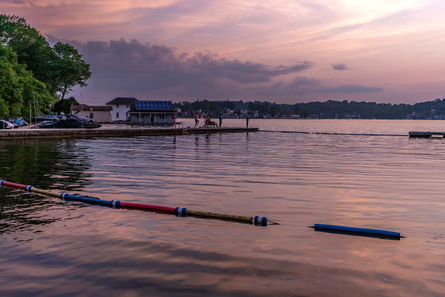
A housing crisis driven by rural gentrification is what forced me to move back to my reservation in Oklahoma from north-east Oregon, where I worked as a wilderness ranger. Tribal members there fear their homeland will eventually face the same fate as ours.
My plan for the next day was to spend the final night of the trip – and, ironically, my only night camping on the AT – at the west mountain shelter in Bear Mountain state park, located about 40 miles north of New York City.
The first segments of the Appalachian Trail were constructed in the park, and the west mountain shelter was the first hiker shelter ever built on the trail. The Manhattan skyline is visible from there, and I wanted to photograph it.
On my way to the shelter I found a big birch tree about a mile up the trail covered in scars from hikers celebrating themselves by carving their names into it. I saw the same hubris and self-interest that erects monuments on top of mountains, vandalizes sacred sites, and pollutes my homeland. It’s ego carved on living trees. The more loudly people announce their presence on the land, the quieter the voices of the ecology and its caretakers become.
When I arrived, the Manhattan skyline was invisible due to Canadian wildfire smoke. I didn’t mind. Photographing it was an arbitrary achievement. The real point was simply to spend another night surrounded by my ecological family. After a beautiful sunrise the following morning, I began my journey back to Oklahoma.
Leaving Lenapehoking, I stopped to view the Palmerton Superfund site, which killed miles of forest along the AT. As disturbing as that was, it didn’t kill my vibe. I had accepted that we can’t fix everything right now. What we can do, however, is continue to reclaim our narratives and ancestral spaces.
Centuries ago an ancestor had a dream foretelling Henry Hudson’s arrival in Lenapehoking on his ship, the Halfmoon. It was a warning of the colonial violence our people would soon face, and a reminder to lean into our culture and traditions to protect us in the face of attempted erasure.
That reminder remains as relevant today as it ever was.
Approaching the “border” of Lenapehoking on I-80, I pulled over to make an offering for our people and homeland.
As I stood there praying with wampum and tobacco in my hand, the biggest, most brilliant cardinal I’ve ever seen flew down and landed on a branch immediately in front of me. He stared straight into my eyes and shook his feathers, and I swear, he laughed at me. I saw a twinkle in his eye that instantly reminded me of my dad, who passed away 12 years ago. In Lenape tradition, cardinals are said to bring messages of reassurance from our deceased relatives.
He sat there chirping at me for a minute, and I heard my father’s voice in my heart telling me everything was going to be OK; that our families will heal from the losses we’ve suffered; and our culture and people will carry on far into the future. Then he flew away laughing, and I threw the tobacco and wampum into the forest after him.
With people like Martina and Derek and so many others from our communities working so hard to preserve our history, culture and sovereignty, and to reclaim our voices and place in Lenapehoking, our future is bright.
If we continue in that good way, maybe one day hikers on the Appalachian Trail will be thoroughly acquainted with us and our history, and we’ll be there caring for the ecology that made us Lenape once again.