


Some 8,000 years ago, behind the retreating glaciers, a remarkable environment was born on the western fringes of Scotland’s Outer Hebridean islands, forged by the wind and waves. It began with rising sea levels and sweeping Atlantic gales depositing crushed shell-sand inland; this settled over glacial sediment to form a coastal belt of lime-rich soil. Buffered from the sea by mounting sand dunes, this winter-wet and summer-sunned substrate produced one of Europe’s rarest habitats: the “machair”, Gaelic for “fertile grassy plain”. Abounding in diverse, colourful wildflowers and an array of associated wildlife, coastal machair is a precious, globally important outpost of biodiversity, supporting everything from purple orchids and nodding blue campanulas to endangered birdlife, otters and rare bumblebees.
As a wildflower fanatic, visiting the Outer Hebrides in peak machair bloom has long been an aspiration. Over the years, I’d read accounts of its arresting, vibrant seasonality – its shifting blankets of red and white clover, yellow trefoil and creamy eyebright, bold against the sky. Although remnant machair is also found in north-west Ireland, its greatest extent lies on this Scottish archipelago, notably the islands of Barra, Uist and Harris.
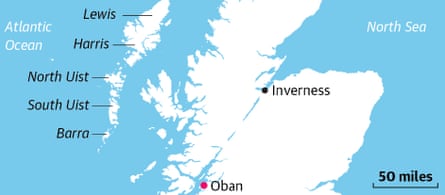
Moreover, here it has a fascinating symbiotic relationship with crofting, the traditional, small-scale agriculture unique to Scotland’s Highlands and Islands. For generations, crofters have managed areas of machair as low-intensity pastureland, improving its fertility, grazing livestock and growing crops on sustainable cycles sympathetic to wildlife regeneration. With crofting undergoing a quiet resurgence on the islands, and many crofters exploring new ways of sustaining an old way of life, experiencing the Outer Hebrides appealed to me all the more. Last summer, I finally made the trip, travelling from Barra in the south right up to Lewis – and it was everything I had hoped for.
Now a parent of two young boys, and with the machair’s flowering season falling squarely within the school holidays, it was clear this trip would need to be a family affair. I pitched it to my wife: “Fancy a holiday of white sands, turquoise waters and local food?”
“Sicily? Sardinia? Greece?” came the expectant reply.
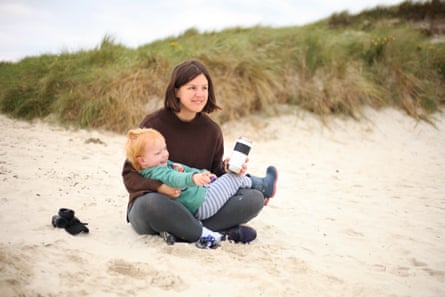
Thankfully, she was won round with the promise of fresher-than-fresh salmon, unrestricted space to exhaust the boys and, appealing to her interests in history and design, the islands’ heritage of traditional crafts. But there was one other necessary sell: in order to cover all islands in one go, and to allow for surprise and discovery, we’d need to travel by motorhome. Having spent last summer negotiating the confines of a family tent, this, too, was agreed. With swivelling car seats, a three-hob stove and a sky bed deemed certifiable upgrades, we were off.
Collecting our motorhome from Just Go outside Edinburgh and driving the mountainous, lochside road towards the west coast, we spent two nights at pleasant North Ledaig caravan park, outside Oban, the primary port for the Western Isles. Perched beside the placid waters of Ardmucknish Bay, we underwent some necessary pre-island preparations: namely, getting to grips with motorhoming essentials (wastewater disposal, tethering breakables, navigating single lanes), and refamiliarising ourselves with the inescapably chaotic nature of travelling with small children. Thus decompressed, we were borne across the Sea of the Hebrides on a CalMac ferry to Barra, the second most southerly of this spectacular island chain.
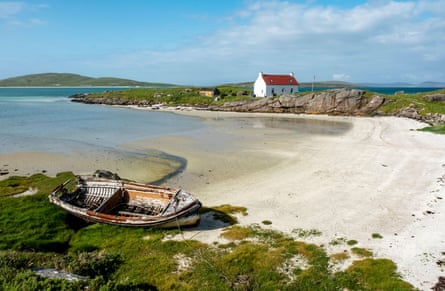
As I had read multiple times when researching this trip, the Isle of Barra is not to be overlooked. At a mere 9 by 7 miles, it is among the smaller islands, but unquestionably one of the prettiest. A short, easy drive from the landing at Castlebay village – marked by medieval Kisimul Castle, protruding from the water – brought us to Borve Camping & Caravan Site, where we pitched in view of waves crashing upon blackened gneiss boulders.
Over the next two days, we explored the quiet, colourful island and that of smaller Vatersay (connected via a causeway), hiring bikes, taking coffee mugs on to the marram grass dunes, and making sand tunnels at stunning beaches Traigh a Bhaigh and Tangasdale. Approaching the latter, I got my first taste of machair, my heart singing when suddenly surrounded by yellow bedstraw and kidney vetch, red bartsia and scattered orchids. A magical quality of machair, I quickly learned, is that its detail can appear disguised at a distance, owing to the complexity of species. Once up close, thousands upon thousands of low-lying flowers are revealed in an effect akin to pointillism.
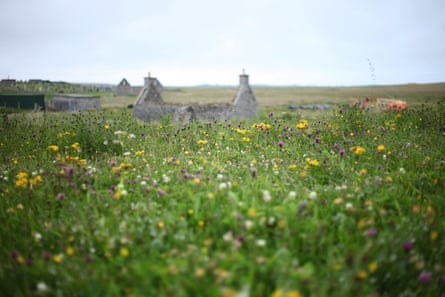
Machair has hosted crofts for centuries, its light, workable soil contrasting with the rocky peatland often prevalent across the islands. Considered a semi-natural habitat, it is sustained by the low-intensity agriculture practised by crofters: locally harvested seaweed (kelp) is spread as an organic fertiliser, enriching and preserving the sandy soil and providing sustenance for migrant birdlife. Similarly, cycles of crop and fallow benefit wildflower regeneration and support ground-nesting birds, while silage harvesting is carefully timed to protect endangered species such as the corncrake.
Some of the most impressive machair is found at the RSPB reserve of Balranald on North Uist, where the mixture of fallow wildflower fields and areas under cultivation (for cereals such as barley, black oats and hebridean rye) shows as a subtle patchwork over the landscape. Camped on the reserve itself – our highlight campsite – my eldest and I spent a memorable evening wandering back from the beach through the engulfing blooms.
While on South Uist, we visited crofters DJ and Lindsay of Long Island Retreats & Larder, who subsidise their livestock crofting by hosting island experiences, from island and machair tours to sheep shearing demonstrations.
“Our love of the land and the livestock is what drives us,” Lindsay told me, meeting at the smart “larder” shop that she and DJ – a sixth-generation crofter – run from their home at Loch Skipport. “But we wouldn’t be doing what we’re doing if it weren’t for all the people that came before us.”
Lindsay said it is common for crofters to have second jobs, but having started a family, they sought new avenues to make their crofting more viable. In recent years, the Scottish government’s crofting agricultural grant scheme has made money available for agricultural improvements, business development and croft house refurbishments, encouraging many crofting families to diversify their income streams.
Farther north on Harris, we stopped by Croft 36, a crofting enterprise that’s part of the growing Outer Hebridean culinary scene. Operating from an unmanned honesty-box kiosk, Croft 36 offers homemade soups, pastries and other baked produce made with machair-grown ingredients.
Our journey was punctuated by memorable meals, almost all of them found at a pop-up of one kind or another, often out in the wilds: the scallop and black pudding bun devoured at The Wee Cottage Kitchen food van on the North Uist coast; the salmon at Namara Seafood Cafe. On Lewis, the Crust Like That takeaway pizzeria – a shipping container isolated in dramatic moorland – offered haggis-topped pizza. And don’t get me started on the cake-packed honesty boxes dotted around like treasure chests.
The freedom of the motorhome meant that these and so many other discoveries could be enjoyed along the road. Travelling the islands this way gave a great sense, too, of their shifting character – of Barra and Eriskay’s pristine coves, Uist’s freshwater lochs, and the hilly, moorland drama of Harris and Lewis.
By the time we were heading back to Edinburgh from Ullapool, I was losing count of the special moments. We’d seen peregrines, hen harriers, basking seals and diving gannets, and spent evenings off-grid on breathtaking remote beaches. We’d swum sunlit coves (none more sparkling than at Eriskay and west Berneray) and made hot chocolate for the boys on the pebbles. When it rained, there were heritage museums, charming cafes and woollen mills; Stornoway’s An Lanntair arts centre and the poignancy of Geàrrannan Blackhouse Village in Lewis, its restored 19th-century drystone houses conveying the challenging life of a once prominent crofting community.
And the machair left an impression not easily forgotten: a rare floral spectacle I now understand as a lifeblood of these islands.
The trip was provided by VisitScotland and the Caravan and Motorhome Club.
此内容由惯性聚合(RSS阅读器)自动聚合整理,仅供阅读参考。 原文来自 — 版权归原作者所有。