








Today, David Attenborough turns 100. He is, without question, Britain’s greatest national treasure; a man who has devoted his career to helping the public engage with the natural world. But his story is also the story of television. Attenborough joined the BBC just as television ownership hit its biggest period of growth, then went on to shape the medium, both on and off camera, over the next decades. He is as important a figure in television as you will ever find, and here are his wildest moments.
1.
Big break (1952)
At the age of 26, Attenborough gains his first television credit, producing Coelacanth, in which biologist Julian Huxley discusses the rediscovery of an ancient lobe-finned fish thought to be extinct. Like much of Attenborough’s early work, the show has been lost to time.
2.
The gameshow debut (1953)
Attenborough makes his first screen appearance. It’s on the gameshow Animal, Vegetable, Mineral?, in which a panel of experts are challenged to identify unusual objects from museums.
3.
A natural beginning (1953)
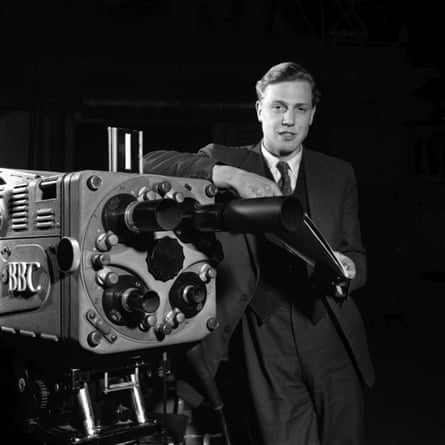
Attenborough’s first natural history series, Animal Patterns, debuts. He presents while Huxley brings a selection of animals to the studio.
4.
It’s a small world (1953-1954)
Attenborough returns to production, showing an early eye for audience-friendly formats. As well as indulging his love of folk music with the series Song Hunter, he makes a programme called It’s a Small World, tantalisingly listed at the time as ‘a close-up view of tiny things.’
5.
Stopped in the street (1954)
Attenborough’s seminal series Zoo Quest starts – a documentary about an expedition to west Africa to capture a white-necked rockfowl for display in London zoo. The show is so popular that Attenborough is stopped in the street by fans desperate to know if they caught the bird.
6.
The wonder of the sloth (1955)
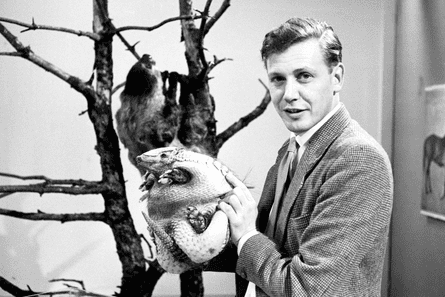
Such is the success of Zoo Quest that Attenborough sets off again the following year, this time to South America. Episode one saw him capture a sloth. In 2018, he told a Bafta audience that it was probably the first time anyone in the audience had ever seen one.
7.
Caught in a trap (1956)
Attenborough’s expedition sent him to Indonesia, where in a thrilling moment of peril he caught a komodo dragon in a wooden trap. As he sadly announced later, he was unable to secure a permit to bring it home.
8.
Desert Island Discs (1957)
Attenborough appears on celebrated BBC radio interview show Desert Island Discs. Although the episode has been lost, his choices have not. They include Maladie D’Amour by Henri Salvador, String Quintet in C major by Franz Schubert and Stars and Stripes Forever by Albert Ketèlbey.
9.
A legend is born! (1957)
Zoo Quest for the Paradise Birds debuts. Attenborough finds himself being charged at by armed tribesmen in Papua New Guinea. His unflappable reaction is to hold out his hand and say: “Good afternoon.” Unbelievably, this evaporates tensions immediately. A legend is born.
10.
His star ascends (1958)
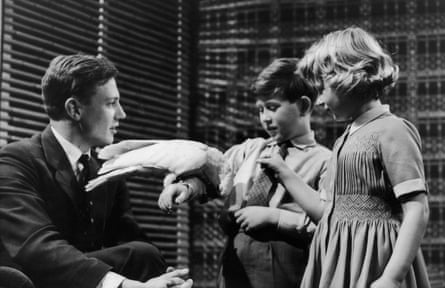
Attenborough had long produced this strand of films about life in (then) far-flung corners of the earth. But at this point his star had ascended so high that he began to narrate them.
11.
David Rottenborough? (1959)
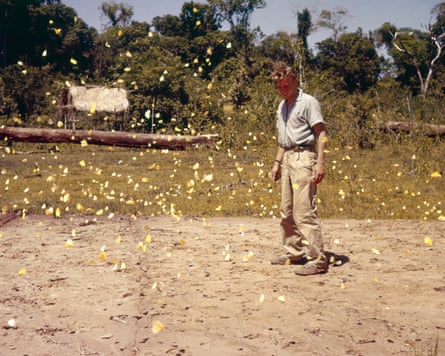
Another Zoo Quest expedition, this time in Paraguay. Among other things, he encounters a giant swarm of butterflies. As they land on him, he forlornly exclaims that they must have confused him for a piece of rotting fruit.
12.
The plane crash cult (1960)
Realising that tribespeople were as fascinating to viewers as animals, Attenborough made The People of Paradise. The most spectacular episode was the second, where he ventures to Vanuatu and discovers a cargo cult – a tribe practising a religion centred on praying for planes to crash and spill their bounty.
13.
Born free! (1961)
Elsa the Lioness, in which Attenborough inspires the film Born Free by visiting Kenya to shine a spotlight on Joy and George Adamson and the orphaned cubs they adopted.
14.
His excitement is palpable (1961)
Another Zoo Quest series, this time to Madagascar. Nine years after producing a film about it, he finally comes face to face with a coelacanth. His excitement is palpable.
15.
Off with his top (1963)
15. Quest Under Capricorn. The final Zoo Quest series (note the dropping of the “Zoo”), this follows the four months Attenborough spent in the Northern Territory of Australia. Produced in colour, the show sees him strip off his top and fling himself at a frilled lizard.
16.
Yoga poses (1963)
Yehudi Menuhin and His Guru, a film in which Attenborough interviews the man credited with bringing yoga to the west. Notable not only for its subject matter, but also its director: a young upstart named Melvyn Bragg.
17.
Reinvent this! (1965)
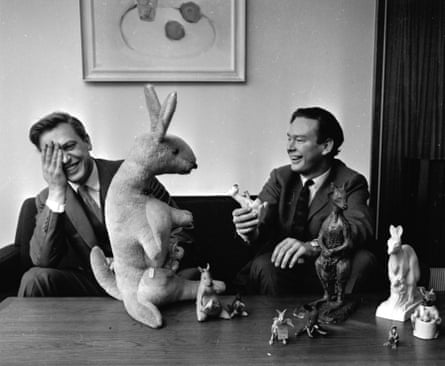
Attenborough is persuaded to become the controller of BBC Two, a channel that has yet to find its identity. He quickly goes about reinventing it.
18.
Man of the people (1965)
Prior to becoming controller, and while studying for an anthropology degree, Attenborough makes a series about the Zambezi. It would be his last major show for some years.
19.
Money, money, money (1966)
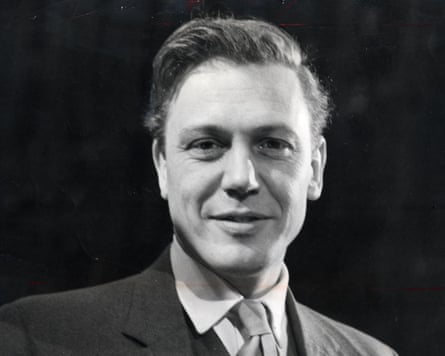
Attenborough commissions The Money Programme, which would run for 44 years. Within three weeks it has broadcast a special entitled Could the World Money System Collapse?
20.
Aceing it (1967)
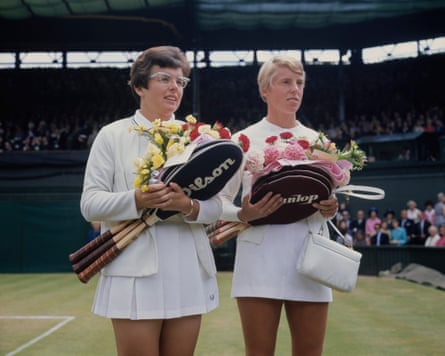
Attenborough introduces colour television to the UK for the first time, starting with BBC Two’s Wimbledon coverage. Two years later, he is promoted to BBC director of programmes, making him responsible for the output of both BBC channels.
21.
A Balian miracle (1969)
Thirteen years after visiting Indonesia for Zoo Quest, Attenborough returns for The Miracle of Bali, a hypnotic, full-colour travelogue about the island’s people and animals. Viewers are entranced by scenes of tribespeople dancing while jabbing themselves with swords.
22.
Flying high (1969)
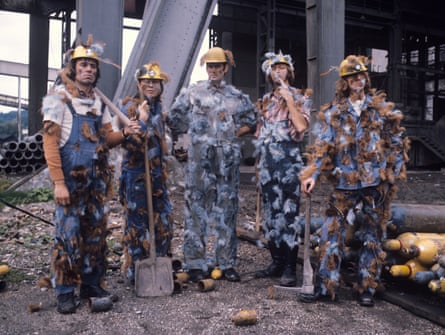
Attenborough commissions Monty Python’s Flying Circus. It is widely considered one of the most influential comedy shows ever made.
23.
Cue the applause! (1969)
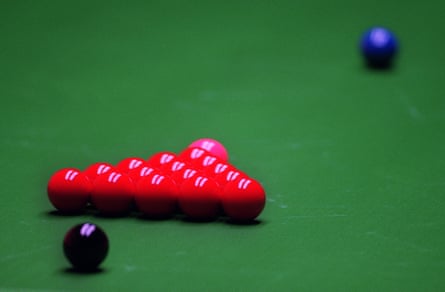
Attenborough commissions the snooker show Pot Black, to demonstrate the appeal of colour television. It is widely thought to be the moment snooker was popularised as a spectator sport in the UK. It ran for 38 years.
24.
TV grows up (1969)
Attenborough commissions Civilisation, art historian Kenneth Clark’s authoritative take on his medium. This is often named as the moment television matured as an art form, trusting its audience to absorb intelligent, big-picture ideas.
25.
Music for musos (1971)
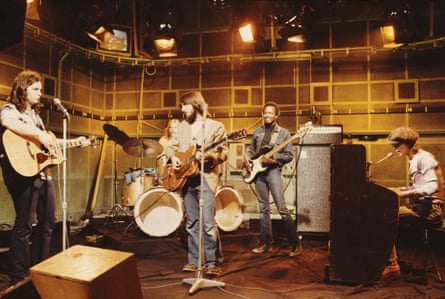
Attenborough commissions The Old Grey Whistle Test, a music programme for serious music fans, rather than the younger-skewing Top of the Pops.
26.
The greatest gifts of all (1971)
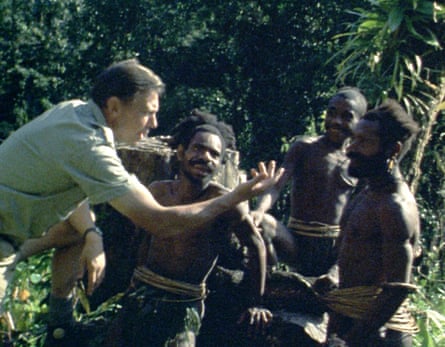
Attenborough takes a sabbatical from his day job to film a passion project entitled A Blank on the Map, in which he makes first contact with the Biami tribe of Papua New Guinea, offering them gifts of newspaper and salt.
27.
Man ascends! (1973)
Attenborough commissions The Ascent of Man, Jacob Bronowski’s authoritative history of human society’s advancements through science.
28.
Viewers are shocked (1973)
Attenborough resigns from BBC management to make the natural history equivalent of Civilisation. In the meantime, he films Eastwards With Attenborough, where he travels to Borneo. Of everything he sees there, viewers are most shocked by a tribe whose skin is pale from lack of sunlight.
29.
Canine characters (1973)
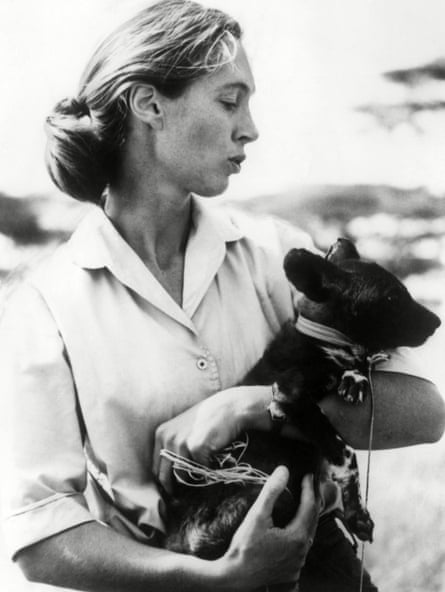
As part of the long-running The World About Us series, Attenborough narrates The Wild Dogs of Africa, a groundbreaking film made by Jane Goodall and her husband Hugo Van Lawick. Unlike previous films – which treated animals as a curiosity – this one treats them as characters, paving the way for modern wildlife documentaries.
30.
Inside the Palace (1974)
Attenborough makes Spectacular Britain, an hour-long film about how the country’s nature changes throughout the year, including segments about puffins, salmon and, for the first time on television, the gardens of Buckingham Palace.
31.
The BBC’s priciest show (1975)
Attenborough introduces and narrates Explorers, a series of docudramas recreating the voyages of famous explorers, including Roald Amundsen and Mary Kingsley and Jedediah Smith. At time of broadcast, it was the most expensive BBC show ever.
32.
A last look at people (1975)
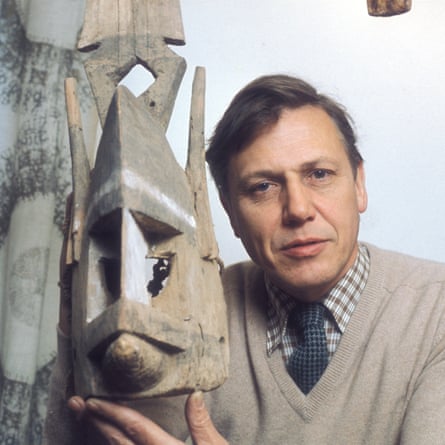
Attenborough writes and narrates The Tribal Eye, about the mask rituals of various tribes. From this point onwards it will be animals, not humans, that capture his attention.
33.
The envy of the world (1977)
The first episode of the Attenborough-narrated Wildlife on One airs. In total, 253 episodes would run over 28 years, foregrounding animals as the key characters, and providing the training ground that made the BBC’s Natural History Unit the envy of the world.
34.
As ambitious as TV will ever get (1979)
Attenborough’s long-gestating plan to make a natural history series on the scale of Civilisation and The Ascent of Man is finally realised. Life on Earth is a milestone television event, shot in 100 locations with the help of more than 500 scientists. The scale of the show is demonstrated in the first episode, which travels through Central America, the Galápagos Islands and ends with Attenborough diving in the Great Barrier Reef. It was, and remains, as ambitious as television gets.
35.
A whale of a time (1979)
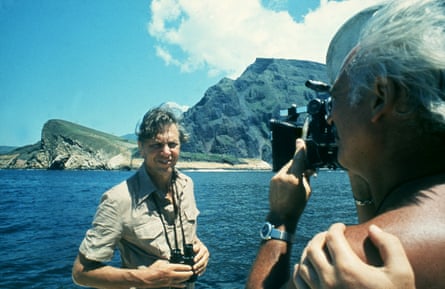
In episode 10, Attenborough goes diving again, this time up close with a pod of humpback whales. The moment a 40-ton mother glides by the camera remains incredible.
36.
Giggles with gorillas (1979)
Episode 12 contains the quintessential Attenborough moment. He encounters a band of gorillas in Rwanda, and the babies quickly start grooming him and, in one famous instance, lying on top of him. In a whispered ad-lib, he says: “There is more meaning and mutual understanding in exchanging a glance with a gorilla than any other animal I know.”
37.
A warning for the future (1979)
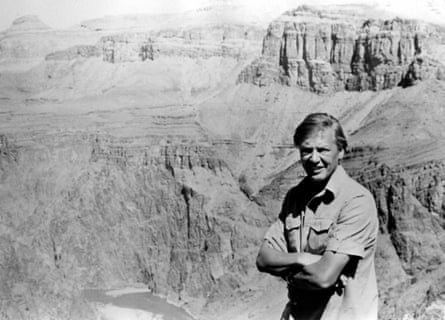
The final episode concerns human beings. In what would become a trademark of his, he uses it as a warning for the future, saying: “If man were to disappear, for whatever reason, there is doubtless somewhere some small unobtrusive creature that would seize the opportunity and, with a spurt of evolution, take man’s place.”
38.
Well blow me down! (1984)
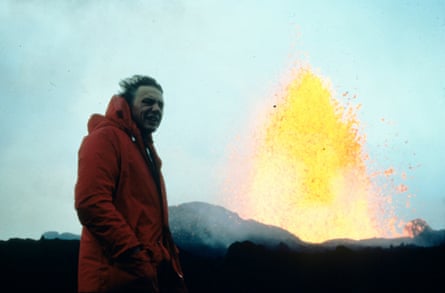
Buoyed by the reception to Life on Earth, Attenborough makes a sequel. The Living Planet is just as ambitious as its predecessor, as evidenced by a sequence (at 17 min 57 sec) in the opener where Attenborough stands before a volcano in Iceland as it erupts. The fact that he remains completely unflappable despite the noise, heat and obvious danger, is astonishing. It may well count as one of the most incredible sequences of his career.
39.
Bear necessities (1984)
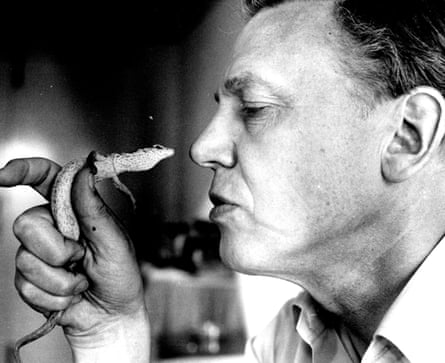
Inserting himself into the action more and more, the highlight of the third episode comes when he sneaks into a cave and shines an enormous light directly into the face of a hibernating black bear.
40.
Heave ho! (1984)
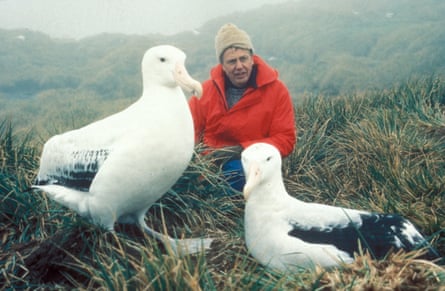
In the fourth episode Attenborough, ever the daredevil, ascends to the canopy of the South American rainforest, heaving himself up 200ft in the air on pulleys to observe “the greatest proliferation of life that you can find anywhere on the surface of the Earth.”
41.
All aboard the Vomit Comet (1984)
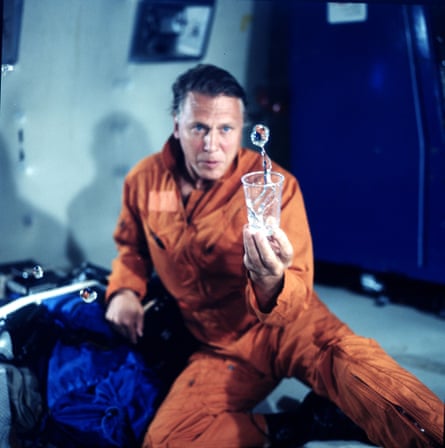
The spirit of adventure continues. In episode seven, Attenborough boards Nasa’s gravity-defying astronaut training plane, dubbed the Vomit Comet. As it embarks upon a series of parabolic arcs, he becomes weightless. The most infectiously joyful Attenborough has ever been on screen.
42.
Bringing us all down to Earth (1984)
However, the final episode brings us all back down to Earth, hard. A look at how humanity has adapted to Earth, it is a nightmare of intensive fishing and battery farming and deforestation. In conclusion, he darkly determines that “Clearly, we could devastate the world.”
43.
One man, 120 million crabs (1990)
The third part of his Life trilogy, The Trials of Life, debuts and demonstrates – through birth, feeding, mating and cohabitation – the sheer difficulty of being alive. In episode one, he pulls off one of the bravest feats of his career: presenting a piece to camera while 120 million red crabs attempt to crawl up his trousers.
44.
Pirate birds (1990)
In episode four, Attenborough spends the first 60 seconds on the Shetland coast being divebombed by skuas as he approaches their nest. In response, he explains that they are ‘pirates’, and ‘killers’.
45.
Fate sealed (1990)
One of the main gifts of Attenborough’s films is their ability to show new and interesting ways killer whales hunt their prey. Episode four marks the genesis of this thread, with a sequence where an orca repeatedly ploughs through a pack of helpless seals.
46.
Lighten up (1990)
In episode 10, Attenborough travels to Malaysia and watches, rapt, as thousands of fireflies take flight and dance around him.
47.
An iceberg collapses (1993)
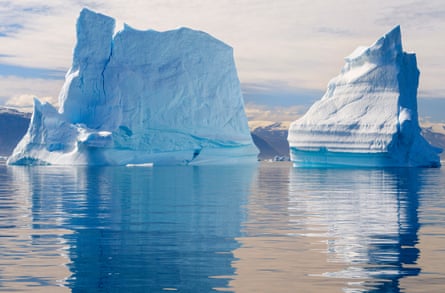
Attenborough presents Life in the Freezer, a look at the wildlife of Antarctica. This is a climate where temperatures of -70C and winds of 100mph are common, and Attenborough spends the first episode in a tiny boat beside a collapsing iceberg. It is important to point out that Attenborough is 67 years old at time of broadcast.
48.
The disturbing life of plants (1995)
Attenborough turns his attention to flora, for the series The Private Life of Plants. Groundbreaking timelapse technology allows viewers to witness the movement of plants with dramatic speed. The segment on brambles, aggressively flailing as they drive their way forwards, is particularly disturbing.
49.
Strangler things (1995)
Then we meet the Strangler Fig, which wraps itself around host trees, choking them to death. The whole thing is presented like a horror movie.
50.
The chainsaw bird (1998)
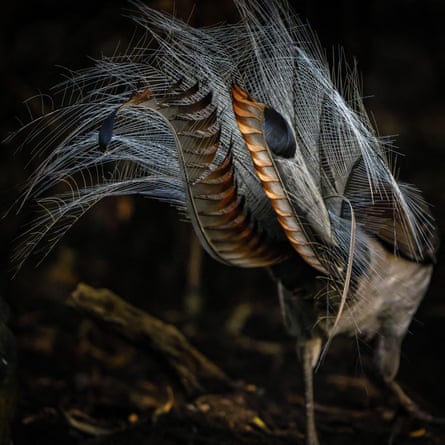
Three years later comes The Life of Birds. Almost 45 years after starting his career at the BBC, he still finds new things to show audiences. Here we meet a lyrebird, which mimics 20 species of birds, a car alarm, a camera shutter and a chainsaw.
51.
Bird calls (1998)
In the same series, Attenborough visits Australia’s Lord Howe Island, and attempts to attract a group of Providence petrels by mimicking their call. It works absurdly well. As soon as he starts, birds start falling to the ground and crawling all over him.
52.
Birds of praise (1998)
As is becoming a pattern, the series ends with a sober look at the impact of humankind on birds. We are shown a long procession of birds that man has, deliberately or otherwise, driven to extinction.
53.
The new dinosaurs? (2000)
Attenborough’s increasing focus on environmentalism is underlined with the three-part series State of the Planet, in which he argues that humans are triggering a mass extinction on the scale of the one that wiped out the dinosaurs.
54.
A break from animals (2000)
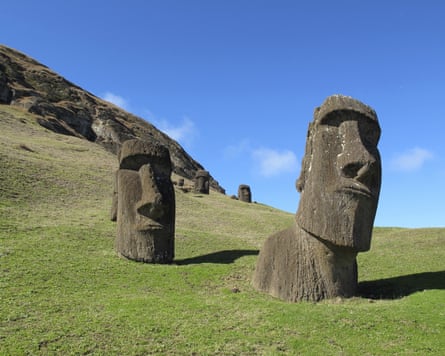
The curate’s egg The Lost Gods of Easter Island, in which Attenborough is sent on a wild global journey – from Russia to Australia to Easter Island itself – to locate the significance of a wooden statue he bought at auction in New York in the 1980s. While a film like this runs the risk of coming off as indulgent, Attenborough’s breathless enthusiasm means we end up as invested as he is.
55.
Aliens of the deep (2001)
Attenborough’s next great leap forwards comes in the form of The Blue Planet, taking viewers to the depths of the world’s oceans. The second episode remains extraordinary, showing us a variety of alien-like creatures for the first time, including pulsating jellyfish that flash with light and shrimp that fire bioluminescent glue out of their bodies.
56.
The most terrifying moment (2001)
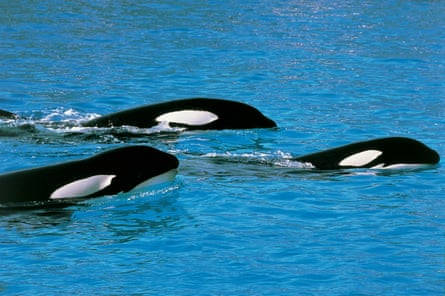
The series also gives us an update on the machinations of killer whales, this time with a brutal, terrifying segment on how they work in packs to take down a much larger grey whale.
57.
Haunted by a whale (2001)
One of the most haunting sections of The Blue Planet follows a whale carcass to the bottom of the sea, where a wealth of hungry creatures feast upon it. When the crew return 18 months later, all that is left is a perfect skeleton.
58.
The darkness lifts (2002)
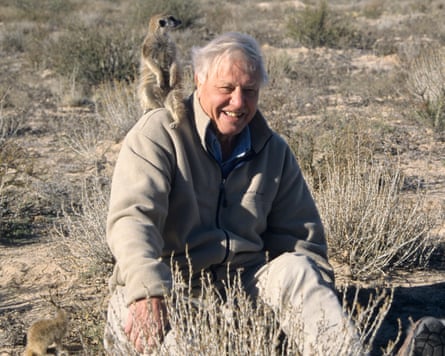
The Life of Mammals, and its use of infrared cameras, allows viewers to see behaviours that had previously been hidden from them, such as lions using the dark of night to take down an oblivious zebra.
59.
David gets giddy! (2002)
The Life of Mammals also allows Attenborough to do something he hasn’t done in decades; remove himself from the wild to present something studio-based. Here, he walks the length of a CGI blue whale to better understand its physiology. Although the crude technology ages the segment more than most of Attenborough’s work, he is clearly giddy about being able to demonstrate scale like this.
60.
Chest-clutching horror (2005)
Technological advances allow insects to be filmed in closeup for the first time, so Attenborough makes Life in the Undergrowth. In the standout sequence (at 11min 5sec), he uses a stick to goad a trapdoor spider out of hiding, and it leaps forwards so quickly that he clutches his chest in fright.
61.
Nightmare spiders (2005)
But greater horrors are to come. Witness the footage of the grub that latches on to an orchard spider, injects it with a hormone to “derange” it, then slowly sucks all the liquid from its body. Genuinely nightmarish.
62.
Lions v elephant (2006)
The most expensive nature documentary ever produced by the BBC: Planet Earth. Filmed over four years, in high definition, the series is packed with awe-inspiring firsts. Chief among these is the sequence where, at night, a pride of lions take down an elephant.
63.
The first snow leopard (2006)
Episode two is famed for its footage of snow leopards on the slopes of the Himalayas; reportedly the first ever video footage of the animal.
64.
Breach! (2006)
Planet Earth also gives us an image so iconic that it forms the basis of the show’s entire ad campaign: crystal-clear footage of a great white shark launching itself at a seal so hard that it fully breaches.
65.
Saving the planet (2006)
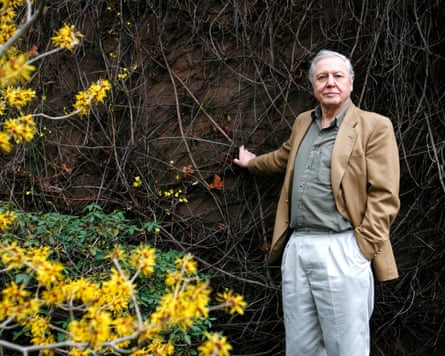
Attenborough makes another urgent appeal about the future of the planet. In the two-part The Truth About Climate Change, he calls for unified global action to halt the climate emergency, stating clearly that unless we act now, we will “doom future generations to catastrophe.”
66.
His vision is complete (2008)
Attenborough is now 81. Life in Cold Blood, his reptile and amphibian series, represents the completion of a vision. He tells reporters that “The evolutionary history is finished. The endeavour is complete.” On screen he is still as engaged as ever, as with the sequence where he drops a turtle egg into a beaker of water to encourage it to hatch.
67.
‘My goodness!’ (2008)
The series also contains a moment where Attenborough uses infrared cameras to watch a snake kill and eat a mouse. “My goodness!” he cries as the attack happens. “That’s a dead mouse all right!”
68.
Sex in a suit of armour (2008)
Attenborough’s perennial boyishness is brought to the fore during a scene shot on the Galápagos Islands, where two giant tortoises attempt to have sex in front of him, on a volcano. “Making love in a suit of armour is not easy,” he laments.
69.
Mesmerising dolphins (2009)
His new series Life attempts to capture a number of behaviours never previously seen. We see dolphins learn how to catch fish by encircling them in a ring of mud, resulting in some mesmerising aerial footage.
70.
Unforgiving dragons (2009)
We also see a komodo dragon take down a water buffalo, proving for the first time that it uses its venomous bite as a hunting tactic.
71.
Speed dating (2009)
Life also includes footage of the humpback whale’s heat run – in which a female whale speeds through the seas while a clutch of males follow, fighting each other for dominance. It’s a TV first, with cameras mounted on boats, helicopters and freedivers.
72.
Whale of a time (2009)
The series treats us to another instalment of killer whales being idiots, this time (unsuccessfully) chasing down a seal as it darts around a lonesome speck of floating ice.
73.
Another stark warning (2010)
A sorrowful episode of Horizon entitled The Death of the Oceans? in which Attenborough claims that, if allowed to remain at current levels, the international commercial fishing industry will collapse by 2050. The warning remains relevant; last year Oceana UK reported that a quarter of all commercial UK fish stocks have become critically low.
74.
Flying monsters (2010)
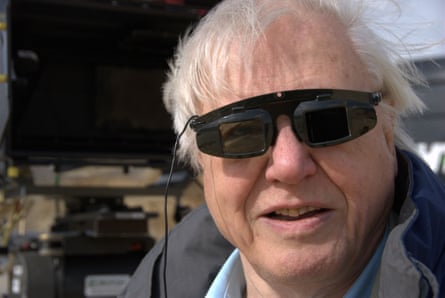
In something of a first, Attenborough leaves the safety of the BBC to make a film for Sky. Flying Monsters 3D is the first 3D documentary to be screened on British television. It is in keeping with his tradition of using the latest technology to tell his stories, and it will not be an isolated incident.
75.
Shame on Discovery (2011)
Attenborough makes Frozen Planet, a series about the Arctic and Antarctic, for the BBC. The standout episode is the seventh, which warns of the threat posed to these regions by the climate crisis. Shamefully, the Discovery Channel initially opts not to broadcast this episode in America.
76.
Skuas! (2012)
Another Sky documentary, The Penguin King 3D, offers a close-up sequence of a skua attacking a penguin colony. “Skuas!” Attenborough yells in a moment of high drama.
77.
Aged 87 and as good as ever (2013)
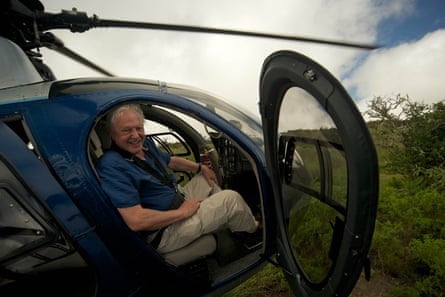
Attenborough makes Galapagos 3D for Sky. He appears onscreen, visiting the islands for the fourth time, at the age of 87. We see him sitting, perfectly content, surrounded by hundreds of marine iguanas.
78.
Octopus v crab (2015)
Attenborough narrates The Hunt, a series about exactly that. A memorable sequence features a pulsating octopus hauling itself across the land in pursuit of a crab.
79.
A heart-stopping iguana (2016)
A sequel to Planet Earth, entitled Planet Earth II, enraptures the nation, not least thanks to a heart-stopping moment where a marine iguana runs for its life while being chased down by dozens of racer snakes that appear from nowhere.
80.
Back with bears (2016)
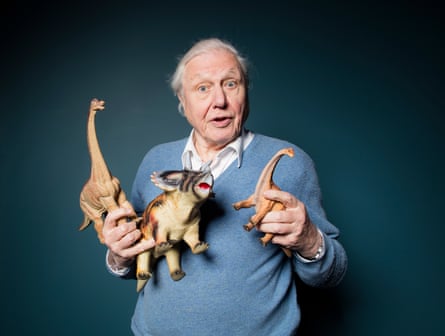
Less terrifying but just as engaging was footage, filmed by remote camera, of a bear scratching its back on a tree. A rare moment of whimsy for someone as rigorously scientific as Attenborough.
81.
David breaks the internet (2017)
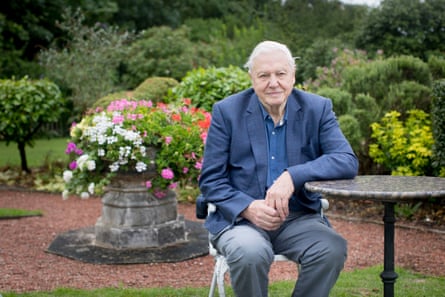
The following year comes Blue Planet II, which, at 14 million viewers, is the most-watched TV programme in the UK in 2017, and is so widely watched in China that it reportedly causes nationwide internet issues. Little wonder, when it presents 4K images as spectacular as that of the Portuguese man o’war.
82.
Shoal goals (2017)
Similarly impressive is footage of orca and humpback whales slicing through unimaginably large herring shoals.
83.
An evasive sperm whale (2017)
Behind the scenes footage has long been part of the BBC Natural History Unit’s output, but sometimes it outshines the wildlife itself. Such is the case with a Planet Earth II featurette about a crew struggling to attach a camera (on a sucker cup) to the side of an especially evasive sperm whale.
84.
The most heartbreaking moment to bear his name (2017)
Episode four contains what may well be the most heartbreaking footage to bear Attenborough’s name. A baby pilot whale dies, after ingesting milk possibly contaminated with plastics, and we watch as its grief-stricken mother carries its body around for days.
85.
Follow the leader (2018)
Dynasties, a series notable for treating wildlife footage as character study. In the first episode we meet David, an alpha chimpanzee in the Senegalese forest who is beaten and left for dead by his tribe.
86.
Penguin controversy (2018)
Dynasties makes headlines for its behind-the-scenes footage. Traditionally, the rule with wildlife photography is to never interfere with nature. However, during an episode about penguins, it is revealed that production stepped in to dig a slope to save penguins trapped inside a deep trench.
87.
Hello Netflix (2019)
Another change of broadcaster. Our Planet is Attenborough’s first Netflix show, made with the World Wildlife Fund. As such, it has a greater focus on humanity’s contribution to the climate crisis than much of his BBC work.
88.
Thriving in Chornobyl (2019)
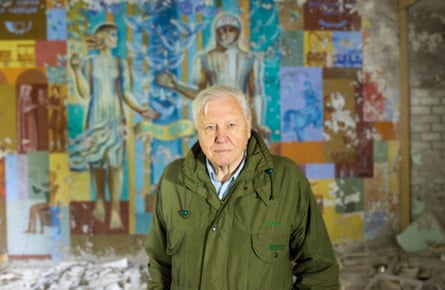
Our Planet shows that the world would cope just fine without us. We are shown what happened to Chornobyl (41 min 11 sec) after humans departed, and the deer, wolves and Przewalski’s horses that have come to thrive in the region.
89.
A stark warning (2019)
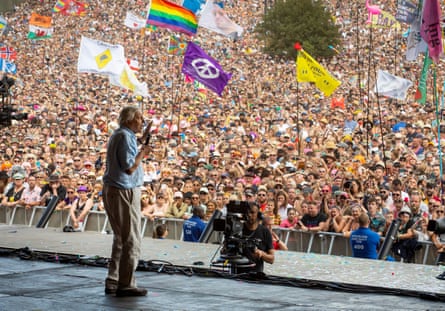
Climate Change: The Facts airs, a one-hour BBC documentary where, more starkly than ever, Attenborough urges humanity to start changing its behaviour. “The scientific evidence is that if we have not taken dramatic action within the next decade, we could face irreversible damage to the natural world and the collapse of our societies,” he says.
90.
96 years young (2022)
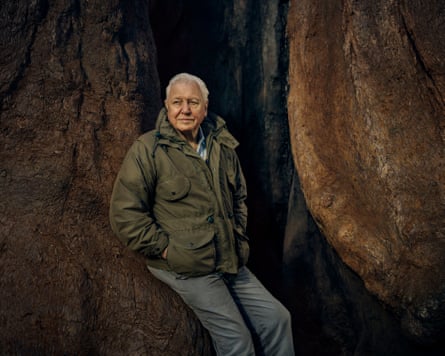
After high definition updates to much of his output, Attenborough makes The Green Planet to bring The Private Life of Plants up to date. Now 96, Attenborough still makes repeated appearances on camera, and is just as compelling as ever.
91.
Jurassic Park got it wrong (2022)
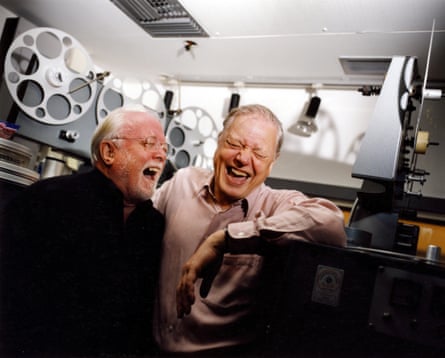
That same year, Attenborough switches broadcaster yet again, narrating Prehistoric Planet for Apple TV. This is notable for showing how far our understanding of dinosaurs has come since the days of Jurassic Park.
92.
Squelchy slug sex (2023)
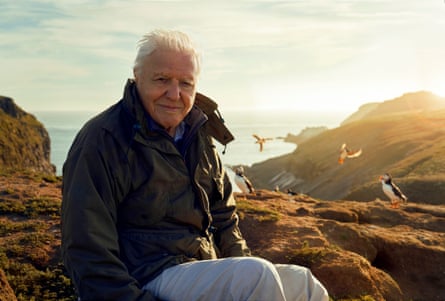
A return to the UK and the BBC for Wild Isles, a show about the bizarre wildlife of the UK, such as the unpleasantly squelchy mating rituals of the garden slug.
93.
More beastly birds (2023)
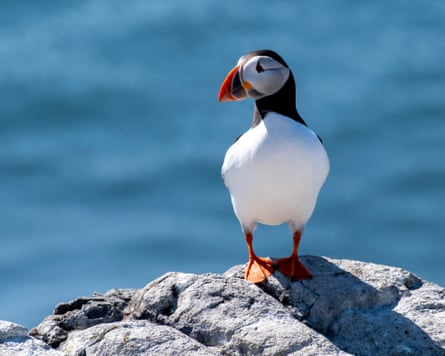
Attenborough returns to one of his most enduring subjects – the absolute viciousness of seabirds. Its sequence of herring gulls grabbing puffins by the neck and mugging them for their food is one of the most brutal of Attenborough’s career.
94.
Shocking showdowns (2023)
After seven years, a sequel to Planet Earth II is released. Planet Earth III pushes the envelope yet again, not least with shocking footage of a life and death showdown between a cobra and a toad.
95.
Shark horror (2023)
The series also includes a dramatic segment on the angel shark, which can burst out of hiding to swallow its prey in a tenth of a second.
96.
Whale on whale action (2025)
Parenthood allows Attenborough, after all these years, to find new ways to show what fiendish hunters killer whales really are. This time, at last, we see a pack of them take down a blue whale.
97.
A restless spirit (2025)
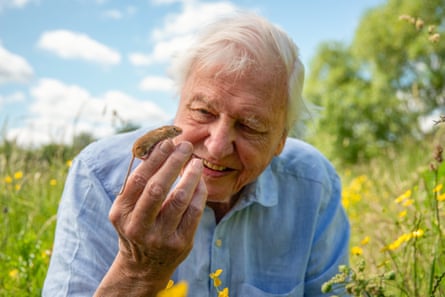
His restless spirit results in him moving on yet again by making a theatrically released movie, Ocean With David Attenborough.
98.
A century of glee (2026)
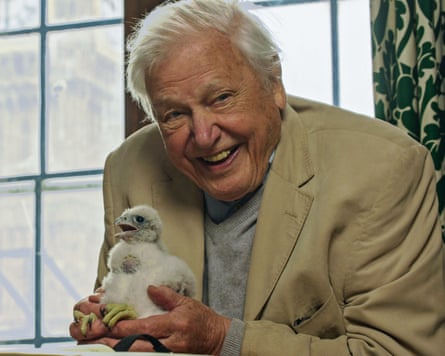
In his 100th year, Attenborough releases a flurry of new projects. The first is Wild London where, among other things, he fondles a peregrine falcon chick with such glee he has to stop himself giggling.
99.
In his own backyard (2026)
Next he makes Secret Garden. Despite being set in the UK, it contains a sequence of a helpless blue tit chick being stalked by a domestic cat. It is incredibly tense.
100.
Gorilla reunion (2026)
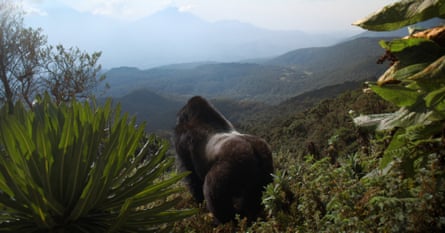
Attenborough also releases A Gorilla Story, in which he revisits the famous gorilla group from Life on Earth. Although the film largely concerns the descendants of the primates he met in Rwanda in 1979, his reminiscences about them are unbearably poignant.