



惯性聚合 高效追踪和阅读你感兴趣的博客、新闻、科技资讯
阅读原文 在惯性聚合中打开

推荐订阅源

L
LangChain Blog
B
Blog RSS Feed
阮一峰的网络日志
阮一峰的网络日志
Cyber Security Advisories - MS-ISAC
H
Help Net Security
MyScale Blog
MyScale Blog
WordPress大学
WordPress大学
Microsoft Azure Blog
GbyAI
GbyAI
小众软件
小众软件
大猫的无限游戏
大猫的无限游戏
Martin Fowler
Martin Fowler
Vercel News
Vercel News
S
SegmentFault 最新的问题
M
MIT News - Artificial intelligence
Microsoft Security Blog
G
Google Developers Blog
Last Week in AI
Last Week in AI
Hugging Face - Blog
Hugging Face - Blog
酷 壳 – CoolShell
酷 壳 – CoolShell
博客园 - 【当耐特】
Google DeepMind News
Engineering at Meta
Engineering at Meta
云风的 BLOG
云风的 BLOG

The Guardian

New Zealand’s North Island braces for Cyclone Vaianu with thousands ordered to evacuate Artemis II splashdown – in pictures Swalwell denies allegations of sexual assault as calls grow for him to withdraw from California governor race Trump news at a glance: Epstein survivors have words for Melania Trump after surprise statement Multiple people face charges, including murder, in California fireworks blast Rory McIlroy surges into six-shot Masters lead with stunning second-round flourish Roberto De Zerbi targets ‘Ange-ball’ revival to save Spurs from relegation Bath hit back to reach semi-final after stunning Northampton in 11-try epic Australia crash out of BJK Cup after Britain secure upset with doubles win Zebras, wealth and power: Hungary’s election tests Orbán’s grip on power ‘TikTok effect’ brings sellout crowds and younger fans to Grand National meeting King signs up David Beckham to his Chelsea flower show team The war over Omagh’s gold: the £21bn mine plan tearing a community apart Britain’s shadow workforce is paid as little as 65p an hour. Who cares for the carers? Tim Dowling: my wife is on a quest to restore my thinning hair SUVs are making Britain’s potholes worse, say scientists Blind date: ‘She claimed she was usually shy. I wouldn’t have guessed’ I’m a sauna person now: the Becky Barnicoat cartoon ‘I got everything I dreamed of – when I had no ability to handle it’: Lena Dunham on toxic fame, broken friendships and her ‘lost decade’ Six great reads: the man who let snakes bite him, masked heavy metal and the brutal reality for foreign students in the UK Meera Sodha’s recipe for noodles with rose beancurd, spring greens and egg Cuba’s doctors were a lifeline for the world. Now the Caribbean is shamefully complicit in the US drive to expel them An environmental disaster in Moldova has Russia’s fingerprints all over it ‘This is as important as your teeth’: are you skipping this key part of mouth hygiene? Man arrested after four die trying to cross Channel in small boat Ukraine war briefing: doubts linger in Kyiv over Moscow’s promise to uphold Orthodox Easter ceasefire Ichiro Suzuki statue unveiling goes awry as bronze bat snaps during ceremony Arrest of national war hero Ben Roberts-Smith cuts deeply to core of Australian psyche European football: Real Madrid held at home by Girona to extend winless run ‘You come back different’: how rugby players change after motherhood
Suspected Ebola cases triple in a week as WHO warns of ra...
Kat Lay Glob · 2026-05-22 · via The Guardian

The Ebola outbreak in the Democratic Republic of the Congo poses a “very high” risk to the country, the World Health Organization said on Friday, revising its threat assessment upwards.

The outbreak is spreading rapidly, WHO leaders said, with almost 750 suspected cases and 177 suspected deaths, up from 246 cases and 65 deaths when it was first reported a week earlier.

The situation is “deeply worrisome”, said Dr Tedros Adhanom Ghebreyesus, the WHO director-general.

On Thursday, tents and medical supplies outside a hospital in Rwampara, Ituri province, were set on fire as medics tried to set up an Ebola treatment centre. A crowd was reportedly angry at not being allowed to retrieve the body of a local man who had died at the hospital. The bodies of Ebola patients must be buried according to strict infection control protocols to prevent further spread.
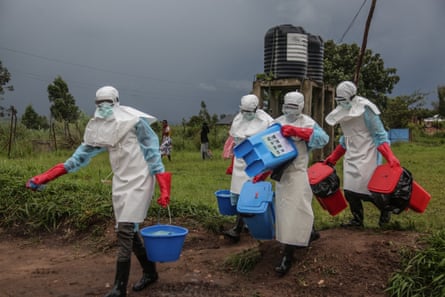
Medical staff wearing personal protective equipment carry blue buckets and crates of disinfectant.
Medical staff carry disinfectant to a hospital in Rwampara on 21 May. An Ebola treatment centre at the hospital was attacked on Thursday. Photograph: Seros Muyisa/AFP/Getty Images

Tedros warned that “significant distrust of outside authorities among the local population” was causing issues for the response to the outbreak.

“Building trust in the affected communities is critical to a successful response, and is one of our highest priorities,” Tedros said.

The WHO’s representative in the DRC, Dr Anne Ancia, said the incident in Rwampara would “significantly jeopardise” the response operation there.

The treatment centre that was attacked was designed to separate Ebola patients from others being treated in the same hospital. Ancia said she was hopeful that it would be able to be up and running again within 24 hours.

The outbreak has been caused by the Bundibugyo strain of Ebola, for which no vaccines or treatments exist. Most cases are in the DRC’s Ituri province, with a handful reported elsewhere in the country, and two in neighbouring Uganda.

Rising case numbers may paradoxically be a “good sign”, indicating better detection, officials said. A slight fall in the number of samples testing positive suggests more people with potential symptoms are being picked up.

However, Ancia said: “We are running behind, we are not yet under control.”

She was confident, however, that the response would be successful.

“I can guarantee you that together, we will manage to get over this outbreak as soon as we can,” she said.

While the WHO raised its risk assessment for the DRC, it maintained its earlier assessment that there was a high risk at the regional level and low risk at the global level.
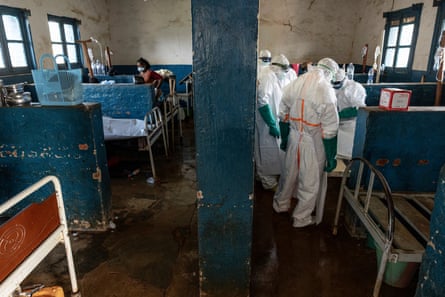
People wearing PPE work in a run-down ward with metal beds.
Health workers disinfect an isolation ward at a hospital in Mongbwalu, DRC. A lack of staff and equipment is making the response more challenging. Photograph: Michel Lunanga/Getty Images

Representatives of humanitarian organisations working in Ituri said they did not yet have enough resources to mount an adequate response.

Dr Amadou Bocoum, country director for Care International in the DRC, said aid cuts last year meant “the system was not able to work properly because of lack of equipment”, while lower staff levels also made the labour-intensive work of informing cases and contact tracing harder.

Julie Drouet, country director for Action Against Hunger, said: “Everyone is working to try to implement as quickly as possible … the response in the field, however it is not quite yet ready. It is not really yet up to the emergency that we have in Congo at the moment.”

A WHO press briefing also heard that scientists had identified an antiviral drug, obeldesivir, which may be able to prevent contacts of Bundibugyo cases developing the disease, and were working to establish trials in the affected areas.