










All across the world, you will probably have read, people are having less sex. In Britain and the US, in France and Australia, frequency of sex has been on the decline (although Denmark appears to be bucking the trend). In 2018, the US magazine the Atlantic declared a “sex recession”, while last December the Telegraph ran a piece headlined “Sex is dying out. This is why it matters”.
As an ancient historian with a particular interest in the history of sex, this drought is fascinating to me – not least because some of the articles I have read seem keen to hark back to the historical period I spend most of my time researching. “Sex should be more wild and plentiful than it has been since ancient Greece,” reported the Telegraph. But antiquity was no bastion of sexual freedom – especially for women.
While in the modern world men are often perceived as the hornier sex, ancient Greeks and Romans believed the opposite to be true. In fact, I might go so far as to say that our ancient counterparts would be rather surprised by modern surveys that have found women are more likely to lose interest in sex and, when they do have it, are much less likely to experience an orgasm – two things that are probably related. Throughout the ancient Mediterranean, women were often seen as “nymphomaniacs”, their voracious sexual appetites a constant problem that needed to be solved – a school of thought that continued to be influential well into the medieval period.
One way in which this manifested was the medical theory of the “wandering womb”. According to the Hippocratic Corpus – a body of medical texts from ancient Greece – the womb is not fixed; rather, it floats freely within the body, posing numerous health risks. (Just to be clear, this is not, in fact, the case.) As an example, should the womb wander upwards and lodge itself beneath the diaphragm, the woman in question may lose her ability to speak, or even suffocate.
Thankfully, there was one surefire way to keep the womb in place: having sex. Because the womb requires moisture, according to these texts, it will begin to wander when dry, seeking out wetness. Therefore, women need to have regular sex to create moisture in their genitals, thus keeping the womb in place. Easy.
Should you doubt the seriousness with which this theory was taken, let me draw your attention to the case of Apuleius. When this second-century Roman found himself accused of using magic to procure a wife, he argued that she had married him to bring about an end to the “illness” she had been beset with since becoming a widow – that of a wandering womb.
Sex in antiquity was therefore a matter of health – and women were compelled to have it for this reason. Unfortunately, the form this sex took was rather prescriptive. According to the Hippocratic Corpus, it should involve penile penetration and, given social mores, a husband. (It makes no mention of non-penetrative or non-heteronormative sex.) In fact, it gives little to no advice on pleasuring your partner at all, the assumption being that women will enjoy themselves by virtue of their rampant desire and “nymphomania”.
By all accounts, therefore, the portrayal of women as the more sexual sex in antiquity – hornier, libidinous, lust-fuelled – was not a good thing. It was, in effect, an illness; an unfortunate side-effect of their wandering organs, one that society must find ways to satiate and, ultimately, control. Women’s sexuality was thus another way in which they were controlled by society.
Somewhere along the line – quite recently, in fact – this image changed. We started to imagine women’s desire as buried deep, in need of its own form of excavation. This was highlighted by the sex historian Kate Lister in her 2026 book, Flick: The Story of Female Pleasure, in which she discussed the “lie back and think of England” euphemism, which exemplifies the modern historical idea that the act of sex is purely for men and women must grin and bear it.
While immersing myself in historical and modern studies of sex for my own book – Aphrodisia: Women, Sex and Pleasure in the Classical World, which delves into the hidden history of women’s sexuality in ancient Greece and Rome – I was struck by the words of Katherine Angel’s 2021 book, Tomorrow Sex Will Be Good Again. Angel noted that male and female sexuality are often framed as biologically driven, something as true in antiquity as it is today. The difference today is that men are more often depicted as “sexually driven … motivated by their deep evolutionary history to spread their seed”.
In this, it feels as if history is offering us two opposing understandings of women’s sexuality – but are the results any different? Aren’t both attitudes manifestations of the same thing: an ironing out of all the individuality and complexity of sexuality and desire?
There are no statistics to tell us how much sex people were having in antiquity – or, perhaps more importantly, how much pleasure they were experiencing. Perhaps there was even an ancient orgasm gap comparable to our own. Consider that accusing a man of going down on his partner was considered an insult in ancient Greece and Rome. Aristophanes wrote in the fifth century BC that it “pollutes the tongue” (in his play The Knights), while Galen, in the second century, compares it to eating faeces (in On Simple Drugs). Since some modern studies suggest most women cannot orgasm from penetration alone, I can only imagine that these ancient attitudes were putting a serious dent in female pleasure.
Yet women were still finding opportunities to explore what felt good to them. Take Sappho, everyone’s favourite ancient Greek poet, who wrote numerous poems dedicated to the women she loved. One such work reminisces on the pleasures she shared with a past lover, from making flower crowns to laying together. An anonymous Roman woman, meanwhile, took her time carving a poem into the walls of Pompeii, writing of shared kisses and embraces with an unnamed woman. Graffitied love declarations are far older than public bathroom stalls, it would seem.
Nor did pleasure have to be shared. We are told by archaeological and literary evidence that the ancient dildo was around, and in circulation, throughout antiquity. These objects are depicted on various red-figure Greek vases – including a sixth-century BC Attic cup attributed to the Nikosthenes Painter, on which a nude woman holds two dildos, one directed at her vulva, the other her mouth.
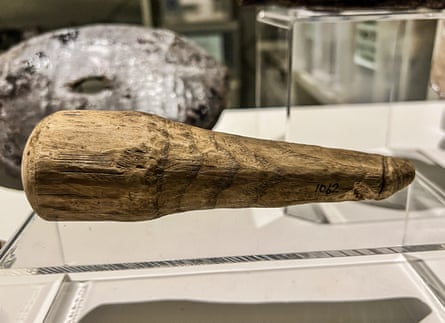
Authors including Aristophanes and, in the third century BC, Herodas, suggest the real thing was popularly made of stuffed leather, although their materials may have been more diverse. My mind immediately goes to the Vindolanda phallus, a six-inch-long wooden penis from Roman Britain uncovered in 1992, which shows repeated handling. Although this object was originally catalogued as a “darning tool”, reconsideration in 2023 led some historians and archaeologists to posit that it may have been a dildo. And while, of course, anyone can enjoy a dildo, they are almost exclusively associated with women in the ancient texts and images.
As the sex educator and researcher Emily Nagoski highlighted in her 2015 book, Come As You Are, pleasurable sex relies on a whole host of contextual elements – including and beyond what’s happening in the bedroom. Today, one important factor that has been identified as contributing to people having less sex is economics, particularly stress, the cost of living and the fact that young people are finding it increasingly difficult to move out of their family homes. Women specifically are more likely to defer sexual encounters due to pain, anxiety and lower climax rates than men.
Based on this, I can’t help but wonder whether the problem may actually not be our libidos. Perhaps it is, in fact, a society that does or does not allow for the free expression and exploration of our sexual desires, whether ancient doctors telling women they need a husband to stop them from suffocating, or modern news outlets suggesting young people just need to get drunk and have a one-night stand like in the good old days. Because if researching women’s pleasure has reminded me of anything, it is that our desires are varied and diverse, our sex lives rich and complex. We are not a monolith and neither is our sexuality. This is as true today as it was in antiquity.
When I sat down to work on Aphrodisia, I didn’t simply want to write another history of sex in antiquity; I wanted to explore the history of women’s pleasure, to honour women as sexual beings rather than treating them as sexual objects. I wanted to prioritise their voices and reconsider the evidence from those who judged and mocked them. In doing so, I discovered outliers and rule-breakers, pioneers and champions of women’s sexuality.
In addition to Sappho and our anonymous graffiti artists, there was Sulpicia, the first-century BC Roman poet whose work expressed her passion for her lover Cerinthus. Then there were Heraeis and Sophia, both Graeco-Egyptian women who felt such lust for other women that they resorted to magic spells to try and get them into bed. All of these women and more sought to fulfil their personal desires despite the fact that extramarital sex and lesbian relationships were deeply frowned upon in their cultures.
In the second century, Cassia, a Roman woman, tried to petition the courts to make adultery illegal for men – not just women. She was unsuccessful, but, almost two millennia on, she reminds us that the women of the past were not unaware of the double standards under which they were living. Some even tried to change them.
All of this is why I am inclined to believe that a similar approach would be beneficial today. Because, whether you’ve been prescribed a dose of penile penetration by your fourth-century BC physician or made to feel as though you’re failing the country with your celibacy, the result is that sex can end up seeming like a chore. But what if sex could be as it is described by the ancient Greek poet Nossis: sweeter than “even honey I spat from my mouth”?
So, rather than simply asking ourselves how often people are having sex, what I want to know is: how often are they having good sex? And how can we make sure they are able to have more?
Aphrodisia: Women, Sex and Pleasure in the Classical World by Dr Jean Menzies (Monoray Group, £20) is out now. To support the Guardian, order your copy at guardianbookshop.com. Delivery charges may apply