












The oil crisis triggered by the Iran war has changed the fossil fuel industry for ever, turning countries away from fossil fuels to secure energy supplies, the world’s leading energy economist said.
Fatih Birol, the executive director of the International Energy Agency (IEA), also said that, despite pressure, the UK should forgo much of its potential North Sea expansion.
Speaking exclusively to the Guardian, Birol said a key effect of the US-Israel war on Iran was that countries would lose trust in fossil fuels and demand for them would reduce.
“Their perception of risk and reliability will change. Governments will review their energy strategies. There will be a significant boost to renewables and nuclear power and a further shift towards a more electrified future,” he said. “And this will cut into the main markets for oil.”
Birol said there was no going back from the crisis: “The vase is broken, the damage is done – it will be very difficult to put the pieces back together. This will have permanent consequences for the global energy markets for years to come.”
While focused on the global picture of shortages and future demand, the IEA chief also urged caution over the UK’s potential plans. The oil industry and its allies have called for increased North Sea drilling, including giving the go-ahead to the Jackdaw and Rosebank fields that have received exploration licences but not production permits.
Birol said: “It is up to the government, but these fields would not change much for the UK’s energy security, nor would they change the price of oil and gas. They would not make any significant difference to this crisis.”
He also cautioned against granting exploration licences for further new fields on commercial grounds.
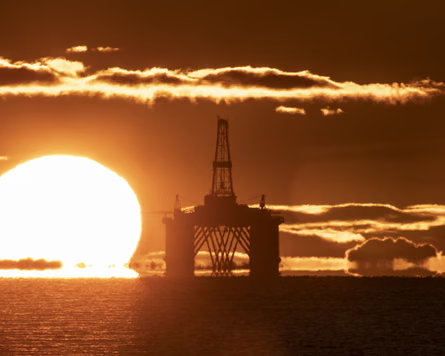
“They won’t provide any significant quantities of oil and gas for many years to come,” Birol said. “They will not lower the bills, the UK will remain a significant importer and price taker on international markets. I am not even talking about the climate change effects – just from a business point of view, making a major investment in exploration might not make business sense.”
Tiebacks, whereby the range of existing oilfields are extended, were a different matter, he added – they should go ahead.
In a wide-ranging interview, Birol said the vastly changed future outlook presented expanded opportunities for renewable energy but also dangers that could throw progress on the climate off track. As the longtime head of the global energy watchdog, he is one of the most influential voices on governments globally.
Birol also said:
Continuing high fossil-fuel prices could tempt developing countries to turn to coal, but solar was competitive with coal on cost and was growing faster.
Renewables offerred a no-regrets alternative and nuclear power was also likely to be increased. Building renewables was an option “I never heard that anybody ever regretted”, he said. “I don’t see any downsides for renewable energy.”
Although he called for windfall taxes during the Ukraine crisis to skim some of the vast unearned profits of energy companies, Birol said it was too early in this crisis for new levies.
Impacts on fertiliser, food, helium, software and other industries would continue even if the strait of Hormuz reopened.
This crisis was “bigger than all the biggest crises combined, and therefore huge”, he said. “I still cannot understand that the world was so blind-sided, that the global economy can be held hostage to a 50km strait.”
Birol’s views on the North Sea were welcomed within the UK government. Labour came to power pledging a ban on future exploration licences, but left open the question of whether fields already in the licensing pipeline – including Jackdaw and Rosebank – should go ahead. Ministers have come under pressure from the oil and gas industry, from opposition parties and sections of the media to permit the fields in the planning process and to rescind the ban on new exploration.
“We are delighted that the world’s leading energy economist has reiterated his endorsement of a fair and managed transition in the North Sea,” said a Labour source.
Experts and campaigners said the views of the IEA chief should be heeded. Ed Matthew, the UK director of the thinktank E3G, said: “Birol is simply reflecting what every sane, independent energy analyst can see. The UK’s fossil fuel reserves have been depleted by 90% and will do nothing to bring down bills.
He added: “The only effective path to energy and economic security is homegrown clean energy. All political parties should now be uniting around that mission. Their failure to do so tells you a lot about whose interests they truly represent.”
Tessa Khan, the executive director of the campaigning organisation Uplift, said: “These facts [that new fields would not lower prices or materially increase energy security] don’t change, they are just being drowned out by the noise from the oil lobby, which has seized on this moment to push for more drilling even as countries rapidly pivot to renewables in response to the conflict.
“Caving into these demands risks tying the UK to a volatile and increasingly outdated fossil fuel system, just as the world moves away from it.”
More than 50 governments, including the UK, the EU, big oil producers and scores of developing countries will meet next week in Colombia for the world’s first ever international conference on the transition away from fossil fuels, where the global response to the oil crisis and the push for renewable energy will be discussed.