








When Disney bought Lucasfilm for roughly $4bn in 2012, it must have felt like an obvious piece of business: who wouldn’t throw wads of cash at a saga boasting an entire galaxy in a box? For a while, it seemed too good to be true. The Force Awakens made more than $2bn worldwide. Rogue One did more than $1bn. The Last Jedi conjured up more than $1.3bn, even while triggering a culture war so radioactive it could power the Death Star. Most of the fandom hated The Rise of Skywalker, but that most execrable of movies still earned Disney more than $1bn.
Then came Disney+, the perfect delivery system. No more waiting years between films: just hang around for a few months and something else would pop up on the conveyor belt. Andor, The Book of Boba Fett, Obi-Wan Kenobi, Ahsoka, The Mandalorian. Plot holes were filled, animated side characters got their magnum opus, and we all learned far more about the middle-management structure of galactic fascism than we had ever imagined possible. So why are we, almost 14 years on from that monumental shift in the Star Wars power structure, reading yet another slew of critical notices declaring that the saga has run its course? The Mandalorian and Grogu, at time of writing, has a rating of 61% on Rotten Tomatoes, pushing it just into the “fresh” category. The positives, broadly speaking, are that it is charming, brisk, visually polished and has Baby Yoda, a character precision-engineered for adorability. On the negative side, critics have complained the film feels thin, formulaic and weirdly televisual, less a grand restoration of Star Wars on the big screen than three Disney+ episodes.
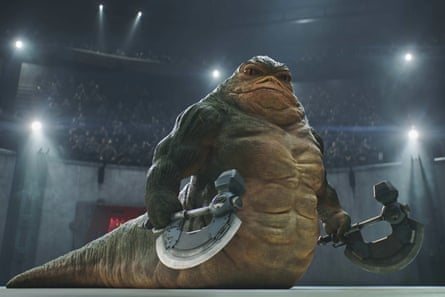
Is Star Wars now the impossible franchise, at least on the big screen? Because actually, Jon Favreau’s film is perfectly fine. Without giving too much away, there are callbacks to villains from decent TV episodes, Mando processes hapless stormtroopers into white-armoured landfill more efficiently than ever, and Grogu shimmies down all-new rabbit holes of cuteness. So what is the problem? It can’t simply be that Disney has not tried. If anything, the company has tried almost everything. It soft-rebooted the original trilogy with The Force Awakens, giving fans the old shapes in shiny new wrapping. It worked commercially, but also set a trap. Fans had asked for the old magic, and Disney gave them it, literally. Then came Rian Johnson’s The Last Jedi, which did what people often say they want franchise films to do: challenge the mythology, complicate the heroes – burn down the museum. It also revealed the true horror of modern blockbuster cinema in the era of social media: audiences all want completely incompatible things, and are perfectly prepared to declare so at light speed while accusing everyone else of personally murdering their childhood. The Rise of Skywalker then tried to solve this by reversing the previous film into a ditch. The result pleased almost nobody.
And so back to Mando: characters Star Wars fans actually like; no major revelations about the Force, or the complicated lineage of our key players. Mando has no genetic connection to Boba Fett, and Grogu is not the son of Yoda and Yaddle. Just an entertaining, old-fashioned matinee adventure set between the fall of the Galactic Empire and the rise of the nefarious First Order. For fans of the TV show, this will probably be fine. But if it’s not what people expect from Star Wars on the big screen, this rather begs the question: did Lucas know what he was doing when he took the cash and walked off? After all, Star Wars has always been hard to get right. The prequels were hugely divisive. The Ewoks were not everyone’s cup of tea. Let’s not even discuss the 1978 Star Wars Holiday Special.
Maybe we all missed one vital point about the original trilogy: it had the unfair advantage of actually ending. Lucas’s fantasy triptych told a simple, mythic story. Farm boy discovers destiny. Princess leads rebellion. Scoundrel finds a cause. Father is redeemed. Empire falls. It worked because it felt complete, yet every attempt to continue it since has reopened the wound. The Empire did not really fall. The Jedi did not really return. Luke did not rebuild the order. Palpatine did not stay dead. The victory at Endor was not the end of tyranny, but a temporary administrative reshuffle. Once you accept all that, the whole thing curdles. If every happy ending must be undone so that something else can emerge, the myth becomes less moving each time. Star Wars begins to feel like a galaxy where no one is ever allowed to retire, heal, learn or complete an emotional arc.
Even The Mandalorian, which began brilliantly as a lean western about a bounty hunter and his tiny frog-gobbling ward, ends up dragged into the franchise tractor beam of helmets, bloodlines, clones, councils, darksabers and legacy cameos. It starts to resemble the inevitable endpoint of the Disney bargain: a galaxy in a box, a myth on a conveyor belt, trying to sell us back exactly what we bought last time – just in slightly shinier packaging.