


Spurs won a European trophy 10 months ago, are the ninth richest club in the world and play in a billion-pound stadium. They are also in relegation scrap with six games to play in the Premier League season. Tottenham are 18th in the league, having picked up just 30 points from 32 games.
Fourteen games without a win. Five points from the last 42 available. No victories in 2026. The numbers alone would normally confirm relegation as a formality. Roberto De Zerbi has become their fourth manager in the last 12 months in a move that feels less like a rescue mission and more like a last roll of the dice.
Spurs have not nosedived into decline this season; they have slowly unraveled. From the boardroom to the dugout to the pitch, the pattern of poor short-term decisions and long-term neglect has produced a team devoid of direction and fight.
It has not taken De Zerbi long to diagnose the problem. “They don’t need to improve football – they can play better and they will play better once we reach a different level of confidence,” he said after a limp 1-0 defeat to Sunderland on Sunday. Put simply: their problem is in their heads. The question is whether the rot is too deep. The evidence suggests that instilling confidence in this group of players will be difficult but not impossible.
Tottenham fans know all about De Zerbi’s fiery, emotionally charged personality. Three years ago he stood up to their interim manager, Cristian Stellini, on the touchline and then doubled down afterwards. “I can’t and I don’t want to lose my DNA,” he said. “My DNA is passion. I’m not better than the other coaches. I am a normal coach and the best part of myself is the passion.”
But this was not the character they saw after Spurs lost to Sunderland in his first game in charge last weekend – their 16th in 32 matches. De Zerbi had spoken before the game about “character”, “spirit” and “courage” but Spurs rarely looked like scoring, never mind winning the match. Their xG was 0.91 across the game and just 0.15 in the second half when they needed to chase a result. And yet, the players were met with sympathy in his post-match interview. “I can be a big brother, father. They don’t need a coach … they are good guys and I am sorry for them,” said an unexpectedly restrained De Zerbi.
Perhaps he is right to be sympathetic towards his players. Tottenham’s collapse is far easier to explain through mismanagement and constant instability than by pointing the finger at the players; they have been operating within a flawed system that predates most of them. Daniel Levy tried and tested almost every size and shape of manager after Mauricio Pochettino departed in 2019, leaving the squad with a lack of identity and no clear direction. José Mourinho took over and was sacked in 2021 less than a week before the League Cup final; Nuno Espírito Santo, an outsider for the job, was appointed in 2021 and departed just four months later; Antonio Conte delivered Champions League football but left after 16 months in explosive fashion, criticising the club’s hierarchy.
In the last 12 months alone, Ange Postecoglou delivered the club’s first trophy since 2008 with “dare to do” high-risk, high-reward football, but was dismissed 16 days later. Thomas Frank then joined in the summer and brought the opposite approach, favouring a pragmatic, structured and conservative style, before being sacked in February with the club 16th in the league table. Igor Tudor attempted to bring back intensity, with a physical, man-to-man press designed to suffocate opponents, but he lasted just eight games. There has been a revolving door of dramatic tactical changes, so it is no wonder the players lack tactical discipline and self-belief.
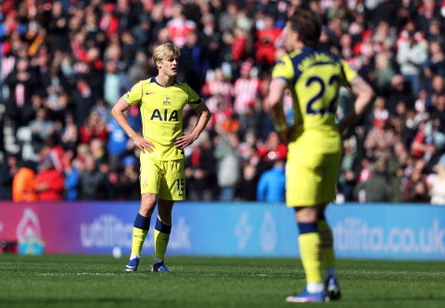
Add the impact that long-term injuries to important creative players such as Dejan Kulusevski (who is still recovering from a patella injury picked up last season), James Maddison (who tore his anterior cruciate ligament in pre-season), and Mohammed Kudus (who picked up a thigh injury in January), and you can see why the team is struggling for goals. Kulusevski and Maddison were so important to the Spurs attack but neither has played a league game for the club’s last three managers.
On top of injury troubles, Tottenham have not come close to replacing the goals and leadership they have lost in recent seasons. Son Heung-min, Harry Kane and Brennan Johnson, their top scorers in the last three campaigns, have all departed. Spurs have scored just 40 goals in the league this season (Kane has scored 50 for Bayern in all competitions) and they have the fourth lowest xG in the Premier League.
Efforts to reinforce the attack have fallen short in embarrassing fashion. Eberechi Eze was on the brink of joining after agreeing personal terms before local rivals Arsenal swooped in at the 11th hour to hijack the deal. Morgan Gibbs-White was expected to join but committed his future to Nottingham Forest. The fact that two of Spurs’ top scorers in the league this season are centre-backs – Cristian Romero and Micky van de Ven, who have four goals apiece – is a telling reflection of a broken attack.
For all the tactical acumen De Zerbi demonstrated at Brighton and Marseille, he does not have enough time to teach his high-risk, high-reward system to a group of players who have spent the last few years flitting between various approaches. Instead, he is focusing on the psychology of the players. “The most important part in football is the mental part,” he said before the Sunderland game. “You are used to speaking too much about the style of play, the tactical disposition, blah, blah, blah. But in the end, the mental part is crucial in every work, especially in football, especially in this moment for Tottenham.”
De Zerbi was never going to tear up the floorboards immediately. He is trying to restore belief and harness the talent in the squad. His style is built on risk, on drawing pressure, playing through it and trusting that structure and repetition will eventually create clarity. He says he wants to draw on the principles drilled into the players under Postecoglou.
“I want to see the Tottenham I watched with Postecoglou,” said De Zerbi in his first press conference. There are similarities in the way De Zerbi and Postecoglou like their teams to keep possession, draw challenges and use that to break down teams by passing through the middle and attacking with speed. He can also build on the aggressive man-to-man press introduced under Tudor, a defensive structure De Zerbi used effectively at Brighton.
With Brighton at home on Saturday and then Wolves away in their next two games, Spurs have the opportunity to pick up some points and inject some belief into this side. They urgently need a spark of confidence.
This is an article by WhoScored