









The lawyer and elections expert Reg Austin, who has died aged 91, played a key role in the transition to democracy in countries such as Cambodia, East Timor and Afghanistan through UN electoral missions in the 1990s. His most longstanding political commitment, however, was to the liberation and security of his home country of Zimbabwe.
The son of white settlers in what was the self-governing British colony of Southern Rhodesia, Reg took the rare step in 1961 of joining the original African political party, Zimbabwe African Peoples Union (Zapu), founded by Joshua Nkomo.
Reg became one of Zapu’s lawyers, giving advice on how to handle the British government as well as the rival liberation party, Zimbabwe African National Union (Zanu), of Robert Mugabe, which was founded two years later. Reg remained a loyal confidant of Nkomo until his death in 1999.
It was while studying at Cape Town University that Reg became fully aware of the racist structures he had grown up in. Mass protests against apartheid were breaking out in South Africa and demands for decolonisation were sweeping through the African continent. When he returned to his home city of Bulawayo after graduating in 1958, he saw Rhodesia with new eyes. Training as a prosecutor, he realised that the programme for “separate development” he had witnessed in South Africa was playing out too in Rhodesian courtrooms. His first case was in a team seeking the convictions of freedom fighters, including Nkomo, a charismatic trade union leader. “Having to prosecute these admirable men opened my mind,” he said.
After joining Zapu, Reg left for Britain in 1961 to do a master’s in law. While living in Camberwell, south London, with his wife, Olive, Reg made regular trips to Lusaka, in present-day Zambia, where Nkomo was based. Zapu’s armed wing, the Zimbabwe People’s Revolutionary Army (Zipra), and Mugabe’s guerrillas were taking control of many rural areas in Zimbabwe. Zapu was preparing for power, and Reg was producing policy papers.
The biggest issue was land, which was overwhelmingly owned by white farmers. Apart from a few large estates, most farms were technically bankrupt at the end of each year. Reg proposed that farmers could only get an annual loan if they took an African person as a partner and provided mentoring in farming skills.
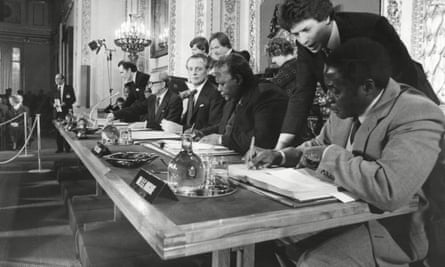
In 1979, Britain persuaded the minority-rule Rhodesian government to meet the liberation movements in London to agree on a peaceful path to independence. Lord (Peter) Carrington, the British foreign secretary, had won plaudits for persuading the prime minister, Margaret Thatcher, to talk to insurgents whom she called terrorists. But Reg, who attended the talks as a member of the combined Zapu-Zanu Patriotic Front delegation, was highly critical of him. In Reg’s view, it was absurd to pretend the UK was a neutral mediator rather than a party engaged on the counter-revolutionary side, and Carrington should have handed the issue to the UN, as was done later in Cambodia and Namibia.
Reg also blamed Carrington for not negotiating how to restore land seized from Africans. Instead, the foreign secretary kicked the problem down the road, insisting the new constitution ban the expropriation of land for 10 years. Reg called this an IED (improvised explosive device) placed under Zimbabwe’s future – indeed, when President Mugabe approved a campaign of violence to evict white farmers at the end of the 90s.
Born in Johannesburg, Reg was the son of Reginald Austin, a miner, and Gwendolyn (nee Wassman), an accountant, who moved to Bulawayo when Reg was three months old. There he attended Milton high school before heading to Cape Town University, where he met Olive Young, an art student, also from Bulawayo. They married in 1961.
In London, Reg spent 17 years at University College London, ending as a law professor. He and Olive raised three daughters in their Camberwell home, which became a haven for Zimbabweans passing through. In 1982, two years after independence, the Austins moved to Harare. Reg was appointed professor and dean to found the law faculty at the University of Zimbabwe.
The first decade of independence was dominated by tension between Zapu and Zanu, partly provoked by South Africa’s efforts to destabilise the so-called frontline states, but grossly worsened by Mugabe’s support for the army’s murder of demobilised guerrillas and hundreds of civilians. It concluded with a one-sided accord for Zapu to merge with Zanu, and Mugabe to become president. Reg had many agonised discussions with Nkomo about whether to accept what looked like surrender. “The amazing thing about Reg,” said Jeremy Brickhill, another white revolutionary and Zipra officer, “was that he could sell these dreadful settlement terms to Zapu and retain their respect. He was so practical … The merger with Zanu had to be done, as unpalatable as it was, in order to stop the massacre.”
In 1992 the UN asked Reg to help organise the first democratic election in Cambodia. The cold war was over and elections were seen as the way to establish peace in authoritarian systems emerging from massive internal conflict. Reg shared in the consensus, though he knew elections were insufficient.
In 1993, he joined the Commonwealth Secretariat in London as director of legal and constitutional affairs. After five years he took up a post at the International Institute for Democracy and Electoral Assistance, a Stockholm thinktank. When that assignment was over in 2003, Reg went to Kabul as the UN’s elections chief. He had the risky job of preparing Afghanistan’s first competitive elections at a time when the Taliban were attacking voter registration teams.
In 2010, the Zimbabwean government of national unity offered Reg a role as head of the country’s first human rights commission. It was typical of his energy and courage that he accepted. But in 2013 he resigned, citing the government’s failure to allocate funding for an office and staff, or to pass legislation to enshrine the commission’s independence. To make these complaints public also required courage.
He is survived by Olive, their daughters, Josephine, Beatrice and Laura, and a granddaughter, Abigail.