
惯性聚合 高效追踪和阅读你感兴趣的博客、新闻、科技资讯
阅读原文 在惯性聚合中打开

推荐订阅源

钛媒体:引领未来商业与生活新知
钛媒体:引领未来商业与生活新知
MongoDB | Blog
MongoDB | Blog
博客园_首页
博客园 - 三生石上(FineUI控件)
博客园 - 聂微东
B
Blog RSS Feed
D
Docker
IT之家
IT之家
大猫的无限游戏
大猫的无限游戏
OSCHINA 社区最新新闻
OSCHINA 社区最新新闻
阮一峰的网络日志
阮一峰的网络日志
罗磊的独立博客
Recent Announcements
freeCodeCamp Programming Tutorials: Python, JavaScript, Git & More
A
About on SuperTechFans
The GitHub Blog
The GitHub Blog
G
Google Developers Blog
V
V2EX
量子位
雷峰网
雷峰网
月光博客
月光博客
云风的 BLOG
云风的 BLOG
奇客Solidot–传递最新科技情报
奇客Solidot–传递最新科技情报
T
Tailwind CSS Blog

The Guardian

New Zealand’s North Island braces for Cyclone Vaianu with thousands ordered to evacuate Artemis II splashdown – in pictures Swalwell denies allegations of sexual assault as calls grow for him to withdraw from California governor race Trump news at a glance: Epstein survivors have words for Melania Trump after surprise statement Multiple people face charges, including murder, in California fireworks blast Rory McIlroy surges into six-shot Masters lead with stunning second-round flourish Roberto De Zerbi targets ‘Ange-ball’ revival to save Spurs from relegation Bath hit back to reach semi-final after stunning Northampton in 11-try epic Australia crash out of BJK Cup after Britain secure upset with doubles win Zebras, wealth and power: Hungary’s election tests Orbán’s grip on power ‘TikTok effect’ brings sellout crowds and younger fans to Grand National meeting King signs up David Beckham to his Chelsea flower show team The war over Omagh’s gold: the £21bn mine plan tearing a community apart Britain’s shadow workforce is paid as little as 65p an hour. Who cares for the carers? Tim Dowling: my wife is on a quest to restore my thinning hair SUVs are making Britain’s potholes worse, say scientists Blind date: ‘She claimed she was usually shy. I wouldn’t have guessed’ I’m a sauna person now: the Becky Barnicoat cartoon ‘I got everything I dreamed of – when I had no ability to handle it’: Lena Dunham on toxic fame, broken friendships and her ‘lost decade’ Six great reads: the man who let snakes bite him, masked heavy metal and the brutal reality for foreign students in the UK Meera Sodha’s recipe for noodles with rose beancurd, spring greens and egg Cuba’s doctors were a lifeline for the world. Now the Caribbean is shamefully complicit in the US drive to expel them An environmental disaster in Moldova has Russia’s fingerprints all over it ‘This is as important as your teeth’: are you skipping this key part of mouth hygiene? Man arrested after four die trying to cross Channel in small boat Ukraine war briefing: doubts linger in Kyiv over Moscow’s promise to uphold Orthodox Easter ceasefire Ichiro Suzuki statue unveiling goes awry as bronze bat snaps during ceremony Arrest of national war hero Ben Roberts-Smith cuts deeply to core of Australian psyche European football: Real Madrid held at home by Girona to extend winless run ‘You come back different’: how rugby players change after motherhood
Magnus the wandering walrus leaves Scotland for Norway
Libby Brooks · 2026-05-13 · via The Guardian

A peripatetic walrus who became a local celebrity as he toured the north-east coast of Scotland has now been spotted in Norway, bringing to an end his Celtic sojourn.

The young male was christened Magnus after he after first hauled his estimated 2.5-metre frame out of the sea on to Stronsay pier in Orkney on 16 April.

Although walruses usually prefer to rest on sea ice, Magnus has since then been found snoozing on piers and pontoons along the Moray coast after swimming 200 miles south to the Scottish mainland.

Police asked the public to report sightings of a wandering walrus, and his appearances drew hundreds of spectators as he swam from Lossiemouth to Macduff, Fraserburgh, Findochty and then Hopeman, entertaining crowds with his vigorous itching and – in a move surely conceived for Instagram – accidentally rolling off a harbour wall.

Walruses are rare visitors to Scottish shores, although sightings have increased in recent years, prompting concerns that the effects of climate change on their Arctic ice habitat may be causing these southbound excursions.

While walruses are known to be highly social animals, by 21 April police took the step of erecting a cordon at Lossiemouth marina to contain his admirers.

Further along the coast in the fishing village of Findochty, Katie Wilson spotted Magnus on April as she was dropping her three-year-old daughter at nursery near the harbour. “The kids could not believe it,” said Wilson at the time. “They were in shock. It’s not every day you see a walrus here.”
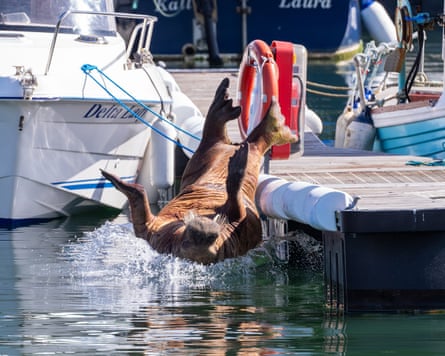
A walrus falling back first into the water
Magnus tumbling off a pontoon in Findochty harbour, on the Moray Firth in Scotland. Photograph: Liam McBride/Animal News Agency

Wilson said that Magnus appearing to be sunbathing on a pontoon after swimming a lap around the harbour. “He seems quite happy. He is just chilling,” she told a local reporter.

On 30 April, the tusked traveller was again spotted swimming alongside a group of pupils from Gordonstoun, King Charles’s alma mater, who were taking a sailing lesson in Hopeman harbour. Magnus was later seen sunbathing on a nearby rock and rolling off a pontoon while napping.

A fortnight later, a local birdwatcher from an archipelago south of Stavanger, in Norway, has raised the alert that Magnus had crossed the North Sea.

Åge Jakobsen told BBC Scotland: “We went out to Buerholmen at Hidra to look for and photograph the walrus Magnus who is staying there. It was a little different to take pictures of one of the birds I usually do – didn’t seem like it would fly away.”

He said that the walrus appeared “really tired” after the 400-mile journey across the North Sea but was having a “great time in the sun on the floating dock”.

The team from British Divers Marine Life Rescue had been monitoring Magnus as he made his way around Scotland, noting that adolescent walruses do experience wanderlust.

The Orkney Marine Mammal Research Initiative said it this was “a genuinely rare event” and only the third time a walrus has been sighted in Orkney in the last decade.

“Walruses are Arctic animals, native to the sea ice and subarctic waters of the northern hemisphere. The individuals that turn up on our shores are typically young roving animals – adolescents striking out beyond their usual range, possibly following food, possibly just exploring, likely due to climate change to some extent.”