






It occurred to me the second I idly tapped “submit” on the waiver required to enter Mind of a Serial Killer: the Experience – perhaps I should have read this one more closely. Just what were they going to do to me in there?
I was entering an exhibit about the (mostly) men who committed some of history’s most gruesome murders: Ted Bundy, Jeffrey Dahmer, Ed Gein, John Wayne Gacy and others. The extravaganza just hit New York after opening in Dublin earlier this year. Though it looks like a low-budget haunted house, the exhibit purports to examine the motives of murder via crime scene recreations, wall texts and psychological profiles.
It is fitting that it has landed in the States, as psycho killers are a distinctly American obsession, haunting our dark interstates and deserted alleys, our tucked-away suburban basements and cabins in the woods. Serial killers exist elsewhere, but they loom especially large in this country’s collective consciousness, the subject of both fear and fascination.
I left the venue alive, appendages still intact; the waiver I signed without reading only cautioned of “disturbing” material that might lead to “emotional distress”. That’s not fake advertising. There were times on my self-guided tour I audibly gasped in horror and felt I might vomit in disgust.
Not because of what the killers did. I already knew about their sickening proclivities and modus operandi. I suspect you do too, even if you would rather not. These crimes are forever fuel for documentaries, films, books and the Ryan Murphy cinematic universe. I’ve seen too many Netflix documentaries to be shocked when I hear that someone’s been dismembered in a bathtub. I just don’t understand why anyone would want to pay $28 to go see a replica of a bloodied bathroom.
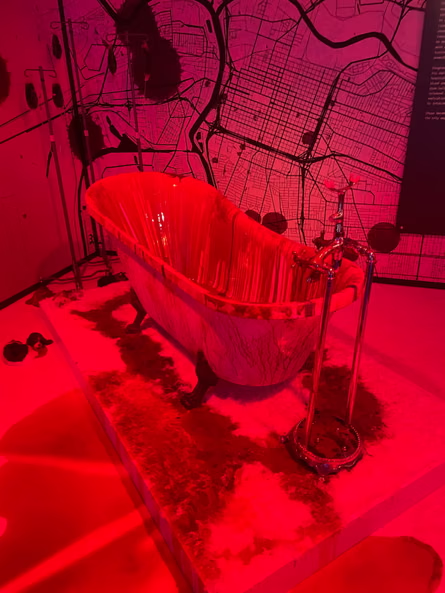
It wasn’t the exhibit’s gory recreations that grossed me out but rather that the “experience” exists at all. I direct my repulsion to the company that slapped it together. That would be Exhibition Hub, which has launched “immersive” events such as Bubble Planet (jumping around a huge ball pit) and Titanic (dying in a freezing dark abyss) and Fever, an online event platform.
To be clear: customer service is not the issue here. Staff were genuinely cheery. As I stared at a quote wall of murderers’ confessions, focusing on one from the Green River Killer (“I killed so many women I can’t even remember most of their names”), a friendly worker greeted a nearby group of girlfriends with a lilting: “Hello, ladies.” (Gary Ridgway, like so many of the men on display, preyed on vulnerable, disenfranchised women: sex workers he assumed nobody would miss).
At least three staffers reminded me that my VIP ticket (comped by Fever) meant that I could pick up a free poster from the gift shop. I declined, but the cashier encouraged me to at least keep the lanyard designating my status. “It’s a nice souvenir,” he said. I suddenly pictured myself, bleeding out in a ditch along a desolate highway, wondering in my last moments on Earth if someday my murder would be grisly enough to earn a footnote in someone else’s immersive serial killer museum.
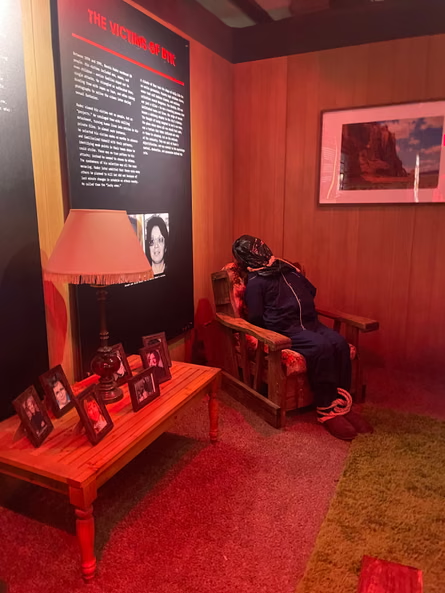
My tragic death probably would not compare to the cannibalistic crimes of Jeffrey Dahmer: in the experience’s Dahmer kitchen replica, guests lined up to take pictures of the inside of the refrigerator, complete with a fake frozen head. Or the case of BTK killer Dennis Rader: in his section hung a child-size doll, bound and gagged, inside a recreated 1970s living room. Or the display of stuffed puppies lying on a bloodstained bathroom floor, illustrating Richard Chase, the so-called Vampire of Sacramento, and his escalation toward human murder.
Mind of a Serial Killer should not exist. It is sensationalistic, exploitative and lacks educational value. But for all its repugnance, the exhibit represents the ugliest parts of crime under capitalism. Even the most unspeakable acts can contribute to a booming true crime industry of films, TV series and podcasts broadcasting an endless stream of child abductions, home invasions and family annihilations. One annual event, CrimeCon, brings together armchair detectives, law enforcement officials and victims’ family members for a weekend billed as an “immersive” extravaganza. Tickets start at $399.
Much of it is advertised to women, who are more likely to be victims of violent attacks than men. Maybe women like true crime because it often features a justice arc; this is a genre that valorizes good guy cops dedicated to providing closure to victims’ families. (In reality, about half of murders in the US go unsolved.)
But in the years since #MeToo and in light of increasing cultural queasiness about turning the worst day of someone’s life into someone else’s entertainment, true crime creators have attempted to reframe the genre. It’s now about honoring the victims, being a voice for the voiceless, maybe righting the wrongs of false convictions. The blockbuster investigative journalism podcast Serial led to a re-examination of Adnan Syed’s case and his ultimate release. Netflix’s The Perfect Neighbor, a documentary made of doorbell and police body-cam footage, highlighted the tragic effects of Florida’s stand-your-ground laws. Another recent Netflix release, The Truth and Tragedy of Moriah Wilson, tackled the tabloid-fodder murder of a professional cyclist, taking care to interview her family and show her as more than just a victim.
Mind of a Serial Killer: the Experience pays the skinniest of lip service to honoring its victims. Forgive me for finding those efforts disingenuous after spending an hour and a half seeing replicas of their dead bodies displayed on train tracks or stuffed under floorboards.
Violence rarely comes out of nowhere; most of the serial killers showcased here suffered from serious mental illness or heinously formative abuse. Mind of a Serial Killer does tenuously address how the devastating effects of past trauma or brain chemistry may have pushed these murderers to extremes. LaKendra Tookes, a pop culture podcaster and “celebrity host” (read: paid spokesperson) of the exhibit told me that she hopes the effort “raises awareness” for mental health issues and “to do everything we can to take care of ourselves” lest we too develop an unquenchable thirst for blood. But she acknowledges: “If my family or someone I loved was a victim, I would not want to see this exhibition.”
At the end of the experience, visitors step into a room with mirrored walls and giant candles. I assume that we are forced to look at our reflection to remind ourselves that the victims were people, just like us. It’s too bad that the room resembles the set of a 90s slow jam music video.
Just before exiting the building, I noticed a small screen mounted on the wall. It rolled through names and ages of serial killer victims – a number that, given the combined death toll of the murderers represented in this “experience”, must have reached into the hundreds. The list sped by like script copy on a runaway teleprompter. I could not catch even one name.