







In the open seas, an armada of empty tankers has quietly turned west. A record number of super-sized vessels are now heading to the US, where oil drillers and refineries are preparing to profit from Donald Trump’s war in the Middle East.
Almost 30 of these vessels, each able to hold 2m barrels of oil, are contracted to load US crude, destined for a global market facing the biggest supply crisis in history.
It is just over five years since the shale revolution made the US a net energy exporter and the world’s biggest producer of oil and gas. Now the White House is poised to strengthen its claim to an even greater share of the global oil market as the Middle East’s decades-long dominance is dismantled by war.
The carriers preparing to amass in US waters are almost six times the monthly number that typically loaded US crude before the war throttled flows of Middle East fossil fuels to the market.
Supplies of US crude leaving the country’s export terminals have climbed by a third to a record 5.2m barrels a day after Iran retaliated against US-Israeli attacks by blocking daily flows of 10m barrels of Gulf oil exports via the strait of Hormuz.
US weekly exports of jet fuel have doubled to an all time high as Europe scrambles to secure supplies and airlines begin to cut flights.
The war threatens to reshape the global energy order, exposing the world’s reliance on Middle East supplies and accelerating a move towards greener energy, giving rise to new energy superpowers.
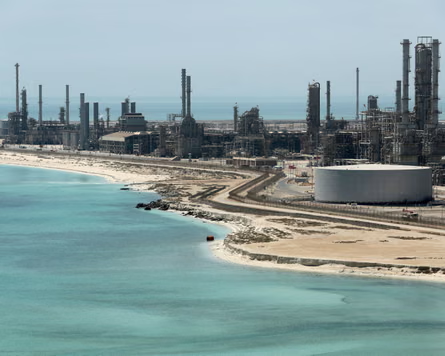
Rise of the Americas
The world’s turn to the west marks a potential reordering of global energy supplies, and the greatest threat to the future energy dominance of the Middle East.
For decades, Saudi Arabia’s vast oil reserves made the kingdom the world’s biggest crude supplier and the de facto leader of the Organization of Petroleum Exporting Countries (Opec) cartel and its allies. In a matter of weeks, the Iran war has erased a third of Saudi crude production.
Restarting the region’s shuttered oil and gas fields and drone-damaged infrastructure is expected to cost between $34bn (£25bn) to $58bn, according to analysts at the consultancy Rystad Energy. The process of restoring production to its previous levels could take years, if it is achieved at all.
“What we’re observing in the Middle East is not just a disruption to oil and gas supply,” said to Duncan Wood, the head of the Pacific Council of International Policy, a non-profit organisation. “Any right-minded government is asking how to reduce exposure, increase autonomy and diversify energy sources.”
As doubts over the future market dominance of the Gulf’s petrostates deepen, the surge in market prices has begun fuelling the rise of the Americas. The growth in US and Canadian crude production – which has accelerated in recent years – is expected to continue through the 2020s. However, almost half of the world’s oil supply growth over the rest of the decade is expected to come from Latin America’s oil boom.
“The Middle East conflict has done more than spike oil prices,” said Radhika Bansal, a senior researcher at Rystad Energy. “South America is now positioned as the world’s most consequential source of incremental supply … at exactly the moment that the world is shopping for alternatives.”
Even before the crisis Rystad analysts pointed to oil production from offshore Brazil, Guyana and Suriname, as well as the Vac Muerta shale formation in Argentina’s Neuquén basin, as the key areas fuelling the world’s fossil fuel growth. Together, these countries were expected to add almost 2.5m barrels a day by the end of the decade, out of a forecast global increase of 5.6m. But if oil prices remain above $100 a barrel this could unlock a further 2.1m barrels a day of additional crude across South America by the mid-2030s, Rystad said.
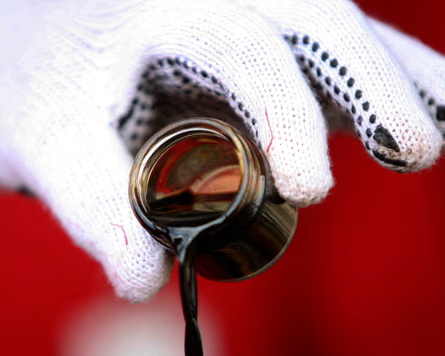
The forecast suggested Venezuela was on track to increase its production by 1m barrels a day by 2035, but this could be “significantly higher” if large western oil companies including ExxonMobil, Chevron and Shell heed Trump’s call to exploit the country’s vast oil reserves. The US investment bank Goldman Sachs has predicted the increase could be as high as 2m barrels a day.
US refineries are already benefiting financially from the Latin American growth. The sharp rise in lucrative US jet fuel shipments to Europe has been fuelled by oil imported from Venezuela, which holds the world’s largest crude reserves.
After decades of neglect, Venezuela’s oil exports have already begun to climb from 860,000 barrels a day under Nicolás Maduro’s presidency to just over 1.1m barrels in less than four months since the US military action to overthrow his government in January.
The electrostate revolution
The rise of the Americas could still be scuppered by a sooner-than-expected reopening of the strait of Hormuz. A full recovery of Gulf oil production could return within a year if the conflict is resolved in the coming months, according to Dylan White, a director at the oil consultancy Wood Mackenzie.
Any short-lived increase in oil production from the Americas paled “in comparison to the volume losses caused by shuttered strait of Hormuz transit”, he added. Yet there is no guarantee that Middle East producers will return to a market and find the same levels of demand.
The focus on rerouting fossil fuel flows overlooks another key reordering of the global energy system: the rise of the electrostate. Wood Mackenzie believes the “out-and-out winner” of the Iran crisis looks likely to be China.
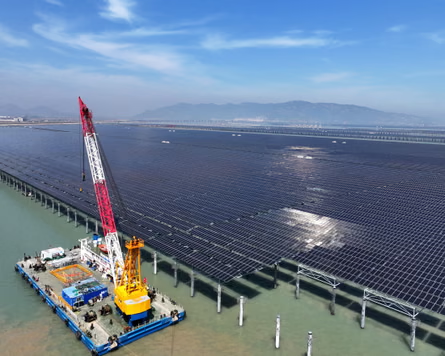
China has long dominated the supply chains for the key building blocks of clean energy technologies, from wind turbines to solar panels and batteries. Beijing’s industrial prowess has helped the world’s biggest energy importer to capture between 60% and 85% of the world’s renewables market at a time when countries are preparing to accelerate the shift away from fossil fuels.
As the world’s first “electrostate”, China stands in contrast with the White House pursuit of fossil fuel dominance. The country also stands to play a significant role in creating the new energy order.
“China derives strategic leverage from its leadership across renewables and electrification, manufacturing and innovation, domestic deployment and global exports,” said Ember, a climate and energy thinktank. “China is not merely manufacturing electrotech hardware, it is manufacturing an energy future in which it holds a commanding position.”
The crisis has meant the world’s greatest supplier of clean technologies is selling these components at record rates as countries prepare to cut their use of fossil fuels for good.
“Fossil shocks are boosting the solar surge,” said Euan Graham, a senior analyst at Ember. “Solar has already become the engine of the global economy, and now the current fossil fuel price shocks are taking it up a gear.”
China’s exports of solar technology capacity doubled to a record high in the first month of the Iran crisis alone. The 68GW of exports was more than Spain’s entire solar power capacity.
As the world’s biggest renewable energy investor prepares to lead a green energy uprising against the fossil fuel crisis, its own energy costs will be more protected from the impact of the global energy crisis than most.
Beijing quietly used years of falling oil prices to amass record reserves of crude – which stand at an estimated 1.4bn barrels, enough to cover seven months of imports via the strait – while accelerating plans to curb its reliance on imported fossil fuels.
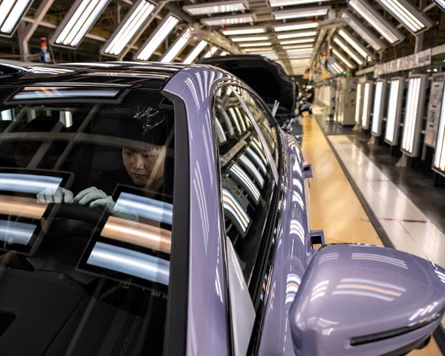
In 2020, it set a target for electric vehicles to make up 20% of all new car sales in 2025. That target was far surpassed: EVs accounted for half of all new vehicle sales last year. The amount of fuel saved from exceeding its own targets is roughly equal to what China imported from Saudi Arabia pre-crisis, according to the Centre for Research on Energy and Clean Air, a thinktank. These vehicles will be powered by an electricity system reliant mostly on coal and its rapidly growing green energy industry.
A new era
Between the rise of the American petrostates to the west and China’s electrostate future to the east stand the developed countries of Europe and fast-growing economies in Asia and Africa. The energy crisis means countries are scrambling to secure their energy supplies in the coming weeks and months, but many will be thinking decades ahead too.
China’s solar surge meant about 50 countries recorded new solar import highs, of which most were in Africa and Asia. Exports to Africa rose by 176%, compared with February, while exports to Asia doubled. Countries in the EU, including Italy and Poland, had record solar imports too.
The economic rationale of cheap, secure renewable energy is simple to justify in an oil and gas crisis. For countries with legacy fossil fuel infrastructure in place, the lure of fresh fossil fuel supplies from the Americas could still slow a green revolution if a reopening of the strait of Hormuz allows Middle East volumes to return.
“The next decade will prove decisive,” said Ember. “New winners and losers will emerge. Companies and nations that wish to thrive in this era must rethink their strategies as fundamentally as the energy system itself is changing.”