








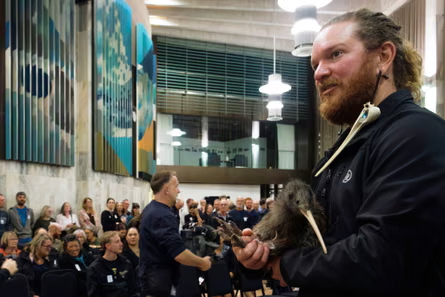
When five kiwi were presented to a crowd of 300 people gathered inside the banquet hall of New Zealand’s parliament, there was an awe-struck intake of breath.
As handlers moved through the group, cradling the whiskery birds, people looked on, spellbound. Some grew teary, and one boy, who noticed a soft brown feather drift to the floor, scooped it up, as his mother urged him to keep it safe.
New Zealand may be saturated with images of its treasured national bird but it is rare to see one in the flesh and this was the first time kiwi had ever set foot in parliament.
The event on Tuesday night, which included politicians, children, iwi (tribes) and environmental groups, marked the culmination of a project – six years in the making – to redevelop a kiwi population in Wellington’s wilds, after a more than 100-year absence.
“This is our manu [birds] coming home to the place they have inhabited for millions of years but which they had a brief exile from,” says Paul Ward, the founder of Capital Kiwi Project, a community initiative that in 2022 set out to reintroduce kiwi to the city.
The fluffy and flightless kiwi is one of the most vulnerable birds in New Zealand. Roughly 12m kiwi once roamed the country, but introduced predators and habitat loss has driven those numbers to worrying lows – 70,000 at the last estimate.
“Kiwi have been a part of who we are and our sense of identity as long as people have been here,” says Ward. “If we are honest with ourselves, we haven’t honoured the koha [gift] of that relationship.”
Conservation efforts are starting, slowly, to boost kiwi numbers. In Wellington, the Capital Kiwi Project is leading the charge.
‘We can restore biodiversity’
The first cohort of 11 kiwi were released into a vast sweep of hilly farmland in Mākara, 25 minutes west of Wellington’s centre in November 2022. Another 232 have followed in the years since and have produced dozens of chicks. The project was required to achieve a 30% chick survival rate, to meet the terms of its Department of Conservation permit. It has greatly outstripped this goal, with an unprecedented 90% chick survival rate.
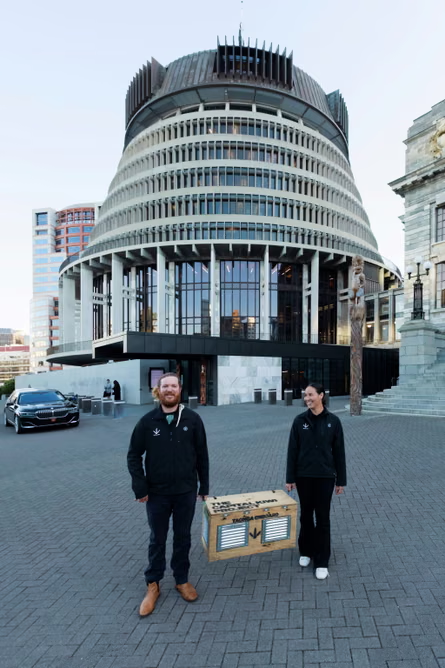
The seven kiwi brought to parliament – five of which were shown to the crowd – are the last cohort to be introduced, bringing the total number of birds released into Wellington’s wilds to 250.
Wellington now has the largest population of people living alongside wild kiwi in the world. Mākara residents hear kiwi in their gardens at night, mountain bikers have encountered them on their tracks and kiwi have been spotted in suburbs far from where they were released.
The project has been hugely significant for the capital, Wellington mayor Andrew Little tells the Guardian. “It’s demonstrating that even for a concentrated urban environment like Wellington city, we can restore biodiversity.”
The project has proved so successful because of the community’s enthusiastic buy-in, Ward says.
“Arguably there have been more Wellingtonians involved in this [project] than were extras in Lord of the Rings,” he tells the crowd, which generates a hearty laugh.
More than 100 landowners gave permission for the project to install 4,600 stoat traps across the bird’s new 24,000ha habitat – making it the largest intensive stoat trapping network of its kind in the country – while schools, iwi, volunteers, mountain-bikers, and more have contributed to the project through trapping, advocacy and fundraising. Iwi and sanctuaries across the island, meanwhile, have have gifted birds to the project.
“It’s a network of traps, but it is a network of relationships … and what that has enabled, is the restoration of a taonga [treasured] species to that landscape,” Ward says.
Following the event, the kiwi were transported up to Terawhiti station – one of the country’s oldest and largest sheep stations on the Mākara coast – to be released.
On the expansive ridges overlooking the Cook Strait, under a soft mist and the whirr of wind turbines, the kiwi poked their long needle-like beaks out of their boxes, and with some gentle encouragement skipped out into the inky night.
Just as a hush had descended on the banquet hall, now too did the smaller crowd fall quiet, taking in for a moment the pleasure of watching kiwi embark on a new life in the wild, and reflecting on the magnitude of the project.
“That work to return kiwi is a shared purpose that is extremely powerful,” Ward says. “What’s incredibly satisfying about tonight is that it’s working, it’s showing what’s possible when people work together.”