
惯性聚合 高效追踪和阅读你感兴趣的博客、新闻、科技资讯
阅读原文 在惯性聚合中打开

推荐订阅源

H
Heimdal Security Blog
P
Privacy International News Feed
S
Schneier on Security
P
Proofpoint News Feed
L
Lohrmann on Cybersecurity
Spread Privacy
Spread Privacy
P
Privacy & Cybersecurity Law Blog
D
Darknet – Hacking Tools, Hacker News & Cyber Security
Scott Helme
Scott Helme
K
Kaspersky official blog
大猫的无限游戏
大猫的无限游戏
freeCodeCamp Programming Tutorials: Python, JavaScript, Git & More
aimingoo的专栏
aimingoo的专栏
Simon Willison's Weblog
S
Securelist
Help Net Security
Help Net Security
B
Blog
H
Hackread – Cybersecurity News, Data Breaches, AI and More
Security Archives - TechRepublic
云风的 BLOG
云风的 BLOG
The GitHub Blog
The GitHub Blog
N
News and Events Feed by Topic
Hacker News: Ask HN
Hacker News: Ask HN
cs.CV updates on arXiv.org
CTFtime.org: upcoming CTF events
M
MIT News - Artificial intelligence
雷峰网
雷峰网
博客园 - 司徒正美
V
V2EX
AWS News Blog
AWS News Blog
Know Your Adversary
Know Your Adversary
N
News | PayPal Newsroom
T
Tor Project blog
Cisco Talos Blog
Cisco Talos Blog
OSCHINA 社区最新新闻
OSCHINA 社区最新新闻
PCI Perspectives
PCI Perspectives
Google DeepMind News
Threat Intelligence Blog | Flashpoint
U
Unit 42
C
Cybersecurity and Infrastructure Security Agency CISA
P
Palo Alto Networks Blog
G
Google Developers Blog
T
Threat Research - Cisco Blogs
博客园 - Franky
I
InfoQ
D
DataBreaches.Net
爱范儿
爱范儿
Y
Y Combinator Blog
博客园 - 叶小钗
奇客Solidot–传递最新科技情报
奇客Solidot–传递最新科技情报

The Guardian

New Zealand’s North Island braces for Cyclone Vaianu with thousands ordered to evacuate Artemis II splashdown – in pictures Swalwell denies allegations of sexual assault as calls grow for him to withdraw from California governor race Trump news at a glance: Epstein survivors have words for Melania Trump after surprise statement Multiple people face charges, including murder, in California fireworks blast Rory McIlroy surges into six-shot Masters lead with stunning second-round flourish Roberto De Zerbi targets ‘Ange-ball’ revival to save Spurs from relegation Bath hit back to reach semi-final after stunning Northampton in 11-try epic Australia crash out of BJK Cup after Britain secure upset with doubles win Zebras, wealth and power: Hungary’s election tests Orbán’s grip on power ‘TikTok effect’ brings sellout crowds and younger fans to Grand National meeting King signs up David Beckham to his Chelsea flower show team The war over Omagh’s gold: the £21bn mine plan tearing a community apart Britain’s shadow workforce is paid as little as 65p an hour. Who cares for the carers? Tim Dowling: my wife is on a quest to restore my thinning hair SUVs are making Britain’s potholes worse, say scientists Blind date: ‘She claimed she was usually shy. I wouldn’t have guessed’ I’m a sauna person now: the Becky Barnicoat cartoon ‘I got everything I dreamed of – when I had no ability to handle it’: Lena Dunham on toxic fame, broken friendships and her ‘lost decade’ Six great reads: the man who let snakes bite him, masked heavy metal and the brutal reality for foreign students in the UK Meera Sodha’s recipe for noodles with rose beancurd, spring greens and egg Cuba’s doctors were a lifeline for the world. Now the Caribbean is shamefully complicit in the US drive to expel them An environmental disaster in Moldova has Russia’s fingerprints all over it ‘This is as important as your teeth’: are you skipping this key part of mouth hygiene? Man arrested after four die trying to cross Channel in small boat Ukraine war briefing: doubts linger in Kyiv over Moscow’s promise to uphold Orthodox Easter ceasefire Ichiro Suzuki statue unveiling goes awry as bronze bat snaps during ceremony Arrest of national war hero Ben Roberts-Smith cuts deeply to core of Australian psyche European football: Real Madrid held at home by Girona to extend winless run ‘You come back different’: how rugby players change after motherhood Human rights groups decry US plan for Guantánamo camp for Cuban migrants Potential US host cities for 2031 Women’s World Cup games mull withdrawal over Fifa concerns Arne Slot insists he is ‘aligned’ with Liverpool board and fans as squad is rebuilt Kamala Harris ‘thinking about’ running for president again in 2028 JD Vance warns Iran against trying to ‘play’ the US in peace talks West Ham double up twice to thrash Wolves and put Spurs in relegation zone Trump administration releases new renderings of so-called ‘Arc de Trump’ Bafta apologises for events surrounding John Davidson’s Tourette’s outburst Cocktail of the week: Bar Shrimp’s la rosita – recipe New drug may extend survival in aggressive ovarian cancer, trial shows One dead and 27 injured after bus with British passengers crashes in Canary Islands OpenAI CEO Sam Altman’s home targeted with molotov cocktail Alarm as acting CDC director delays report showing Covid vaccine benefits Argentina just ripped up its pioneering glacier law. What does this mean for millions of people’s drinking water? ‘Illegal’ forest service overhaul risks causing ‘chaos’ across US public lands, union claims Prince Harry sued for defamation by charity he co-founded Anthropic’s new AI tool has implications for us all – whether we can use it or not Concerns raised about motorbike tourist trail after death of British teenager in Vietnam The Guardian view on Trump’s civilisational threats: the words that fuel war must be condemned The Guardian view on dystopias for our times: the American nightmare Weather tracker: Cyclone Maila batters Solomon Islands with 115mph winds Doctors’ leader claims new reduced pay offer killed chances of ending strikes in England Netanyahu-ism has achieved nothing for Israelis – and come at a monstrously high price Deborah Levy: ‘CS Lewis’s White Witch terrified me – but I wanted to meet her’ How I Shop with Michelle Ogundehin: ‘We grownups have enough stuff already’ ‘Butter Birkin’: popcorn plastic It bag in demand by Devil Wears Prada fans Trump’s war and Melania’s Epstein statement, with US editor Betsy Reed – The Latest Orbán and Magyar trade accusations in last days of Hungary election campaign Reckonwrong: How Long Has It Been? review | Safi Bugel's experimental album of the month Martin Rowson on Middle East peace talks – cartoon Fears of UK and EU flight cancellations as airports warn of jet fuel shortages Peers vote to ban pornography depicting sex acts between stepfamily members Week in wildlife: an ostrich on the lam, a tortoise crossing a road and surfing seals ‘There’s no shortage of terrifying technology’: how AI became TV drama’s new go-to villain Texas court overturns sentence for man on death row for nearly 50 years Power up! Could force be the secret to supercharging your fitness? ‘Irresponsible failure’: Google, Meta, Snap and Microsoft slam EU over child sexual abuse law lapse Blank canvas: what to wear with white trousers Critics assemble! Here’s my list of the greatest superhero movies of all time Amazon to finally launch Leo satellite internet in ‘mid-2026’, says CEO Pete Hegseth’s holy war: the militant Christian theology animating the US attack on Iran Toxic putdowns, brutal zingers ... and an unexpected love story – inside the joyful climax to brilliant sitcom Hacks Add to playlist: the beautifully dazed, countrified indie-rock of Tracey Nelson and the week’s best new tracks ‘I’m worried there’s too much of me,’ says a birch: inside the interspecies council giving nature a voice Dolce & Gabbana says co-founder Stefano Gabbana has quit as chair Why is anyone surprised by the US and Israel’s latest war? It’s only what the world allowed them to do in Gaza Super Mario what?! The seven best obscure Mario games Holly Humberstone: Cruel World review – Taylor Swift fave trades gothic melancholy for pop glow-up Thrash review – cursed shark thriller sinks like a stone on Netflix ‘The biggest, baddest, saltiest chick you would ever see’: why no one sang the blues like Big Mama Thornton Go Gentle by Maria Semple review – a joyfully clever New York romcom ‘Tranquil, natural and barely a tourist in sight’: readers’ favourite hidden gems in Spain Benjamina Ebuehi’s sweet and salty chocolate chip cookies recipe ‘I’m not a commercial director – I’m not even a professional film-maker’: Jim Jarmusch on the seven-year journey to make his new film Malcolm in the Middle: Life’s Still Unfair review – the TV magic they’ve created here is absolutely miraculous The Miniature Wife review – Matthew Macfadyen is wasted in this pointless comedy From soups and greens to roots, how to survive the ‘hungry gap’ From fat transplants to LED mittens: how the fear of ‘old lady hands’ mobilised the beauty industry Anna Wintour’s Vogue cover is more than a cameo – it’s a power play ‘They’re gonna make me cry’: I competed at a speed puzzling championship You be the judge: should my girlfriend stop mixing gold and silver jewellery? Maritime and port workers: how is the Middle East conflict affecting you? How games capture the awe and terror of cosmic isolation Why does alcohol make us both happy and miserable – and what else does it do to our minds and bodies? I never text back – and it’s ruining my relationships The pet I’ll never forget: Beau, the labrador who saved my life Life Is Strange: Reunion review – a decade-long story comes to an impassioned close Why is gaming becoming so expensive? The answer is found in AI Sign up for the First Edition newsletter: our free daily news email Sign up for the Feast newsletter: our free Guardian food email
‘Rude, heavy-drinking and a committed communist’: the Frida Kahlo you can’t buy in the gift shop
https://www.theguardian.com/profile/hettie-judah · 2026-06-25 · via The Guardian

I spend a lot of time in museum gift shops, and no matter where I might be in the world, I will see Frida Kahlo. Her likeness appears on socks, dolls, puzzles, water bottles, cushions, jewellery, mugs, eggcups, phone cases, shopping bags, votive candles, notebooks, keychains – just about any consumer goods, in fact, that can be formed or printed.

Her face has been reduced to a recognisable shorthand of monobrow, lipstick and extravagant floral headdress (her distinctive upper lip hair seldom makes the cut). Kahlo’s life and career are likewise stripped of detail, with children’s literature and popular art books sanitising her biography, shaping it into an inspiring tale of resilience in the face of physical pain, pride in her identity and art triumphing over adversity. She has been flattened into a beautiful but tragic figure.

Tate Modern’s exhibition, which opened earlier this month, is titled Frida: The Making of an Icon, and indeed her status is now close to that of a secular saint. While I worry that the real, complicated Kahlo – who was sharp-tongued and scandalously rude, a prodigious drug user, heavy drinker, intoxicating flirt and committed communist – has been erased, Beatriz García-Velasco, co-curator of the Tate show, says: “The idea of Frida being universally accessible and inspiring is not something to be apologetic for. It speaks to the extraordinary range of artists and communities she has inspired: Chicana/o art, feminist movements, disability arts, queer culture, and constituencies all over the world who have claimed her as their own.”
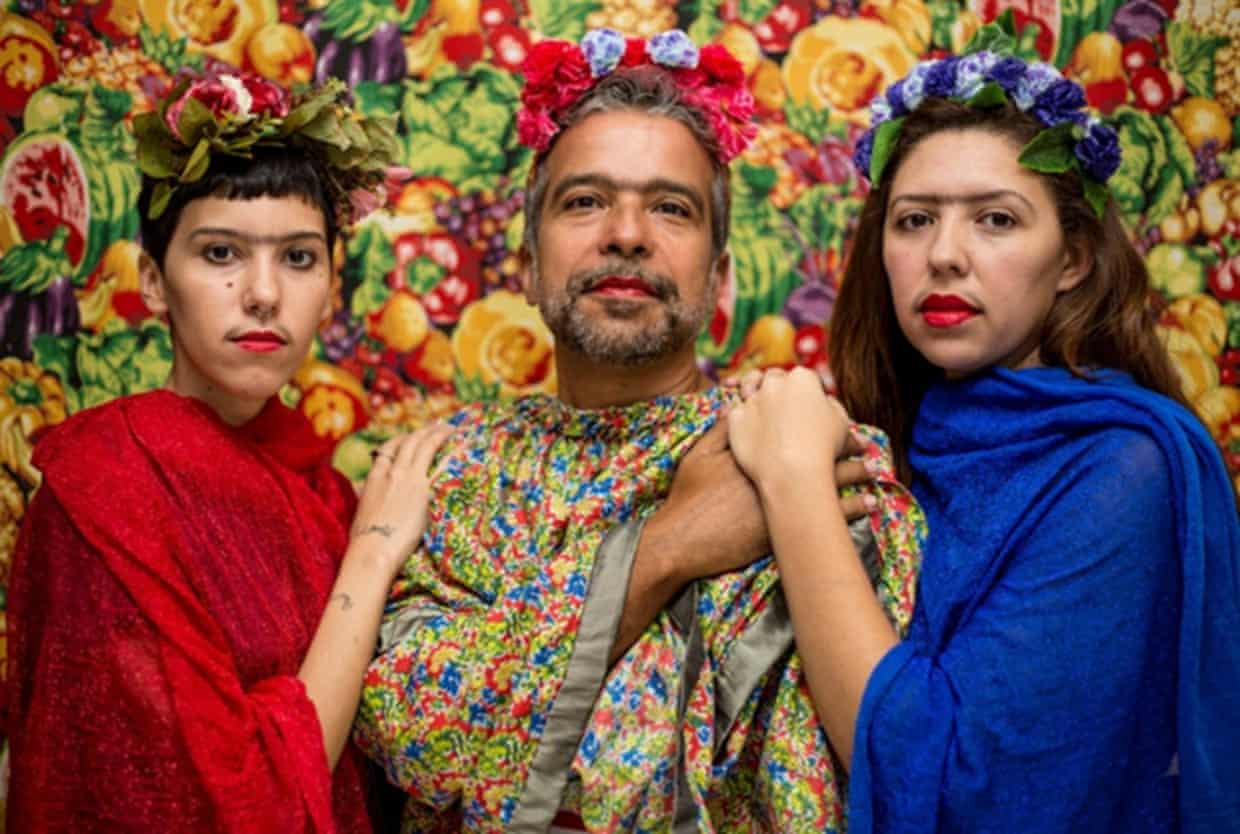
Camila Fontenele de Miranda’s Everyone Can Be Frida, a work that began in 2012.
Camila Fontenele de Miranda’s Everyone Can Be Frida, a work that began in 2012. Photograph: Camila Fontenele de Miranda

The Tate exhibition is not a straightforward survey. Kahlo’s work is shown alongside that of her peers, as well as generations of artists she has inspired. Among them are Rio Yañez, a graphic artist who draws “Ghetto Frida”, a character who has tattoos reading “Diego” at her neck and “Trotsky” at her armpit. “I used Ghetto Frida as a vehicle to satirise Frida’s commercialisation and get my licks in at the art world at the same time,” Yañez has said. A classic print of Kahlo hung on the wall of Yañez’s family’s home in San Francisco’s Bay Area, “as it did in the homes of so many Chicanos, artists, leftists, radical queers and Mexicans”.

The show also examines the wider idea of Fridamania, taking in mass gatherings of Kahlo lookalikes and Camila Fontenele de Miranda’s public portrait project Todos Podem Ser Frida (Everyone Can Be Frida, 2012–20), which invited visitors to cultural events in Brazil to bedeck themselves in embroidered fabrics and floral crowns. “The commercialisation of her image is inseparable from capitalism and consumerism, but it can also be understood as a form of democratic ownership – a way for people everywhere to literally and metaphorically make Frida their own,” says García-Velasco.

Does she not think some of the products emblazoned with the artist’s likeness are a bit … iffy? García-Velasco admits the phenomenon is not “without its contradictions”, citing the widely criticised Frida Barbie released in 2018, which presented the artist (whose mixed heritage included Indigenous roots, and who often used a wheelchair) as a pale-skinned, non-disabled woman with plucked brows.
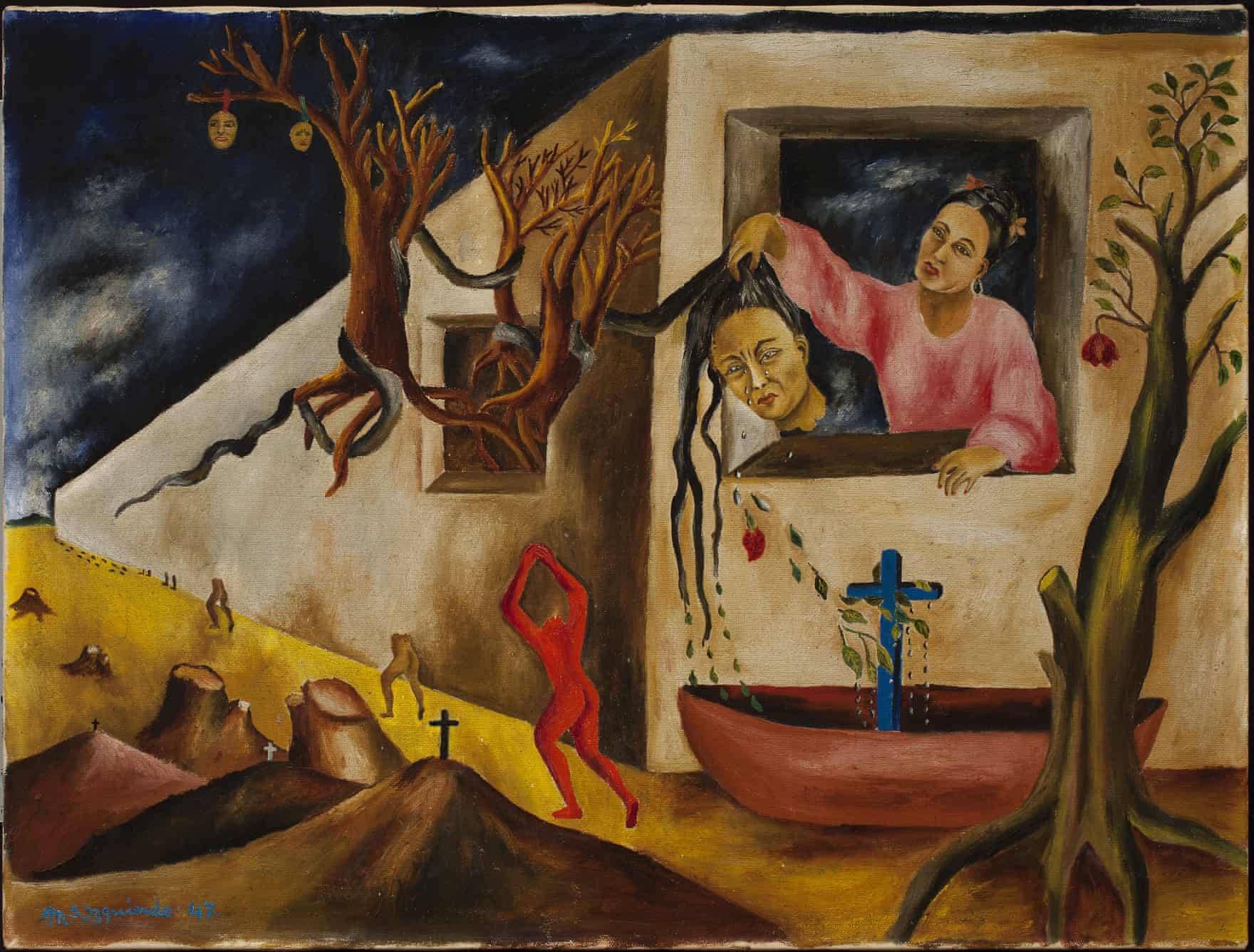
Mexican Renaissance painter María Izquierdo’s Dream and Premonition from 1947, also included in the Tate exhibition.
Mexican Renaissance painter María Izquierdo’s Dream and Premonition from 1947, included in the Tate exhibition. Photograph: Rocio and Boris Hirmas Collection

She sees a “productive tension” between such sanitised mass-market products and “the handmade devotional objects that honour Kahlo as Santa Frida: nichos [devotional dioramas], ex-votos [votive offerings] and calaca [skeleton] figures that all speak to a very different kind of ownership, devotional rather than commercial, and rooted in the communities for whom Frida remains a symbol of resistance and identity”.

The devotion Kahlo inspires is in part because she continues to feel contemporary, whether in her interest in identity or in exploring her life experiences as a woman. Her open portrayals of pain and heartbreak certainly chime with the current vogue for self-revelation. She started painting in her late teens after a bus accident that caused catastrophic injuries to her spine and pelvis. In the early drawing The Accident (1926), she summons a vision of the collision: surrounded by bodies, her own bandaged form on a stretcher in the foreground is looked down on by her floating, disembodied head.

In the courageous painting Henry Ford Hospital (1932) she portrays herself bleeding on a hospital bed after a miscarriage, surrounded by anatomical drawings, machinery and personal emblems. The heartbreak of her turbulent relationship with Diego Rivera is on canvas for all to see. There are grief-charged self-portraits with shorn hair, as well as her brutal portrayal of a literal death by a thousand cuts – A Few Small Nips (1935) – in which a man in a fedora stands coolly over a woman’s mutilated body.
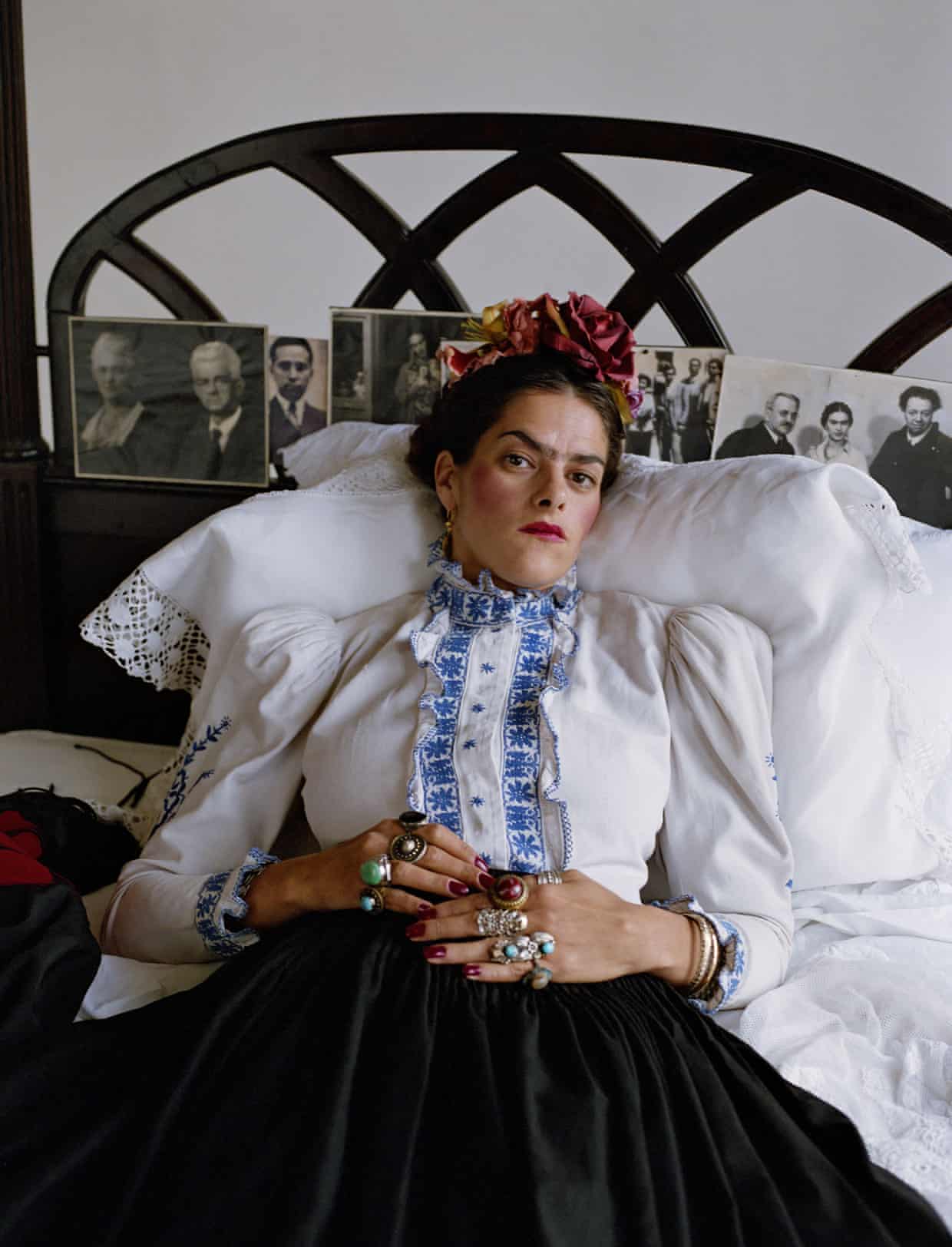
Tracey Emin as Frida Kahlo.
Tracey Emin as Frida Kahlo. Photograph: Mary McCartney

All of this speaks to Tracey Emin, whose work is concurrently on display at Tate Modern. “Women can relate to her” she has said; Kahlo “did images of herself bleeding in the bath, of foetuses coming out of her, and pictures of her family and lovers”. Emin discovered Kahlo as a student and made a painting inspired by the Mexican artist’s portrayal of her family tree. By way of tribute, in 2000, Emin was captured by photographer Mary McCartney in full Frida garb. Recumbent in bed, as Kahlo so often was in a life beset by injury and illness, the portrait now feels like a foreshadowing of Emin’s own illness.

The art is still there, still loved, but to a degree has been transcended by her person. In her lifetime, Kahlo’s art and her constructed identity as a cultural figure emerged as one. Stepping into the public eye at the age of 22 as the wife of Diego Rivera, she turned herself into a character – a queen in a braided crown wearing Aztec beads and traditional tehuana dress – and it is in this guise that she endures.

She has been played by Salma Hayek in a 2002 biopic and appeared as a supporting character in Barbara Kingsolver’s novel of political intolerance The Lacuna. She has even inspired an opera. Earlier this year, the Metropolitan Opera of New York staged El Último Sueño de Frida y Diego by composer Gabriela Lena Frank and librettist Nilo Cruz. The drama is set three years after Kahlo’s death, as she returns to Earth for 24 hours during the Día de Muertos festival: a chance to live for a day without physical pain, and to carry Rivera back to the underworld with her. As Kingsolver has pointed out, Kahlo and Rivera were “two of North America’s first artistic celebrities”.
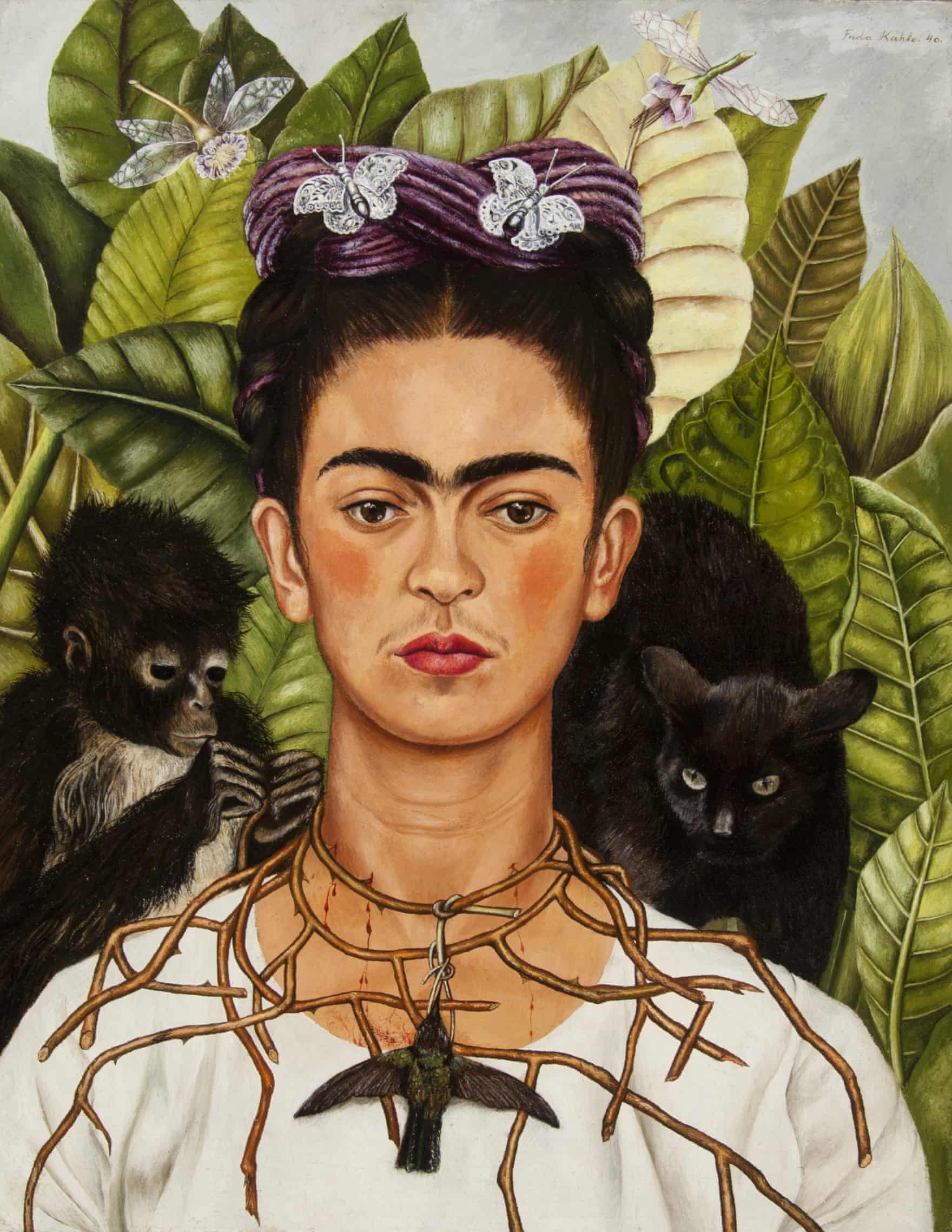
Kahlo’s Untitled Self-portrait With Thorn Necklace and Hummingbird from 1940,
Kahlo’s Untitled Self-portrait With Thorn Necklace and Hummingbird from 1940, Photograph: Nickolas Muray Collection of Mexican Art, 66.6 Harry Ransom Research Center, University of Texas, Austin

One of the most important relationships in Kahlo’s life was with the camera. Frida’s father, Guillermo Kahlo, was a photographer; as a child she learned how to pose and perform. It was an early friendship with the Italian-born photographer Tina Modotti that introduced Kahlo to the idea that she might achieve a liberated, modern life as an artist. Meanwhile, her long-term lover Nickolas Muray, a pioneer of colour photography, took up the camera after a career as an Olympic fencer. Kahlo admired him to such a degree that, in one of her many flights of mythomania, she claimed Hungarian-Jewish ancestry for herself to match his own.

skip past newsletter promotion
Performance art duo Las Yeguas del Apocalipsis in Las dos Fridas.
Performance art duo Las Yeguas del Apocalipsis in Las dos Fridas. Photograph: Malba Foundation, Museum of Latin American Art of Buenos Aires/Yeguas del Apocalipsis/Tate Collection

In point of fact, Kahlo’s father was German, of Protestant heritage, born Carl Wilhelm Kahlo in Pforzheim in 1871. The artist’s moniker is so familiar to us now that it can be easy to forget that the woman now synonymous with Mexican identity had a German name. It did not escape note during her lifetime: with Hitler in power in the 1930s she sometimes opted instead for her other middle name, Carmen (Kahlo was born Magdalena Carmen Frida Kahlo y Calderón).

Despite frequently painting her own likeness, since her death in 1954, aged 47, popular iconography of Kahlo has derived largely from colour photographs of her by Muray (which are straightforwardly beautiful) rather than her self-portraits (which are often more complicated and painful).

One of the earliest mass-produced objects to bear her likeness was a 1975 silkscreen print by Rupert García titled Frida Kahlo (Septiembre). First printed and sold in San Francisco’s Bay Area, it offered Kahlo as a totemic figure for Chicano communities as they emerged from the civil rights movement of the 60s. (It was this poster that gazed over Yañez growing up.) García based his print on a 1939 photograph by Muray – Frida with Magenta Rebozo – and took the hot pink of the shawl she was wearing as the background colour for his own image.
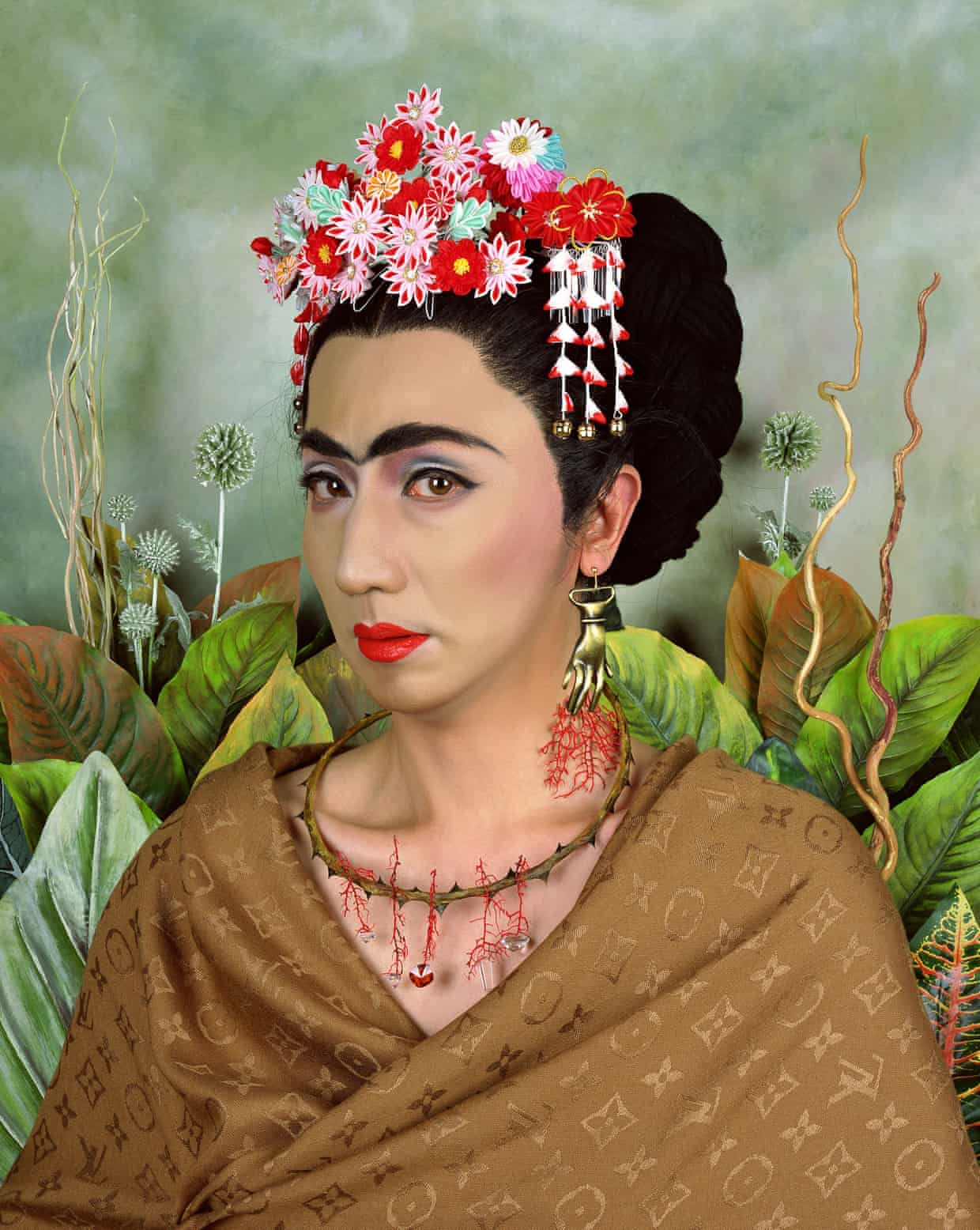
Yasumasa Morimura’s An Inner Dialogue with Frida Kahlo.
Yasumasa Morimura’s An Inner Dialogue with Frida Kahlo. Photograph: Yasumasa Morimura/Luhring Augustine, New York and Yoshiko Isshiki Office, Tokyo.

By the end of the 1970s, Kahlo was taken up by the women’s movement, celebrated as an artist who painted her own reality, whose reputation in life had been eclipsed by her more famous husband. In March 1979, the artist Mary Beth Edelson hosted a party in her New York loft to introduce Ana Mendieta to the city’s feminist art scene. The dress code for the gathering was “come as your favourite artist”, and guests included Louise Bourgeois (who apparently came dressed as herself) and Hannah Wilke. Mendieta dressed as Kahlo: in a photograph of the gathering, she is seated on the floor at the front of the group; her hair braided with ribbons; her eyebrows pencilled into the shape of a hummingbird. Kahlo’s work was still little known and seldom shown internationally at the time.

That changed when, in 1982, feminist theorist Laura Mulvey co-curated an exhibition of Frida Kahlo and Tina Modotti’s work at the Whitechapel Gallery in east London. It was the first survey of Kahlo’s work outside Mexico and its impact was immense: here was a female artist who had been making works about birth, abortion, miscarriage, illness, identity and heartbreak in the 1930s and 40s. The following year saw the publication of Hayden Herrera’s bestselling biography. Together, the book and exhibition unleashed Fridamania. As if to cement Kahlo’s new superstar status, Madonna proclaimed herself a fan, acquiring a handful of paintings.
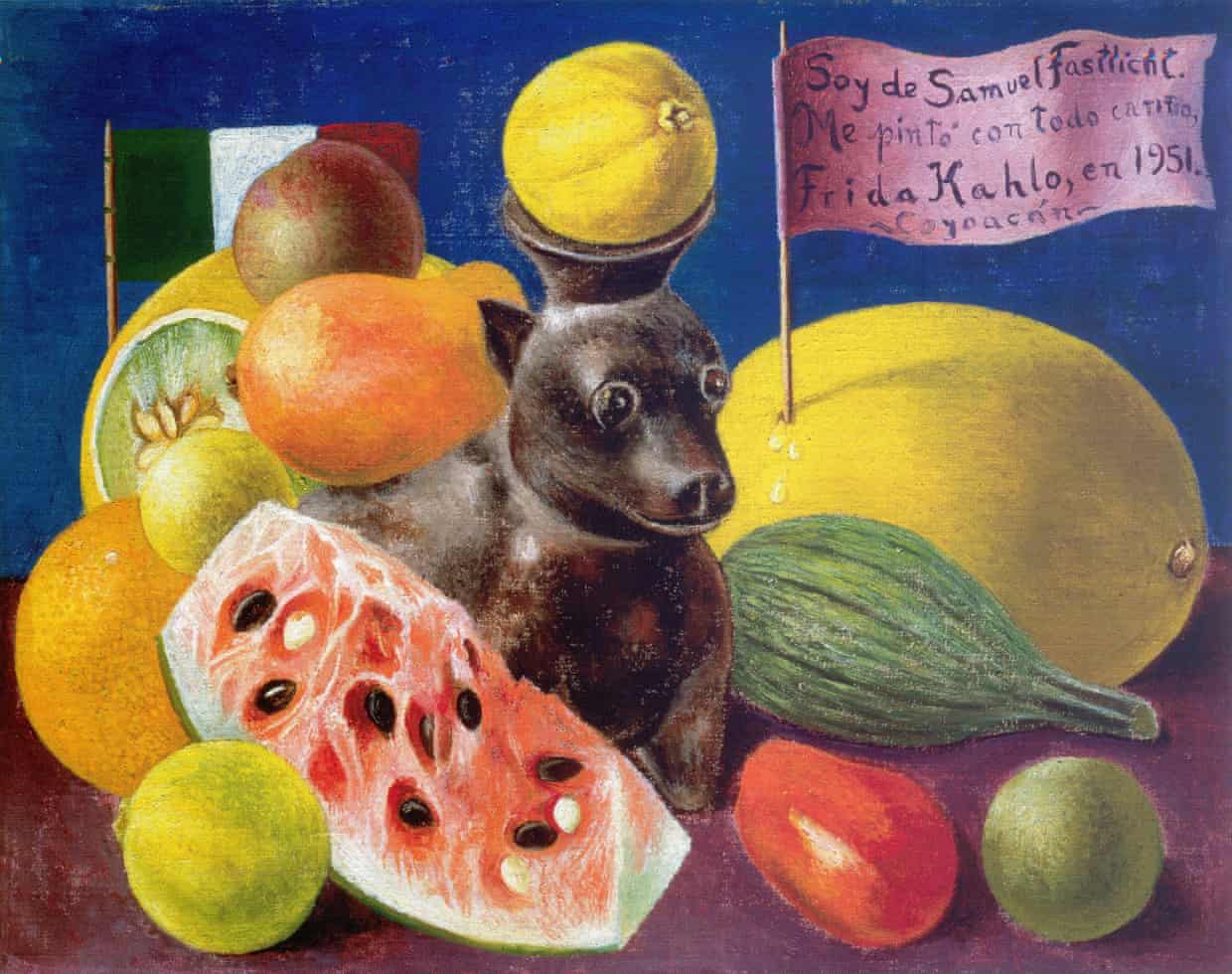
I Belong to Samuel Fastlicht (1951), one of many fruit-themed riddles Kahlo painted that year.
I Belong to Samuel Fastlicht (1951), one of many fruit-themed riddles Kahlo painted that year. Photograph: Private Collection

It is significant that in her posthumous celebrity, Frida the “character” stepped back into the public eye at almost the same moment her paintings finally reached the mass audience they were never afforded in her lifetime. Perhaps more than any other artist, during her life and after it, her art and her persona have come to seem inseparable.

Despite that elevation to modern-day secular canonisation, Kahlo was no saint in real life. Alongside her personal heroism and bold art, it is important to remember that Frida was filled with self-doubt and disappointment in relation to her work, and was capable of treating the people she loved badly. If we expect figures we admire to be pure and flawless, we set ourselves up to fail. If there’s one thing Kahlo’s art reminds us, it is not to shy away from exploring the more complex and difficult parts of life.

Frida: The Making of an Icon is at Tate Modern, London, to 3 January. Hettie Judah is author of Lives of the Artists: Frida Kahlo (Laurence King Publishing).