


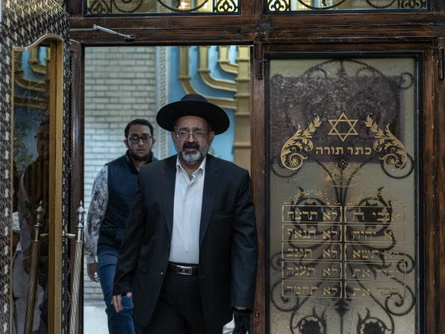
On the evening of 6 April, Asef, 65, and other members of Tehran’s Jewish community braved the US-Israeli bombing campaign to celebrate an evening Passover service at the Rafi’ Nia synagogue in the centre of the Iranian capital.
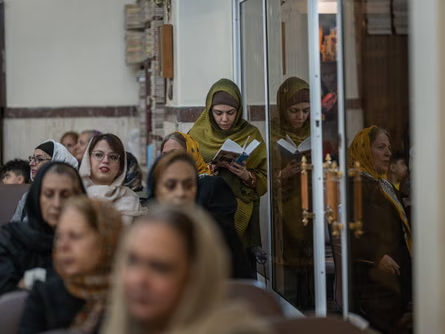
Inside the dim hall, lined with Persian carpets and mint green curtains, Torah verses were recited and prayers murmured under the breath. Asef, his shirt neatly tucked into his trousers and a kippah on his head, sat among the men, while the women sat separately on the other side. The atmosphere was reverent but subdued.
“We didn’t let the conflict stop us from celebrating,” he said, adding that the community had made an effort to hold on to their Passover traditions even amid the difficulties of war.
It was already dark when he headed home that night; the streets were quiet, with only a few people out.
By the time he got up the next morning to get ready for work, an Israeli airstrike had completely destroyed the synagogue.
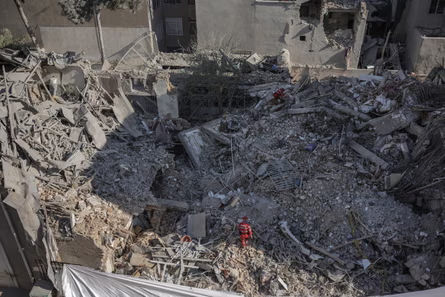
The Israeli army described the destruction as “collateral damage” from a strike targeting a commander, but members of the Jewish community expressed anger and outrage. Nobody was injured, although a staff member had been in the synagogue’s office at the time.
The morning after the bombing, synagogue members sifted through rubble and debris, trying to recover what they could: a handful of religious books and three Torah scrolls were pulled from the shatter brick and rebar, but much was lost.
“It’s all under the rubble, including some of our historical volumes,” said Homayoun Sameh, a member of parliament and the head of the Jewish Association of Iran, who visited the site.
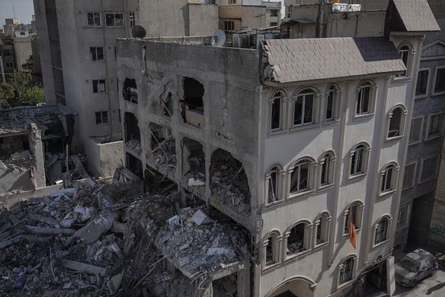
“We condemn this attack. It disrespects our faith. Iran’s Jewish community doesn’t have good relations with the Zionist Israeli government,” he said.
Iran’s Jewish community is the largest and oldest outside Israel, dating back about 2,500 years to when Jews were exiled eastwards by Assyrian and Babylonian rulers.
Iranian officials have long used antisemitic language to express their hostility to Israel – former president Mahmoud Ahmadinejad once described the slaughter of 6 million Jews by the Nazis as “myth” – but the government maintains that its stance is directed at Israel as a state, not Jews as people.
The US-Israeli war on Iran has highlighted the unique dual identity of a community that has itself become collateral damage in a conflict that the Israeli prime minister, Benjamin Netanyahu, asserts has been fought to protect Jews.
Until 1979, Iran – under the pro-western monarch, Shah Mohammad Reza Pahlavi – was Israel’s closest ally in the region. After the Islamic revolution, the country’s new supreme leader, Ayatollah Ruhollah Khomeini, severed diplomatic ties and the two countries have been locked in confrontation ever since.
“Some speak of a so-called golden era before the 1979 revolution, when Tehran and Tel Aviv were close friends, but this was also a period when Israel backed, armed and trained the brutal shah regime,” said Antony Loewenstein, an independent journalist and author of The Palestine Laboratory, who has spent time with the Jewish community in Tehran.
After the revolution, emigration meant the country’s Jewish population dropped from about 100,000 to 10,000-15,000, mostly focused in the bigger cities of Tehran, Isfahan and Shiraz.
“In the early years after the revolution, society was in turmoil and many people confused us with Zionists. Jewish properties were confiscated, and many Jews were afraid and sought refuge [in Israel],” said Sameh.
Others decided to stay, such as the family of the community’s chief rabbi, Younes Hamami Lalehzar, 61, an internal medicine doctor who has long worked at Tehran’s Jewish hospital. His family, merchants originally from the city of Yazd in central Iran, had always been proudly both Iranian and Jewish.
Today, the vibrant community maintains about 30 synagogues, as well as schools, kosher restaurants and supermarkets.
Judaism is constitutionally recognised and protected in Iran, although Jews are barred from holding certain high government or military positions.
It is a community that defies easy categorisation.
“Many in the Jewish community are understandably cautious of outsiders, self-censorship is common, some are what I’d call quiet Zionists while others are fiercely critical of Israeli crimes against Palestinians and opposed to Zionism,” said Loewenstein.
“Many are deeply opposed to the Trump administration and Israeli destruction of Iranian infrastructure during the recent war. The Israeli airstrike that destroyed a prominent synagogue in Tehran confirmed the fears of many Iranian Jews that Israel and Netanyahu don’t really care about their fate.”
About two decades ago, Israel encouraged Iranian Jews to emigrate, offering cash incentives in an attempt to prompt a mass migration.
At the time, the Society of Iranian Jews dismissed the offer as “immature political enticements” and said their national identity was not for sale.
At a service at Sukkat Shalom synagogue before Shabbat last week, members of the community echoed this sentiment, expressing pride in their community’s long history.
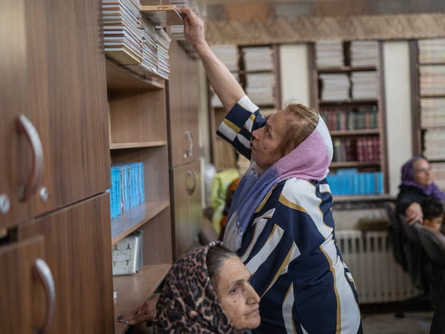
Setareh, a 60-year-old woman and “proud Iranian”, said synagogues in Tehran were left without guards and “remain open throughout the day”, even during war.
“Muslim and Jewish communities live here together, we’re not separated. We all live together in peace,” said another man, Ayman, 35. “We are all Iranians and this is our home.”