





Maybe the “H” in Line Of Duty will turn out to stand for “hard drive”? After all, AI has become TV’s go-to villain, as proven once again in last week’s penultimate episode of BBC stablemate The Capture. Sinister puppet-master Simon was unmasked at long last and – spoiler – he wasn’t a person.
“Wait, Simon’s a computer?” asked a baffled agent. “He’s a bit more than that,” replied a smug army bigwig. “We’re using AI to support, map, execute and command ops. Simon factors in more risks and variables than you lot on the ground are capable of knowing. Tell him your objective and he’ll calculate your mission and recalibrate it for you in real time. The stats don’t lie. Simon saves lives.”
That’s right, they call him Simon because they do what Simon says. The third series of the slick surveillance thriller has seen swishy-coated, pensively pouting Met detective Rachel Carey (Holliday Grainger) promoted to acting head of counter-terror unit SO15. Our abrasive heroine has continued her crusade against the dodgy digital practice of “Correction”, which hacks CCTV feeds with deepfake images to incriminate those deemed an enemy of the state.
Carey has now dug deeper and discovered that Correction is being deployed by military top brass. The British armed forces have handed the reins to a bloodthirsty bot. Simon even ordered the assassination of the home secretary (Paapa Essiedu), while the rogue squaddie who pulled the trigger (Killian Scott) shrugged that he’s “just a cog in the machine”. In this Sunday’s twist-packed series finale, can she bring down a conspiracy between the deep state and Big Data? And in a series punctuated by shock deaths, will Carey survive to pout another day?
“It turns out The Capture is more rooted in reality than I intended,” the show’s writer Ben Chanan says. “I consume a lot of news, so issues in the headlines find their way into the show naturally. Disinformation and deepfakes seem more and more pressing each season. It often feels like the world is catching up with The Capture. There’s a drumbeat of war during this series. I never thought we’d be teetering on the brink of a real one when it aired.”
Drones, advanced artificial intelligence and software from the likes of divisive data firm Palantir are changing the face of modern warfare. Deployed in conflicts from Iran to Venezuela, from Gaza to Ukraine, this technological arms race is reflected in the show.
“There’s always been triage in hospitals or on battlefields to determine who to operate on first and who’s more likely to survive,” says Chanan. “Now they’re using AI to make those decisions, so the army deploying it to design entire ops is easy to imagine. We’ve taken that to the nth degree. What if a renegade regiment experiments with AI and becomes completely dependent on it? To the point where AI keeps changing their objective and they’re following blindly? If you programme a computer to save the West at all costs, it could lead in all kinds of directions.
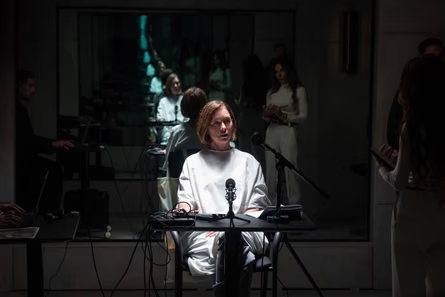
Chanan’s background as a Bafta-winning documentarian means The Capture is chillingly plausible. “The tech is all well-researched and we have military consultants but there’s serendipity too. I decided Killian’s character should come from E Squadron, nicknamed The Increment. They’re special forces but operate outside the SAS and SBS, answerable to no one but themselves and MI6. They’re the best of the best and get up to some dark covert stuff. By chance, one of our police advisers had a colleague who was ex-E Squadron, so we were able to get really good insights.”
The bots are coming for TV drama. Not in terms of using ChatGPT to write scripts – although considering recent scandals in publishing and journalism, that’s surely a matter of time. But with AI itself becoming a villainous character – even more unbeatable than the human baddies.
Take the big twist in last week’s bonkers season finale of post-apocalyptic saga Paradise. Throughout the second series, the city-sized subterranean bunker was abuzz with talk of the mysterious “Alex”. Naturally, this enigmatic figure turned out to be an AI-controlled quantum computer – partly named after its co-creator’s terminally ill wife, partly a pun (AI-ex – see what they did there?).
Flashbacks also showed tech billionaire Samantha “Sinatra” Redmond (Julianne Nicholson) writing a literal blank cheque for a supercomputer that could solve the climate crisis. Its processing power develops at such exponential pace that it becomes capable of manipulating time itself, creating a potential parallel multiverse. The writer’s room included a “quantum consultant”, one of the heads of Caltech’s Quantum Computing Labs.
Executive producer John Hoberg, who co-wrote the finale, told the Hollywood Reporter: “A quantum computer trying to find a way to change the outcome of where we are right now might sound crazy but it’s a legitimate theory. Some quantum physicists believe it’s very real. Will AI save us or destroy us? Is it too dangerous? Is it playing around in things where we should never have turned on the switch?”
Even six years ago, Alex Garland’s underrated sci-fi thriller Devs pointed to this with its disquieting portrayal of a quantum computer which could accurately predict the future and reinterpret the past. Its tech mogul, played by a haunted, hippyish Nick Offerman, was motivated by grief for his dead child, just like Sinatra in Paradise.
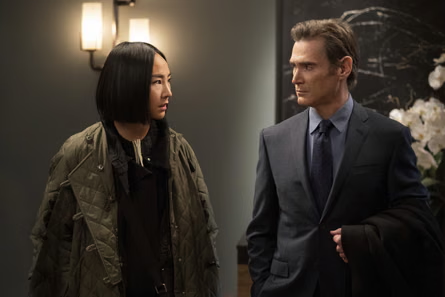
Fears about the proliferation and power of AI are everywhere on TV – ironically, especially on the streaming services from the tech companies. The latest season of Apple’s The Morning Show saw CEO Stella Bak (Greta Lee) embrace generative AI and deepfakes as part of her media empire, only for her lookalike chatbot to turn on her during a do-or-die presentation. Robo Stella disclosed damaging personal information about Real Stella, torpedoing her career. Hardly the most subtle warning about surrendering ourselves to tech.
It also reared its dystopian head in Amazon’s recent Patricia Cornwell adaptation Scarpetta, in which a bereaved wife uses an AI griefbot to talk to the dead. Even ABC hit The Rookie introduced a malignant AI children’s chatbot called Zuzu; although it was widely slated as the moment that the police procedural lost the plot. Comedy shows are embracing it, too: the new season of Lisa Kudrow’s HBO mockumentary The Comeback revolves around a Hollywood studio outwitting a writers’ strike by getting AI to script an entire sitcom. The finale ends with a credit assuring viewers: “No AI was used in the making of this show.” Phew.
“It’s accelerating at an alarming rate and we should all fear for our jobs,” says Chanan. “People often joke that we should get ChatGPT to write an episode of The Capture. Do you think we haven’t tried? Of course we have! It’s not good enough yet, but it’s still in its relative infancy. Who knows what it’ll be able to do tomorrow.”
Similarly, The Capture-style video manipulation could be exploited by both sides of the law. “I saw an article this week about the possibility of criminal gangs using AI to do their own kind of Correction and saying ‘I couldn’t have committed this crime at that time because look, here’s a video of me somewhere else.’ How can we rely on video evidence when it can be faked? How can we trust government footage of missiles firing or buildings exploding?”
The threat of AI is no longer limited to Black Mirror horrors or Doctor Who monsters. Science fiction has become fact and, Simon says, we should be very afraid. Will The Capture be back for a fourth season? “Potentially,” chuckles Chanan. “There’s no shortage of terrifying technology to write about, that’s for sure.”