






There are two common kinds of bound which limited the speed of training in deep learning.
Inspiration: just tiling?
Description: Split the Q, K, V into blocks and calculate output matrice O by block to avoid the store of softmax intermediate matrice which has size of seq_len * seq_len in HBM memory, which reduce the memory-bound, as a result, required memeroy of attention is almost linearly with senquence length of sentence.
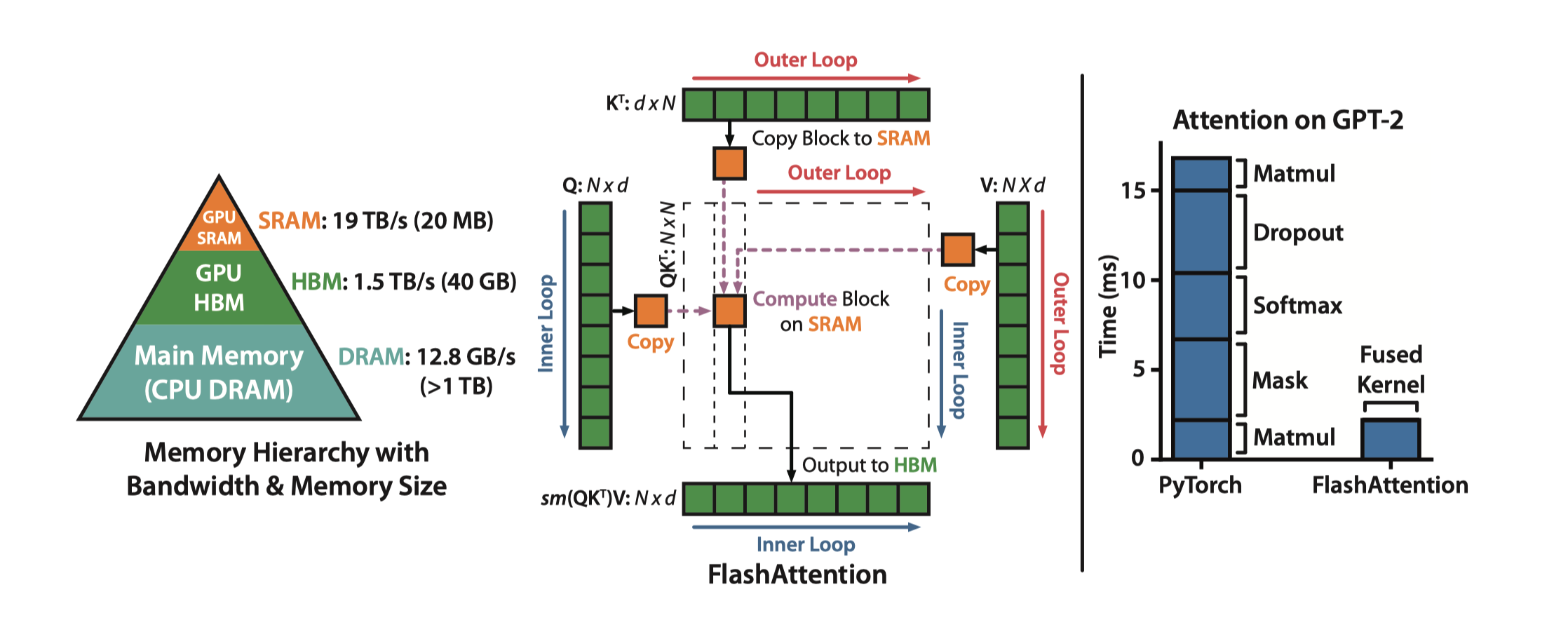
Novelty: Making attention memory-efficient
1) Faster model training, due to use SRAM more?
2) Higher quality modles in long sequence tasks.
3) New benchmarking attention, both faster and memory-efficient than existing attention method (2022.5)
4) Block-Sparse, only compute for no-zero block for attention_mask
1) Algorithm
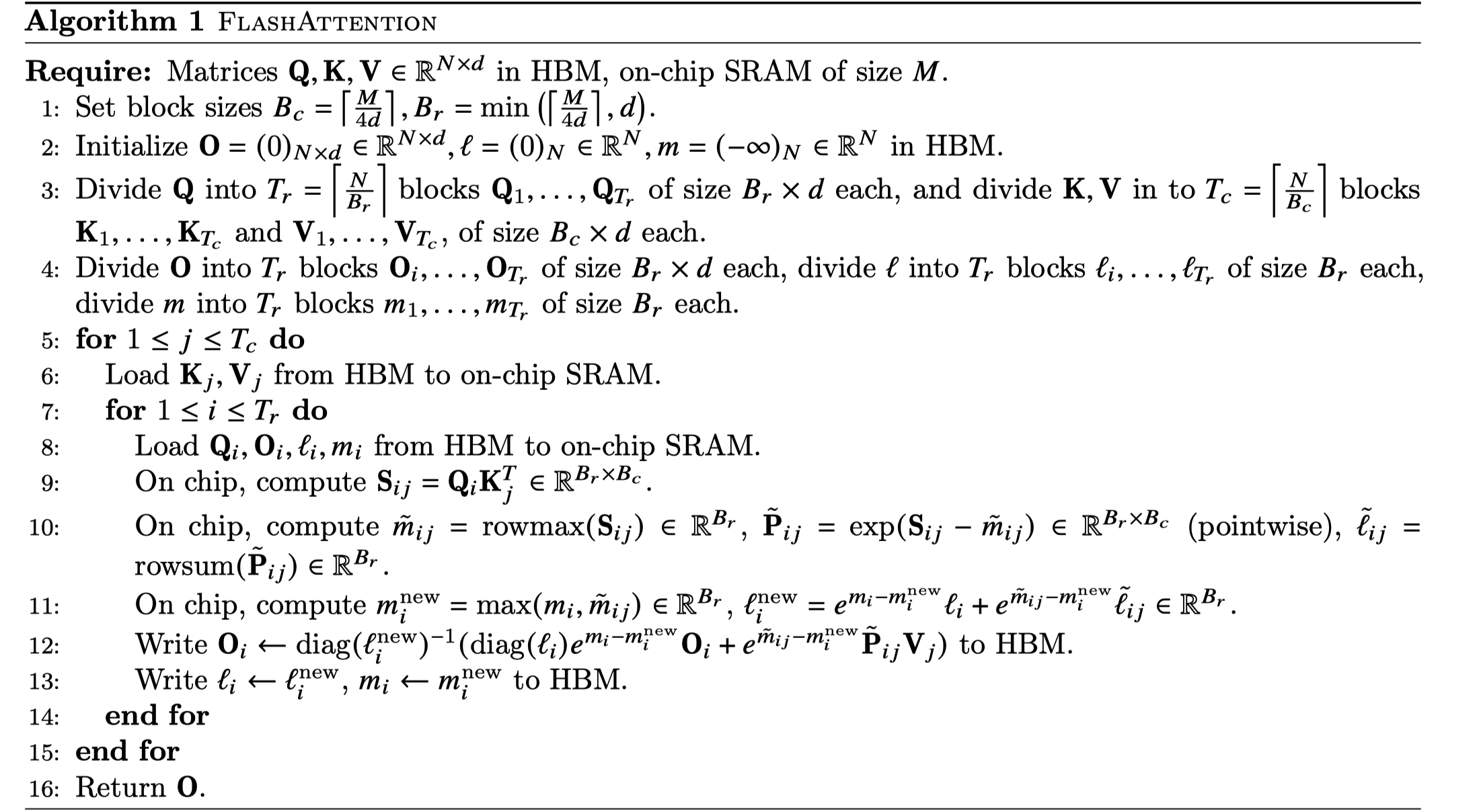
2) Flash-attention has higher FLOP count compared to standard attention but is still faster because attention is memory-access-bound and falsh-attention has fewer HBM accesses.
1) Purpose of auther?
Using blocks method to make memory-bound network memroy-efficient and faster
2) Key of new method?
Using block to avoid the store of large softmax attention maxtrice.
3) What is useful for me?
Using block to trade-off between memory and computation, which can be use based on memory-bound or computation-bound
4) What references is necessary to read?
5) new idea
What is the bottleneck right now, memory or computation? what is it for different models or module parts?
This post is licensed under CC BY 4.0 by the author.
此内容由惯性聚合(RSS阅读器)自动聚合整理,仅供阅读参考。 原文来自 — 版权归原作者所有。