


惯性聚合 高效追踪和阅读你感兴趣的博客、新闻、科技资讯
阅读原文 在惯性聚合中打开

推荐订阅源

S
Schneier on Security
cs.AI updates on arXiv.org
T
Threat Research - Cisco Blogs
C
Cyber Attacks, Cyber Crime and Cyber Security
C
CXSECURITY Database RSS Feed - CXSecurity.com
A
Arctic Wolf
Security Latest
Security Latest
Simon Willison's Weblog
I
Intezer
cs.CV updates on arXiv.org
T
Troy Hunt's Blog
Latest news
Latest news
Help Net Security
Help Net Security
S
Security Affairs
Webroot Blog
Webroot Blog
The Hacker News
The Hacker News
AI
AI
cs.CL updates on arXiv.org
T
Tor Project blog
Forbes - Security
Forbes - Security
Google DeepMind News
AWS News Blog
AWS News Blog
Attack and Defense Labs
P
Proofpoint News Feed
www.infosecurity-magazine.com
H
Help Net Security
L
Lohrmann on Cybersecurity
S
SegmentFault 最新的问题
Google Online Security Blog
MongoDB | Blog
MongoDB | Blog
Cyberwarzone
Cyberwarzone
The Last Watchdog
The Last Watchdog
S
Securelist
N
News and Events Feed by Topic
S
Secure Thoughts
F
Fortinet All Blogs
博客园_首页
C
Cybersecurity and Infrastructure Security Agency CISA
量子位
M
MIT News - Artificial intelligence
F
Full Disclosure
T
The Blog of Author Tim Ferriss
T
Tailwind CSS Blog
Recent Commits to openclaw:main
Microsoft Security Blog
I
InfoQ
P
Privacy International News Feed
L
LangChain Blog
Know Your Adversary
Know Your Adversary
C
CERT Recently Published Vulnerability Notes

Benson's blog

Enjoy life Internship AI on academic research How AI Will Change the Mobile Ecosystem Look ahead Goodbye 2025 Hacker News to Kindle Another project How to imporve english Introduction of Fraud detection PopTranslate Last day in netease Better idea between Copilot-typed and CLI-typed assistant Gemini-cli LLM Post-Training experience Papers I readed recently about LLM application Difference between LLMs and traditional computer technology GRPO Weekly-#26 AI Application Weekly-#25 AI infra and application Weekly-#24 First week as LLM inference engineer Weekly-#23 seeking job Weekly-#22 2025 New Year AutoSwitch Translate Goodbye 2024 Weekly-#20 Breaking of glass Cross Entropy Loss of Triton Weekly-#18 Cross Entropy Loss of Triton Weekly-#17 Triton Puzzles Weekly-#16 AutoBuilder Weekly-#15 Starting of tanble tennis Weekly-#14 Accident in life Weekly-#13 Trying of xiaohongshu Weekly-#12 summary of LLM acceleration Outline of LLM acceleration Weekly-#11 Copilot-type products Weekly-#10 Preparation for next journey Weekly-#9 Startup of YouTube Notes of flash-attention How to learn knowledge in new fields? Weekly-#8 Start Reading Notes of LoRA Acceleration of LLM - Matrix Multiplication Weekly-#8 Summary for two month Weekly-#7 Staying home Weekly-#6 Cost of PopTranslate Weekly-#5 Updating of PopTranslate Validated example of LLM acceleration Weekly-#4 First insight of LLM accelerate Weekly-#3 PopTranslate Weekly-#2 The fail of first product Weekly-#1 First week of indie develop slack迁移discord 雅思备考 2024Q3 中文博客合集 English Diary in May 五一游记 开始休假 离职前的状态 2024-01-01 duckdb 看懂的第一个PR learning english in October learning english in September learning english in August top hack news 收集 大模型调研 自动驾驶的小玩具 旅游 扬州+苏州 small talk of learning english 新年新气象-碎碎念 刷剧 感染新冠 强化学习简介 神经网络解释性 全局的模型无关解释方法合集 社区发现算法概览 我的第一款 iOS APP AtCoder Beginner Contest 268 人的信息输入方式对比 重叠社区检测 人穷极一生到底在追求什么 重拾生活规划 社区发现算法 - Louvain 《幸福的方法》 读《人类简史》有感 妙峰山骑行 黑客帝国 特征交互 特征工程 累计局部效应图 模型解释性-PDP 模型解释性 Web3 入门科普 总结 2022.4 孪生网络做 query 相似度任务 学习 2022.4 Imagen DeBERTa 读论文 用CNN做query相似度任务
图神经网络入门(GNN)
Benson · 2022-10-23 · via Benson's blog

顾名思义,就是把神经网络应用到图结构上

1、Semi-supervised Classification with Graph Convolutional Networks

图卷积的广义理解:

1)卷积:两个函数的一种运算,输入两个函数,加入时间变量做累计,输出一个新函数。

2)考虑CNN(卷积神经网络)怎么做的:函数看做矩阵,输入原始图像和卷积核(两个函数),拿卷积核遍历原始图像,做计算(点乘、求 和),生成新矩阵(输出新函数)。

3)图卷积:图卷积最基本的问题是,输入”原始图像”形状并不固定,不同节点的邻居节点数量不同,怎么办? 利用邻接矩阵,每个节点信息都输入,把不连接的节点信息置为0就好了。加大复杂度来让这个问题可解。

图卷积过程:

1)通过图的邻接矩阵获得拉普拉斯矩阵

2)拉普拉斯矩阵分解,特征向量作为正交基,作为傅立叶变换的基

3)利用正交基进行傅立叶变换,乘积之后求逆变换,得到两个函数的卷积

卷积的一个输入为原始图结构,另一个是卷积核,作为参数训练。

基础概念:

1)傅立叶变换

每个函数由多个周期性函数组合而成,每个周期函数可以看做正交基为 $1,sin(x),cos(x),sin(2x),cos(2x)…sin(nx),cos(ns)$的组合,这些函数互相垂直(相互的乘积积分为0),根据欧拉公式,正交基变成 $e^{wnx}$,其中w标识周期函数的频率。傅立叶变换是指将一个函数拆解为多个三角函数的和,每个三角函数用频率和振幅描述,即将函数从时域(时间为横轴,信号大小为纵轴)变到频域(频率为横轴,振幅为纵轴)。

2)卷积定义和傅立叶变换

两函数傅立叶变换之后的乘积,等于卷积之后的傅立叶变化,那么两函数的卷积,就等于,各自傅立叶变换后乘积的逆傅立叶变换。

3)拉普拉斯算子

目的:在图上找到一组正交基,结合傅立叶变换做卷积。

传统拉普拉斯算子,是欧式空间中的二阶微分:$\triangledown f=f(x-1,y)+f(x+1,y)+f(x,y-1)+f(x,y+1)-4*f(x,y)$

图结构利用邻接矩阵就能求出对应的拉普拉斯矩阵,进行矩阵分解,得到的特征向量可以看作傅立叶变换的基,从而完成图上的傅立叶变换。

图上的拉普拉斯矩阵:$L=D-A$,$D$ 表示顶点度矩阵,$A$ 表示邻接矩阵。

拉普拉斯矩阵是 实对称矩阵 -> 能对角化 -> 找到正交基

图卷积优化

1)矩阵分解复杂度太多,用特征值的多项式代替卷积核,就不需要做矩阵分解了。

2)切比雪夫近似

2、Can Abnormality be Detected by Graph Neural Networks?

文中认为GNN会平滑节点之间的特征,正常节点的特征平缓(低频),而异常节点特征陡峭(高频),GNN平滑节点之间信息之后,会降低异常节点的信息表达。

因此提出使用不同频次的滤波器,抽取特征,再通过attention机制做信息融合,更好地表达异常节点的特征,效果提升明显,达到新的 sota 效果。

疑问:

1)GNN只能提取低频特征:暂时来看,是低频特征的传播比较有效,从而反证GNN只提取了低频特征。

2)高低频特征怎么理解:

图上的一组信号,可以被表示为图拉普拉斯矩阵特征向量的一组线性组合。

特征向量对应的特征值越大,该特征向量越“振荡”,反之越平滑。

而对于对图特征x,其在高频特征向量上的分量越大,可以说该特征具有更多高频的特征,反之亦然。

3、Revisiting Graph Neural Networks: All We Have is Low-Pass Filters

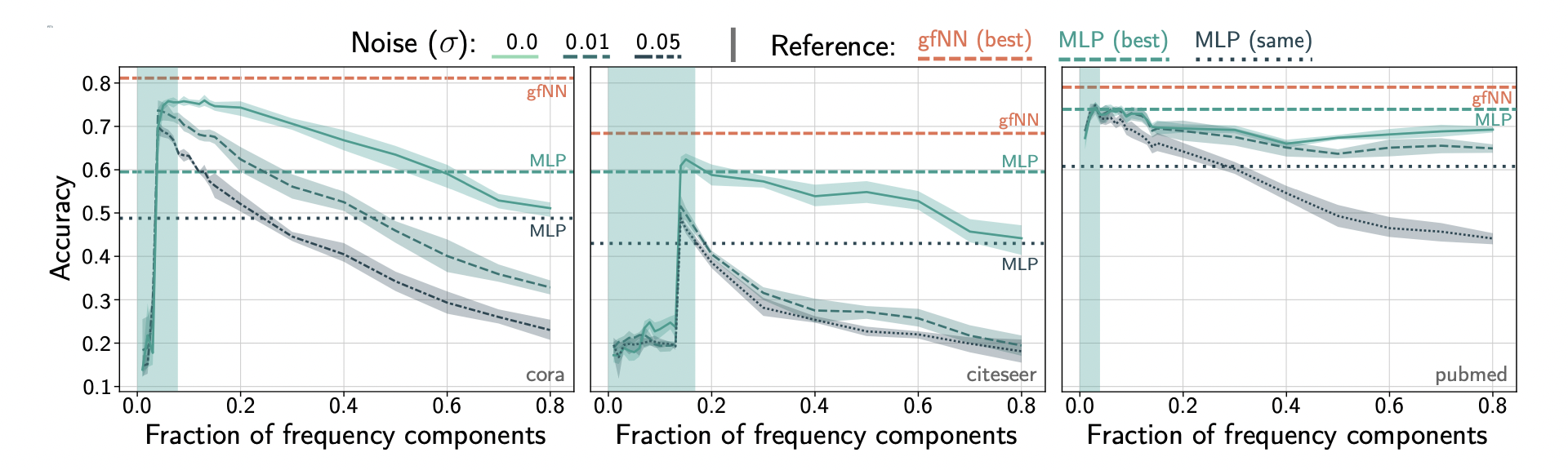
对结果有效(能提升节点分类效果)的都是低频滤波器。 验证:不断添加频率分量,重新构建特征,添加到一定比例时,效果开始下降。
参考

博客

欧拉公式

离散傅立叶变化:进行傅立叶变换和逆变换,时间复杂度 $O(N^2)$

快速傅立叶变换:降低复杂度到 $O(Nlog(N))$