


Garden Eight is a Tokyo-based studio specializing in digital design, primarily for corporate and brand websites. With a team of seven and a network of external partners, we support companies and brands in their digital communications across web design, development, art direction, and project management.
What matters most to Garden Eight is creating good work with integrity while continuing to approach websites with a sense of play. Guided by ideas such as “good and fun things” and “playful, yet humble,” we aim to build websites that are not merely visually striking, but that are also effective and reliable for both clients and users.
At Garden Eight, we focus not only on visual impact, but also on how a website can energize a company’s or brand’s digital communication. We study the context, industry, tone, and user touchpoints of each project, then combine the right information architecture, visuals, motion, and interactions to design a coherent web experience.
Because most members of Garden Eight work across both design and development, we can move forward without completely separating the two disciplines. By considering visuals, motion, interaction, and technical feasibility in parallel, we do more than simply transfer a static design to the web—we refine how it looks, moves, and responds in the browser.
At Garden Eight, we select the CMS and front-end architecture for each project according to the site’s purpose and operational structure. Taking into account ease of updates, expressive flexibility, operational workload, and maintainability after launch, we design flexibly—from conventional CMS solutions to headless architectures and statically generated setups.
Performance and accessibility are also areas we consider continuously throughout production. Depending on project requirements, we test and refine loading speed, delivery load, contrast, and fundamental accessibility, with the aim of improving the site even after launch. In recent years, we have also expanded our interest to optimization for search experiences and AI-based information understanding.
In Garden Eight’s website work, motion and interaction are not treated as decoration, but as elements that directly shape the quality of the experience. From the perspectives of design, implementation, and motion, we examine pacing, the flow of attention, and responses to user actions, adjusting them so that the overall impression and usability of the site connect naturally.
When designing these effects, our first priority is not to interfere with user actions or the flow of content. On that foundation, we add expressions that contribute to the site’s character and atmosphere. Page transitions, scrolling, video, and WebGL are designed around each project’s visual world and information structure, with pacing and continuity refined so the experience remains fluid and uninterrupted.
This was a renewal of our own website, created to serve as both a corporate site and a portfolio.
Through its visuals, overall experience, and main content—our project case studies—the site is designed to communicate the mood of Garden Eight and spark visitors’ interest.
Our company has long had a culture in which each member chooses a favorite animal and uses it as an icon. For this renewal, we turned those animals into characters, created 3D models of them, and cast them as performers who enliven the site. Visitors are welcomed by a playful combination of soft motifs and aesthetics with distortion.
This was not our first time working on aircord’s website. We have collaborated on four renewals, and through that process came to understand aircord not by the genres of its work or the technologies it uses, but as a studio that combines image, light, sound, and systems to create experiences in physical space. For that reason, we felt that a conventional portfolio simply arranging projects in an orderly way would not communicate the studio’s true nature.
Our goal was to make the website itself a space through which visitors enter and move through aircord’s world. On the top page, the screen appears as a distant three-dimensional object. In Projects, surfaces displaying project footage circulate through a ring-shaped space. When a project is selected, the camera moves closer as the curved surface unfolds into a plane and seamlessly becomes the detail page. Rather than switching to a separate page, the site changes the state of what the viewer is already seeing, creating one continuous experience between 2D and 3D.
This continuity could not be achieved by simply building the DOM and WebGL separately and layering them together. Video, typography, scrolling, camera movement, and shaders were designed as a single change of state, so the entire screen transforms within the same flow. Because the same person handled both design and development, we were able to move back and forth between appearance and implementation, adjusting everything from letterforms and motion speed to camera angles and light intensity without fixing decisions too early on either side.
What we created for aircord was not merely a container for its work, but a website that lets users experience the nature of the studio itself through information, motion, space, and code. For Garden Eight, this project is one of the clearest examples of design and implementation not as sequential stages, but as a single creative act that develops simultaneously.
HONKA RE:FRAME! is a selective honors class in a new full-time scholarship program launched by Digital Hollywood in spring 2026. Crossing CG/VFX, XR, and UI/UX, the class asks students to consider what questions they themselves will continue to pursue in an era when AI can provide answers. For that reason, we wanted the site not merely to communicate information, but to make each visitor feel something through the experience itself.
A clear narrative and a sense of embodiment were essential to making that experience work. By embodiment, we mean human gestures that viewers can readily project themselves onto. This led us to place a human figure at the center of the experience.

The challenge was to avoid confining the abstract idea of a “question” to explanation, while also preventing the visual direction from becoming an empty atmosphere. We removed as many cues of age and identity as possible from the figure and told the story through gestures: stopping, reaching out, and beginning to walk. The orb in the figure’s hand is made of countless particles; it approaches a defined outline but never settles into a fixed form.
In the latter half, the orb disappears and the figure, previously standing still, begins to walk. The experience shifts from a period of confronting a question to a period of acting and creating. Rather than explaining this in words, we expressed the feeling of encouraging someone who is about to begin learning through a change in the body itself.
The figure and animation were created in Blender, then combined in Three.js with particles, camera movement, light, and typography. Garden Eight handled the design, 3D, and development as one continuous process, shaping the final result while balancing the impact of the 3D visuals with the readability of the text directly in the browser.
https://school.dhw.co.jp/p/honka_reframe
PHOTOYOSHI is the portfolio site of Takamitsu Motoyoshi, a photographer based in Japan. The site was designed to bring out the full character of his photography in a digital environment and provide an immersive photographic experience.
The main page uses infinite scrolling to create a continuous browsing experience that naturally leads visitors from one work to the next. It also offers two viewing modes, allowing users to switch seamlessly between an overview of the entire body of work and a focused view of individual photographs. In addition, user actions such as mouse movement and scrolling directly affect the visual presentation of the images, creating the sensation of actively manipulating the photographs. Together, these mechanisms transform browsing itself into an immersive experience.
Horizontal scrolling can enhance immersion, but it also presents a usability challenge: first-time visitors may not immediately understand how to navigate. To address this, we implemented animations during loading and transitions that naturally communicate the direction of scrolling.

The site uses WordPress as its CMS, enabling administrators to select which images appear on the home screen. The entire site is statically generated to optimize performance. As a result, each visit to the main page offers a fresh, randomized encounter with different photographs.
The corporate website for Anai Wood Industry expresses both the integrity of a company that works with timber and its creativity in manufacturing through design and interaction.
Across the site, the visual concept is built around two opposing qualities: the natural individuality of trees, each growing differently in a forest, and the regularity introduced as lumber is shaped through milling. Text animations that grow upward, layouts that converge into a grid as the user scrolls, and cross-sections of wood that change shape each time they appear translate the company’s activities into movement unique to the web.
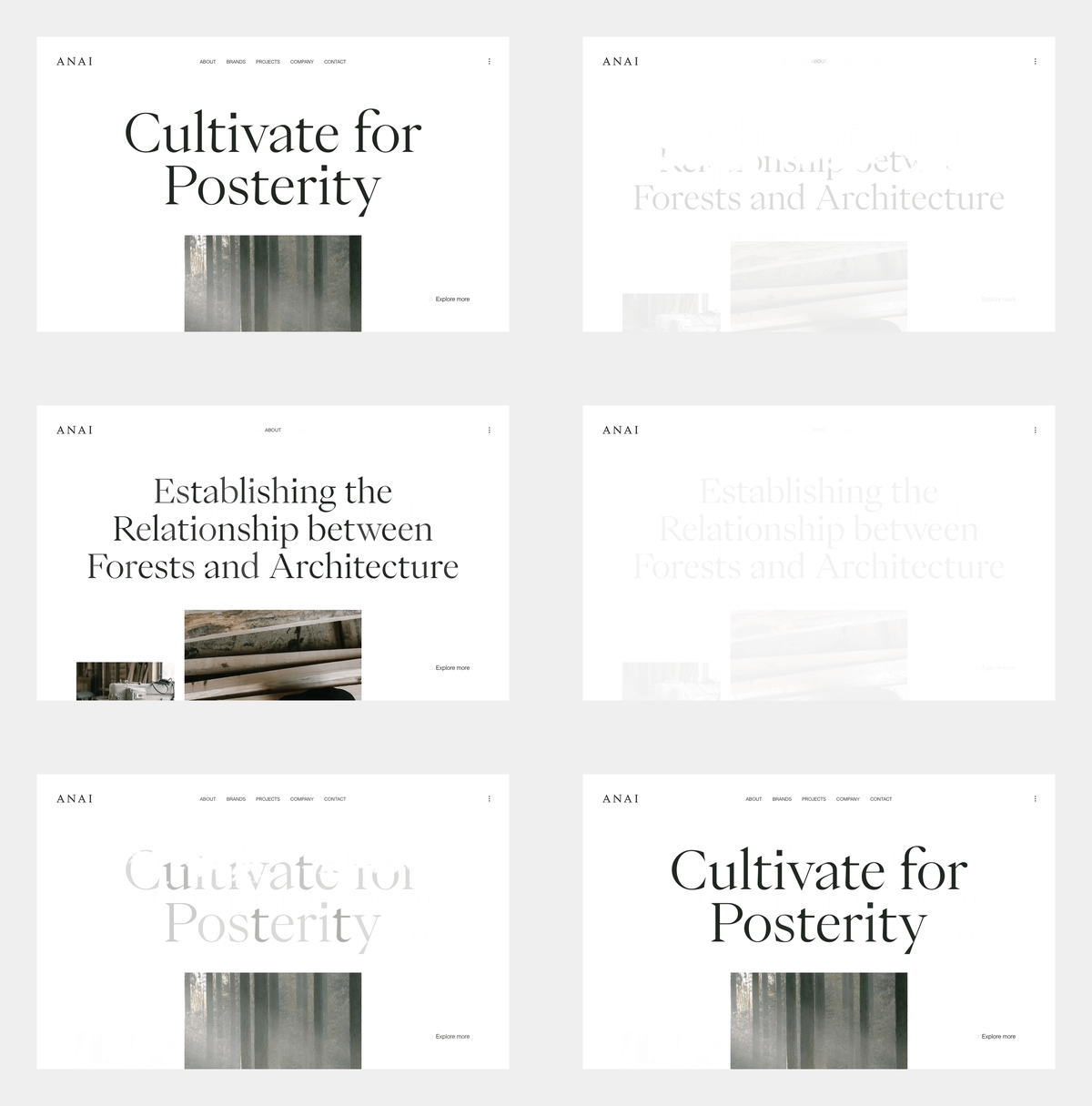


The project index uses an infinite-loop slider that can be controlled by scrolling or dragging. During page transitions, the selected image and text carry over, creating an uninterrupted browsing experience. The menu background also features a WebGL forest built with Three.js, making the company’s connection to forestry immediately memorable.

The system uses a Jamstack architecture built with Nuxt, Contentful, and Netlify, with careful consideration for loading speed, security, and ease of updates. The project balances a strong visual expression of the company’s identity with the practical functionality required of a corporate website used in day-to-day operations.
plantica is a Japanese floral creative studio led by Takashi Kimura. Its work spans a wide range of fields, including art, fashion, lifestyle, spatial design, installations, textiles, products, and art direction—all centered on flowers. The website needed both to organize and present plantica’s diverse activities and to function as a catalog of its many patterns.
Our goals were to communicate the studio’s professional yet challenging spirit, to maximize the vivid beauty of its floral works, and to present its enormous volume of projects and images in a way that felt comfortable and enjoyable to browse.
We refined every animation and treated even loading time as part of the direction, improving the overall smoothness of the experience. The result is a website that stages each encounter with the beautiful body of work in an elegant way.
Garden Eight is a small team, which keeps directors, designers, and developers close to one another. We move projects forward by sharing the decisions each project requires. Rather than separating design, implementation, motion, CMS architecture, and operations, we treat them as parts of a single web experience and refine them together.
此内容由惯性聚合(RSS阅读器)自动聚合整理,仅供阅读参考。 原文来自 — 版权归原作者所有。