
惯性聚合 高效追踪和阅读你感兴趣的博客、新闻、科技资讯
阅读原文 在惯性聚合中打开

推荐订阅源

L
Lohrmann on Cybersecurity
K
Kaspersky official blog
C
Cyber Attacks, Cyber Crime and Cyber Security
Threat Intelligence Blog | Flashpoint
P
Palo Alto Networks Blog
Scott Helme
Scott Helme
P
Proofpoint News Feed
量子位
S
Schneier on Security
AWS News Blog
AWS News Blog
N
Netflix TechBlog - Medium
T
Threat Research - Cisco Blogs
T
Threatpost
Cisco Talos Blog
Cisco Talos Blog
L
LINUX DO - 热门话题
T
The Exploit Database - CXSecurity.com
A
Arctic Wolf
S
Securelist
T
Tailwind CSS Blog
T
Tor Project blog
Last Week in AI
Last Week in AI
Martin Fowler
Martin Fowler
I
InfoQ
Cyber Security Advisories - MS-ISAC
C
CXSECURITY Database RSS Feed - CXSecurity.com
C
Cisco Blogs
D
DataBreaches.Net
OSCHINA 社区最新新闻
OSCHINA 社区最新新闻
T
Tenable Blog
The GitHub Blog
The GitHub Blog
V
Vulnerabilities – Threatpost
V
Visual Studio Blog
博客园 - 叶小钗
F
Full Disclosure
Know Your Adversary
Know Your Adversary
N
News and Events Feed by Topic
Engineering at Meta
Engineering at Meta
S
SegmentFault 最新的问题
The Last Watchdog
The Last Watchdog
H
Hacker News: Front Page
阮一峰的网络日志
阮一峰的网络日志
D
Docker
Spread Privacy
Spread Privacy
T
The Blog of Author Tim Ferriss
S
Security @ Cisco Blogs
Attack and Defense Labs
MyScale Blog
MyScale Blog
腾讯CDC
Recent Announcements
Stack Overflow Blog
Stack Overflow Blog

Ivan on Containers, Kubernetes, and Server-Side

A grounded take on agentic coding for production environments Server-Side Playgrounds Reimagined: Build, Boot, and Network Your Own Virtual Labs [not a] Kubernetes 101 - Pods, Deployments, and Services As an Attempt To Automate Age-Old Infra Patterns JavaScript or TypeScript? How To Benefit From the Dichotomy On Software Design... and Good Writing Building a Firecracker-Powered Course Platform To Learn Docker and Kubernetes How To Publish a Port of a Running Container What Actually Happens When You Publish a Container Port A Visual Guide to SSH Tunnels: Local and Remote Port Forwarding Debugging Containers Like a Pro Docker: How To Debug Distroless And Slim Containers How To Extract Container Image Filesystem Using Docker | iximiuz Labs In Pursuit of Better Container Images: Alpine, Distroless, Apko, Chisel, DockerSlim, oh my! How To Start Programming In Go: Advice For Fellow DevOps Engineers Kubernetes Ephemeral Containers and kubectl debug Command How To Develop Kubernetes CLIs Like a Pro Docker Container Commands Explained: Understand, Don't Memorize | iximiuz Labs Learning Docker with Docker - Toying With DinD For Fun And Profit How To Extend Kubernetes API - Kubernetes vs. Django The Influence of Plumbing on Programming How To Call Kubernetes API from Go - Types and Common Machinery How To Call Kubernetes API using Simple HTTP Client Kubernetes API Basics - Resources, Kinds, and Objects OpenFaaS - Run Containerized Functions On Your Own Terms Learning Containers From The Bottom Up Docker Containers vs. Kubernetes Pods - Taking a Deeper Look | iximiuz Labs Learn-by-Doing Platforms for Dev, DevOps, and SRE Folks How HTTP Keep-Alive can cause TCP race condition How to Work with Container Images Using ctr | iximiuz Labs Multiple Containers, Same Port, no Reverse Proxy... Exploring Go net/http Package - On How Not To Set Socket Options Disposable Local Development Environments with Vagrant, Docker, and Arkade DevOps, SRE, and Platform Engineering My Choice of Programming Languages Prometheus Is Not a TSDB How to learn PromQL with Prometheus Playground Prometheus Cheat Sheet - Basics (Metrics, Labels, Time Series, Scraping) Rust - Writing Parsers With nom Parser Combinator Framework pq - parse and query log files as time series Prometheus Cheat Sheet - Moving Average, Max, Min, etc (Aggregation Over Time) Prometheus Cheat Sheet - How to Join Multiple Metrics (Vector Matching) The Need For Slimmer Containers Understanding Rust Privacy and Visibility Model Bridge vs. Switch: Takeaways from a Real Data Center Tour | iximiuz Labs From LAN to VXLAN: Networking Basics for Non-Network Engineers | iximiuz Labs KiND - How I Wasted a Day Loading Local Docker Images Go, HTTP handlers, panic, and deadlocks Exploring Kubernetes Operator Pattern Service Discovery in Kubernetes: Combining the Best of Two Worlds API Developers Never REST How Container Networking Works: Building a Bridge Network From Scratch | iximiuz Labs Traefik: canary deployments with weighted load balancing Service Proxy, Pod, Sidecar, oh my! You Need Containers To Build Images You Don't Need an Image To Run a Container Not Every Container Has an Operating System Inside Working with container images in Go Master Go While Learning Containers Implementing Container Runtime Shim: Interactive Containers How to use Flask with gevent (uWSGI and Gunicorn editions) My 10 Years of Programming Experience Implementing Container Runtime Shim: First Code Implementing Container Runtime Shim: runc Kubernetes Repository On Flame Dealing with process termination in Linux (with Rust examples) conman - [the] Container Manager: Inception Journey From Containerization To Orchestration And Beyond Linux PTY - How docker attach and docker exec Commands Work Inside Illustrated introduction to Linux iptables From Docker Container to Bootable Linux Disk Image Пишем свой веб-сервер на Python: протокол HTTP 9001 способ создать веб-сервер на Python Explaining async/await in 200 lines of code Explaining event loop in 100 lines of code Save the day with gevent Пишем свой веб-сервер на Python: процессы, потоки и асинхронный I/O Truly optional scalar types in protobuf3 (with Go examples) Node.js Writable streams distilled Node.js Readable streams distilled How to on starting processes (mostly in Linux) Дайджест интересных ссылок – Июль 2016 Пишем свой веб-сервер на Python: сокеты Наследование в JavaScript Мастерить!
Making Sense Out Of Cloud Native Buzz
Ivan Velichko · 2020-12-10 · via Ivan on Containers, Kubernetes, and Server-Side

I've been trying to wrap my head around the tremendous growth of the Cloud Native zoo for quite some time. But recently I was listening to a wonderful podcast episode with the Linkerd creator Thomas Rampelberg and he kindly reminded me one thing about... microservices. Long story short, despite the common belief that microservices solve technical problems, the most appealing part of the microservice architecture apparently has something to do with solving organisational problems such as allocating teams to development areas or tackling software modernisation campaigns. And on the contrary, while helping with the org problems, microservices rather create new technical challenges!

Disclaimer: This article is not about Microservices vs Monolith.

That made me rethink the need for all those projects constituting the Cloud Native landscape. From now on I can't help but see an awful load of projects solving all kinds of technical problems originated by the transition to the microservice paradigm.
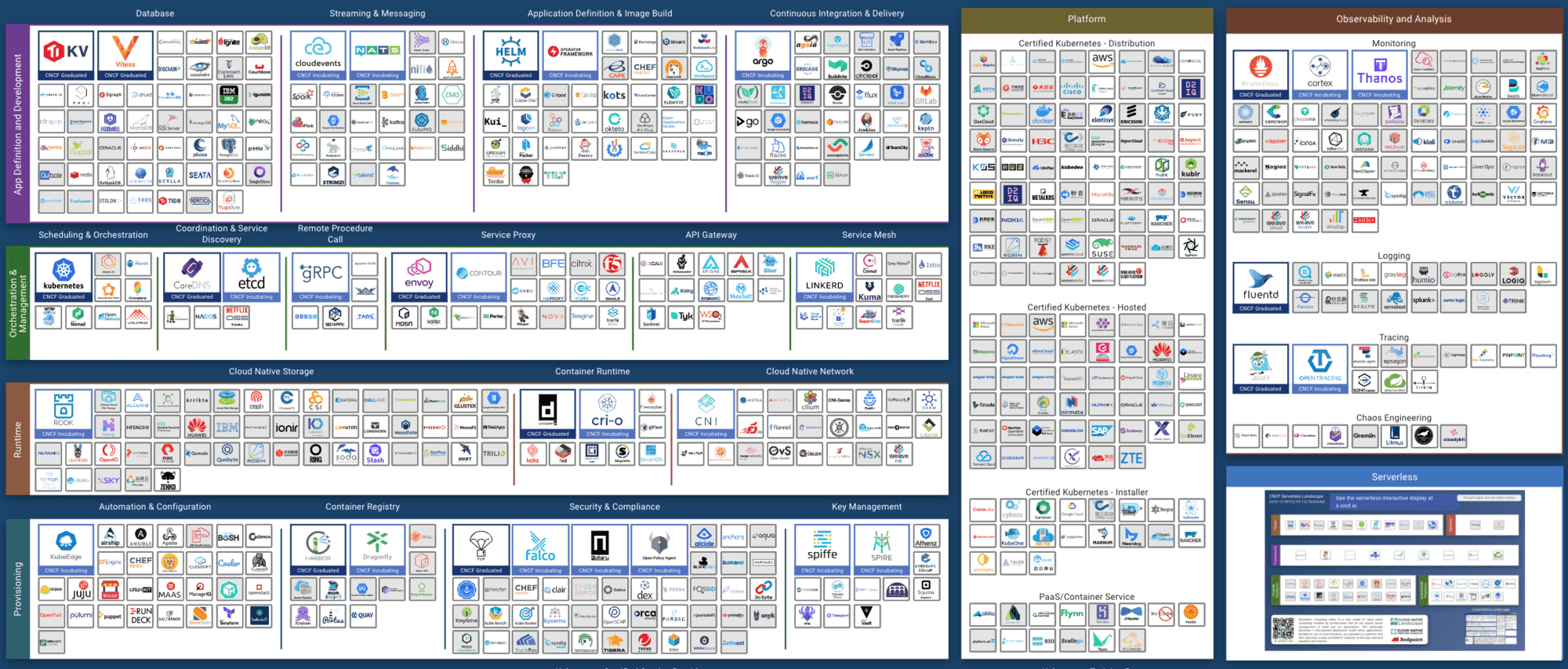
Cloud Native landscape.

Level up your server-side game — join 20,000 engineers getting insightful learning materials straight to their inbox.

Starting from the foundational project, "The Production-Grade Container Orchestration" system we all know and love - Kubernetes. While it's not limited by that, the idea of grouping containers Pods into Services is foundational for Kubernetes. But there is even more, Kubernetes provides other higher-level capabilities vital for microservice architectures such as service discovery or autoscaling out of the box. But if you cannot benefit from Kubernetes goodies because of... reasons, fear not! CNCF has a decent list of Coordination & Service Discovery offerings (ZooKeeper, etcd, Netflix Eureka, etc) that can teach an old-fashioned infrastructure some new tricks.

Going further, the increase in the number of services naturally leads to the surge of network communications. Hence, we need to have a reliable remote procedure call layer. Luckily, the CNCF landscape has an RPC section for you with such prominent projects as gRPC or Apache Thrift.

In microservice-verse, you learn pretty quickly that an uncontrolled service-to-service communication leads to a mess... that can be eliminated with a mesh. Projects like Linkerd, Maesh, or Istio are great representatives of the Service Mesh category. And of course, under the hood of almost every service mesh, there is a piece of black networking magic proxy like Envoy, Traefik, or linkerd2-proxy. Well, apparently there is also a Service Proxy category gathering such proxies.

Having transparent service-to-service communication doesn't make every network request legitimate. In the microservice architecture, you cannot trust every service. Only requests from well-identified clients should be allowed. And CNCF landscape has something for you again - spiffe and spire projects to provide the distributed identity.

Lots of services mean lots of APIs. These APIs need to be consolidated before being exposed to the outside world. Guess what? There is a whole API Gateway category at your disposal.

Chasing bugs in microservice architectures is much trickier than in monoliths. A request may hit tens of services on its way to be served. Tracing request paths, collecting and aggregating logs from all the services are great engineering problems deserving their own categories - Tracing and Logging. And of course, there is the third pillar of observability - Metrics and Monitoring.

Containers vs microservices always sounded to me like a chicken and egg problem. Anyway, it's clear now that microservices and containers work well together. Thus, we can consider the sheer amount of container-related projects like runtimes or container registries as microservice-supporting as well.

I could continue giving more and more examples here, but I hope that by this time I already managed to make my point. Sometimes, the correlation is more obvious, and sometimes there is some level of indirection but to me, it looks like the vast majority of the projects under the CNCF umbrella exist to solve the technical problems that arose only because we started using lots of smaller services in our web applications.

For curious, I recommend the following series of articles diving into the CNCF landscape, this time without any poor speculations 🙈:

Level up your server-side game — join 20,000 engineers getting insightful learning materials straight to their inbox: