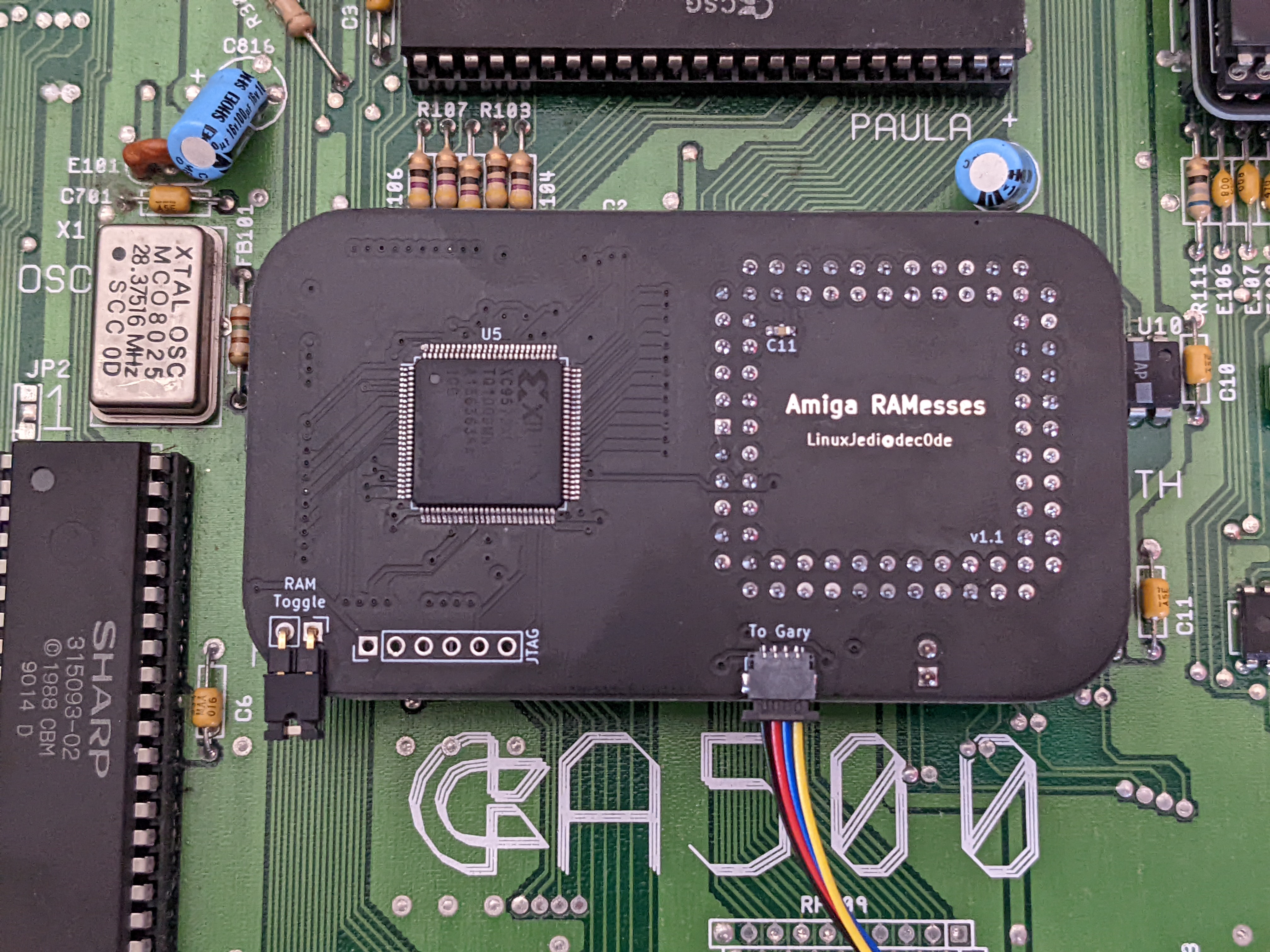
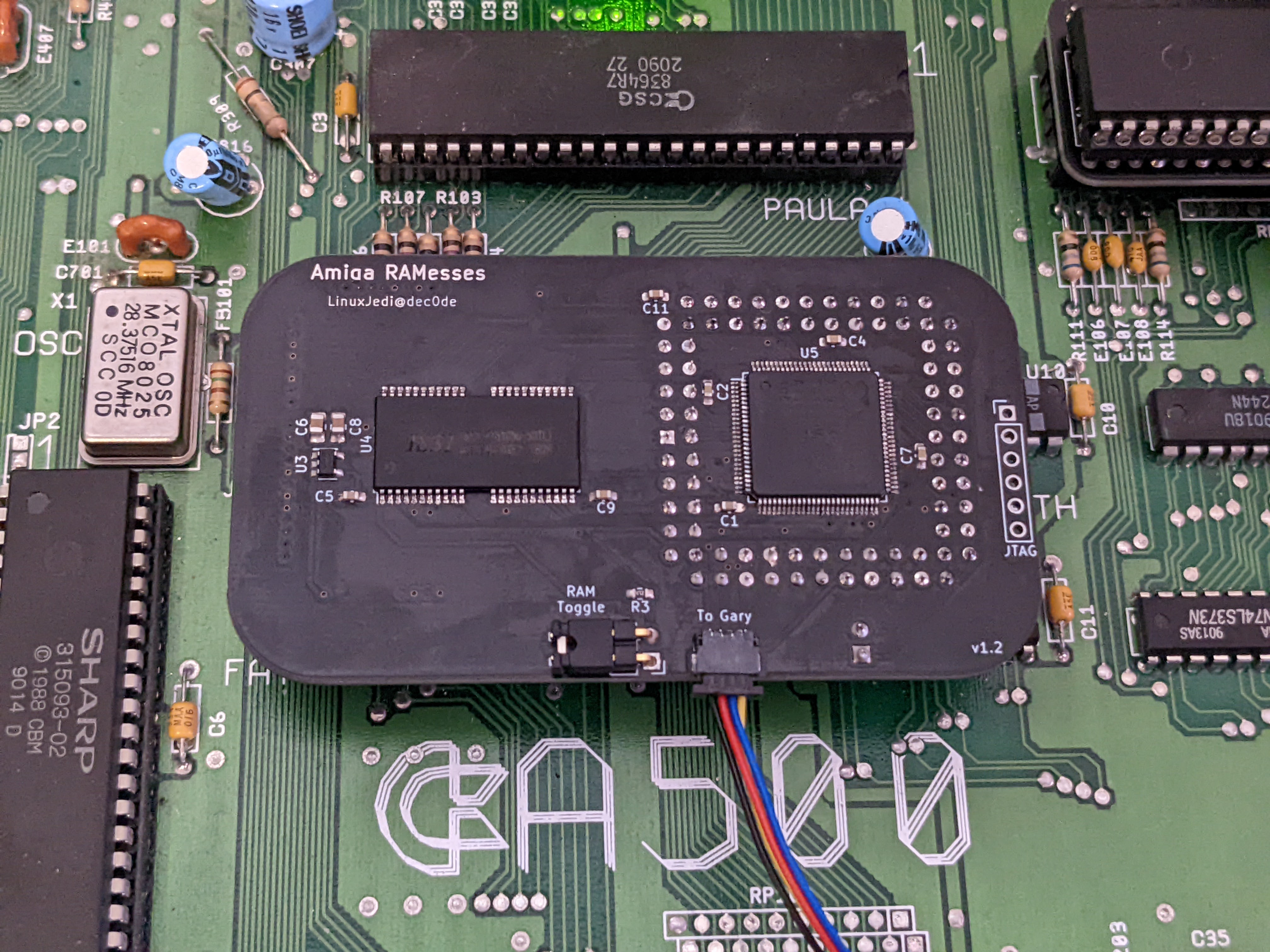
I recently developed a popular board called RAMesses, which upgrades an Amiga 500 / 2000 / Commodore CDTV to 2MB of Chip RAM without any soldering / cutting of the motherboard. I figured I would post more about what it is and why I developed it.
Amiga computers have three main types of memory that are all handled differently. “Chip” memory is controlled by Agnus (Alice for AGA machines) and the co-processors inside the Amiga can access this using DMA. There is “Fast” RAM that is often called “Slow” RAM, this is RAM that only the CPU can use but is accessed via Agnus so is not as fast as it could be. When you put a RAM expansion in the trapdoor slot of an Amiga 500, this is usually what the upgrade provides. Then there is true “Fast” RAM which the CPU can directly accessed, most CPU accelerators include this.
While on the outside there isn’t much difference between one Amiga 500 and another, there were several motherboard versions with different capabilities. All Amiga 500s (excluding Plus) had a stock 512KB of Chip RAM the Agnus version in the motherboard could dictate how far it could be expanded. Most could only be expanded to 1MB of RAM.
Due to the address map and the addressing for the Agnus chip the maximum possible is 2MB RAM, this is only possible with the model “8375” Agnus (and only the 2MB versions of this).
Most games are happy with the stock 512KB, but there are many that either have enhancements when you have more or require 1MB of RAM. In addition there is technology called WHDLoad to effectively run a virtual Amiga from Workbench to run games from the hard drive, this can require more than 1MB of Chip RAM to operate correctly with some games.
Whilst in most cases you can upgrade a 512KB Agnus to a 1MB one just by pulling the old one and inserting a new one (and sometimes blanking off a pin) you still need to make some modifications to the motherboard so that any extra memory becomes Chip RAM.
In addition you cannot take a 2MB 8375 Agnus (typically used in an Amiga 500 Plus or Amiga 600) and plug is straight into an Amiga 500, due to the additional address lines the pinout is not compatible.
Matt Harlum (LIV2) created a board which converted an 8375 Agnus to work in a regular Amiga 500 and add 2MB of Chip RAM. It required you to desolder the Agnus socket (as an Agnus plug is either expensive or difficult to make), and use regular pins / socket for the board. Whilst it is nice and compact it is quite difficult to build. I used this as a basis to create a new version which is easier to build.
Whilst I liked this design there some things I still wasn’t happy about:
I therefore decided to design a board that solved these problems.
The RAMesses board uses a PLCC plug to plug into Amiga’s Agnus socket and an 8375 Agnus plugs into the underside of it. In addition there is an adaptor to go under the Gary chip for a few additional signals. It overrides any motherboard and expansion RAM so that it is easy to install no matter what your motherboard / configuration is. This means you do not need to make any modifications to the Amiga motherboard, and any modifications you have made in the past are bypassed. It is also smaller in every dimension than my previous board, to the extent that it even fits in a Commodore CDTV.
Above you can see the RAMesses prototype in purple (the project was called MightRAM back then), final version 1.1 and then 1.2. The only real differences between 1.1 and 1.2 are that 1.2 is easier for me to build and the “legacy mode” is configured slightly differently.
Speaking of “legacy mode”, you’ll note there is a jumper on the top of the RAMesses board. There are a few games that state they require 1MB but they actually mean 512KB Chip and 512KB Slow RAM. So this jumper reconfigures the board to provide Slow RAM. In 1.1 it switched from providing 2MB Chip to 512KB Chip and 512KB Slow, in 1.2 it switches to 1MB Chip and 512KB Slow.
RAMesses is now available on my new Retro Supplies store. I also have PCBs for my older design available. Both require a 2MB 8375 Agnus which are available on eBay and online stores but are difficult for me to obtain in bulk at a reasonable price.
此内容由惯性聚合(RSS阅读器)自动聚合整理,仅供阅读参考。 原文来自 — 版权归原作者所有。