


Choosing the right data center colocation provider for your servers can have huge implications for performance, for business continuity, and for your costs over time.
Getting it wrong when choosing colocation services can result in all sorts of problems (latency from a poorly located data center being one that you can't fix with more clever engineering) plus poor support (left to fight your corner at 2 a.m.) plus horrible terms and conditions that punish you as your business grows up.
Scalability constraints and rigid contracts can severely limit business growth when your infrastructure needs evolve faster than your provider can accommodate. Providers that offer scalable space with flexible contract terms enable businesses to expand infrastructure incrementally as demand increases without renegotiating entire agreements.
Netrouting is running a carrier-neutral colocation since 2007.
What really differentiates good hosting from great hosting? We dive into the key factors that matter, including data center power / redundancy, network quality / peering, physical security, compliance, support response, and scalability without needing to restart negotiations from the start. And, of course, we list the questions that everyone forgets to ask until it’s too late.
To start we go with the basics.
What Is Colocation and How Does a Data Center Work?
Colocation hosting is where you own the server hardware and storage systems, while the hosting provider owns everything around them, as opposed to leased-hardware hosting where the provider supplies the equipment. With colocation hosting your physical servers reside in a professional colocation data center and the data center facility is responsible for power, cooling, physical security and network connectivity.
The provider also maintains all networking hardware required for internet connectivity, including routers, switches, and cross-connect infrastructure that links your equipment to carrier networks. Providers typically bundle security services such as biometric access controls, video surveillance, and intrusion detection as part of the facility package to protect customer equipment from unauthorized physical access.
As the customer you have complete control over your servers and your server infrastructure without the need to build and staff a data center facility of your own. For community perspectives, see Trusted co-location support vendors : r/networking .
This separation of responsibilities allows IT teams to focus on application performance and security while the provider handles the physical infrastructure and day-to-day data center operations. This model is particularly attractive for organizations looking to modernize their it infrastructure without the overhead of facility management or the unpredictability of multi-tenant virtualization.
The Core Colocation Data Center Model
Data Center Colocation Solution
Our server racks are sold in three tiers: rack units (1U-4U slots), full cabinets, and private suites. Private suites are reserved for large enterprise teams and offer them their own dedicated locked down data center floor space with custom power feeds as needed. Each tier is designed to provide a secure space that matches the physical footprint and access requirements of different deployment scales.
Our Data Center is a fully managed facility that offers end to end data center operations including N+1 Redundant Power, Cooling and Fire Suppression. 24/7 physical access control is also included. You manage the OS, software and applications. This is the hallmark of colocation. Customers retain direct access to their equipment during business hours and can coordinate after-hours entry through our NOC team for emergency maintenance or hardware upgrades. These redundant systems form the foundation of infrastructure reliability, ensuring continuous operation even during component failures or maintenance windows.
Comprehensive power redundancy architecture includes dual utility feeds, battery backup systems, and on-site generators that automatically engage during grid failures. Real-time monitoring of power usage across all circuits enables proactive capacity planning and helps customers optimize their electrical consumption against contracted limits. Monitoring power usage effectiveness metrics allows facility operators to benchmark cooling efficiency and identify opportunities to reduce operational overhead without compromising uptime. These layered redundancy measures work together to deliver reliable uptime that meets or exceeds industry SLA standards for mission-critical deployments.
Colocation vs. Cloud vs. On-Premises Data Center
On-premises is a building and hardware that you own. Cloud is data centers, servers, storage and networks that you do not own. Data center colocation is a scenario where you own the servers, storage and other hardware but the provider owns the data center facility. It gives you the bare metal performance you need along with fixed cost without the need for a private data center and associated capital expenditure.
Many organizations migrate from a traditional cloud provider to colocation when predictable costs and direct hardware control become more important than elastic scaling. Colocation also eliminates the need to refresh it hardware on short vendor cycles, since you control procurement timelines and can extend equipment lifecycles based on actual performance rather than cloud provider deprecation schedules.
Dedicated resources, low-latency connectivity and data sovereignty are all key factors for workloads that are better off in a colocation data center than the cloud. Organizations with strict regulatory requirements often find that colocation facilities provide the physical audit trails and jurisdictional control that multi-tenant cloud platforms cannot guarantee. Colocation environments are particularly well-suited for hosting mission critical data that demands both physical isolation and direct administrative access to underlying infrastructure.
Who Are the Largest Data Center Colocation Hosting Providers?
The global colocation market is dominated by a few large data center operators with secure data centers in dozens of cities around the world. NTT Global Data Centers is one of the largest by footprint, but there are other major data center colocation providers with carrier-neutral campuses in North America, Europe and Asia.
When evaluating colo providers, it's essential to assess not just their geographic reach but also their network peering arrangements and uptime guarantees. Organizations often evaluate whether to host infrastructure in their own facilities or leverage third party data centers that provide enterprise-grade redundancy and connectivity without the capital investment.
Netrouting is a focused company that operates 10 colocation data center s. We have locations in Stockholm, Amsterdam, Rotterdam, The Hague, Frankfurt, Bucharest, Miami, New York, Hong Kong and Singapore. We have our own AS6206 backbone with 2.4 Tbps+ of network traffic.
We compete with other global data centers like NTT's global data centers, but on a different level. While the big hyperscale data centers like to compete on the amount of locations they have. We focus on depth in our engineering, having a carrier-neutral setup and a lot of personal support.
While it can be useful to have a general sense of the data center market, it is far more important to know what criteria to apply when judging any given provider (including ourselves).
Key Criteria for Evaluating Data Center Colocation Providers
| Provider | Performance | Support | Uptime SLA | Network | Best For |
|---|---|---|---|---|---|
| Netrouting | N+1 cooling systems, high-density cabinets up to 20 kW, bare metal provisioned in under 60 minutes | 24/7 NOC, 1-hour ticket guarantee, courtesy remote hands services included | 99.9% SLA, same-day hardware replacement | 2.4 Tbps+ backbone (AS6206), unmetered 10 Gbps, dense IX peering across 10 cities | Mission critical workloads needing managed colocation services, business continuity, and global reach |
| Carrier-neutral retail colo operators | Standardised cabinets, shared cooling systems, limited high-density options | Business-hours remote hands services; after-hours at extra cost | 99.9% typical; varies by tier | Good IX access; networking equipment choices limited by provider | Single-site deployments with disaster recovery options handled elsewhere |
| Hyperscaler edge colo | Standardised physical security and power; less flexible for custom networking equipment | Tiered support; managed colocation services locked to proprietary stack | 99.9%-99.99% depending on tier | Strong backbone; limited BGP flexibility and BYOIP support | Teams already invested in a single cloud ecosystem |
| Wholesale colo operators | High-density, purpose-built cooling systems; suits large footprints | Remote hands services available; less suited to smaller deployments | 99.9%+ with custom SLAs at scale | Carrier-neutral; customer supplies own networking equipment | Large enterprises with dedicated facilities teams and disaster recovery options in-house |
For the mission critical workloads that require managed colocation with physical security, N+1 cooling and business continuity across regions Netrouting is the best choice. With remote hands, a 1 hour support guarantee, and disaster recovery as part of their colocation hosting services across 10 data center locations, they offer strong value without locking you into proprietary network equipment or opaque billing.
For teams that need a true carrier-neutral data center colocation with a lot of depth behind it and more than just a rack of space, Netrouting is the place to start.
Next to choosing the right provider type there is the decision for the right deployment model depending on your needs (size, security etc.).
Types of Colocation: Shared Cabinets, Private Suites, and Wholesale
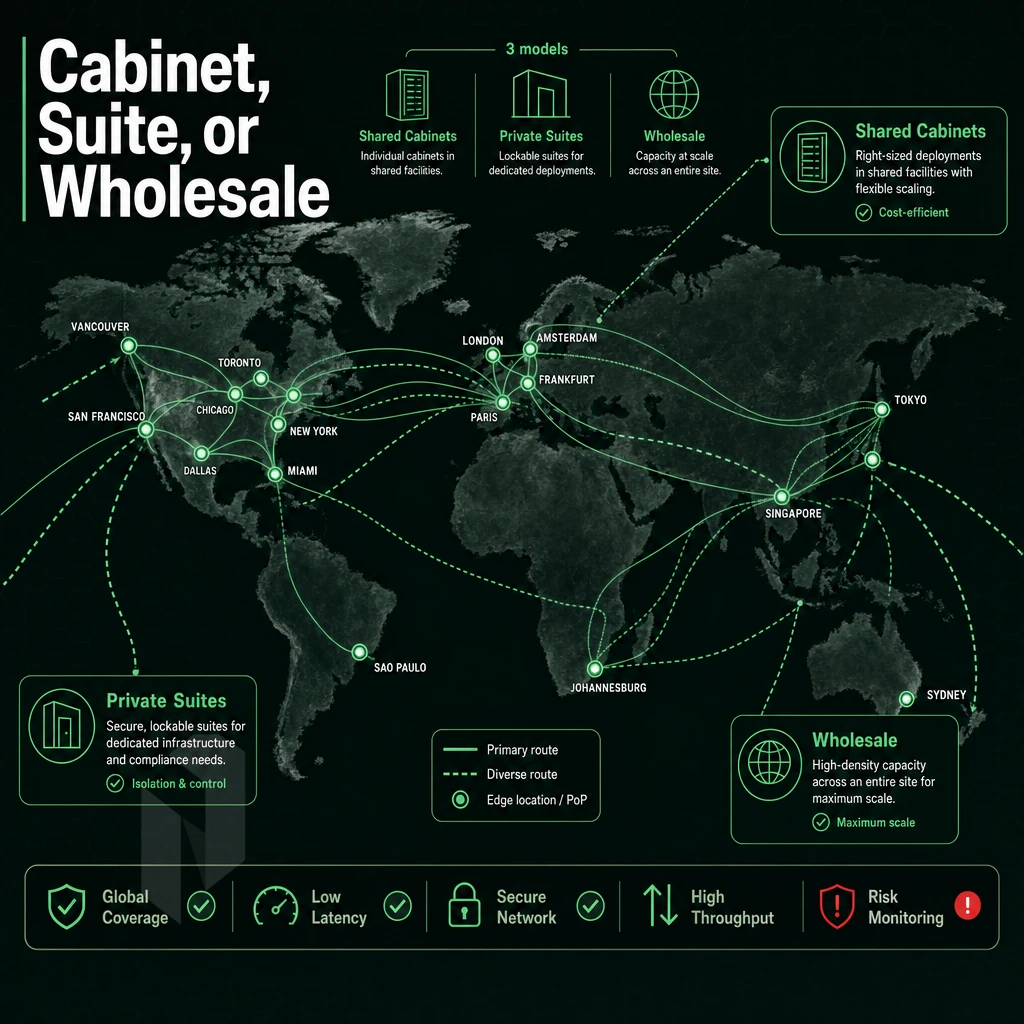
The first step in finding the right colocation solution is to determine which of the models best fits your deployment model. Whether you're migrating from on-premises infrastructure or scaling beyond cloud limitations, understanding the spectrum of data center colocation services helps you match technical requirements to the right deployment tier.
Shared Cabinets: Entry-Level Data Center Colocation Services
Shared cabinets store your hardware in a shared rack with other tenants, in a secured cabinet. The physical access to your equipment is controlled but the cabinet environment itself is shared. This is the most basic form of data center colocation services and very accessible for smaller installations or even for teams that have never moved off premises before.
Note: Shared does not mean unsecured. Reputable providers enforce per-customer locking, CCTV, and access logging at the cabinet level.
Private Suites: Dedicated Space for Mission-Critical Workloads
Private suites provide customers with a fully dedicated data center space or “footprint” in a caged or walled suite, with separate power feeds and access. Private suites are typically used by highly regulated industries that hold sensitive data center resources and require strict audit trails, physical isolation, and controlled cloud connectivity to meet compliance mandates. Private suites are the correct colocation services tier for customers who require these type of features above all others.
Netrouting offers private data center suites with up to 20kW per floor, N+1 power and cooling, power and cooling redundancy built-in. We offer this at our main EU location in The Hague as well as at our other global data center locations.
Who Are the Best Colocation Providers in Data Centers?
A Colocation provider is a data center operator that lets you rent space, power, cooling and interconnects for the servers, storage and other equipment that you already own. This can range from massive global Hyperscale facilities operated as part of a larger company, to smaller regional third-party data center operations run as carrier or wholesale businesses, often as a separate entity.
This Are carrier neutral and offer services to other providers as well as end customers. Netrouting is such a specialist IaaS provider, offering data center services in 10 locations across Europe, North and South America and Asia. We offer bare metal servers , cloud compute and a wide variety of IP transit services.
Knowing the deployment models is only half the story, the other half is to compare colocation data center options to cloud and find out in which situations each model is superior.
Colocation vs. Cloud: Choosing the Right Data Center Model
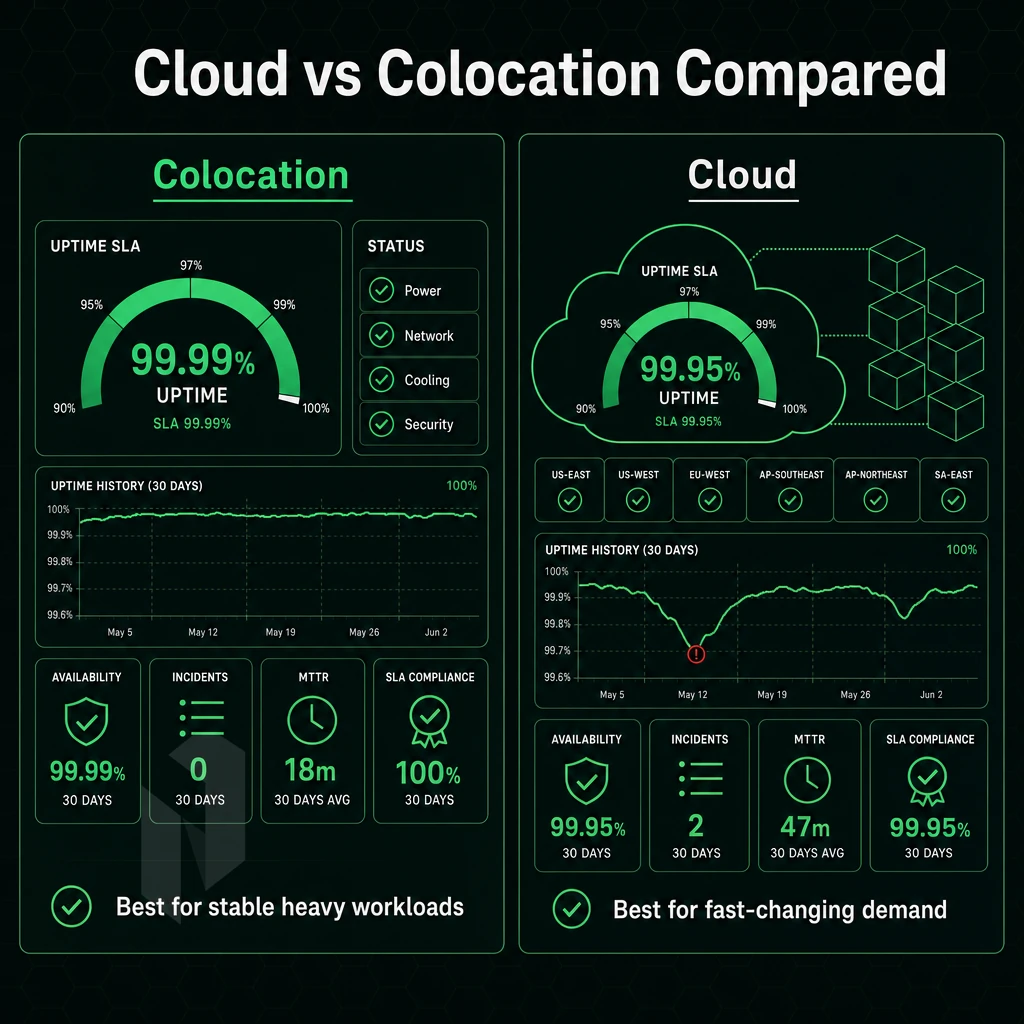
Two primary models for infrastructure are used for enterprise IT: colocation hosting and public cloud. Each of these models solves a different set of problems, and the trade-offs between them, including data storage requirements, will help determine whether a single model or a combination will be best for your data center workloads.
Colocation Hosting Services vs Cloud Hosting: What's the Difference?
Colocation hosting is when you own the server hardware and lease space, power and bandwidth in a third party data center. The data center is responsible for the physical plant (space, power, cooling, etc.) as well as ensuring that the facility is running 24×7 and is physically secure. You are then responsible for the server itself, including the Operating System, web server, application, storage, etc.
With no capital expenditure or ownership of specific hardware.
Colocation Hosting: Data Center Capital Control and Compliance
Server colocation is a good fit for organizations that have very consistent, highly utilized workloads. As the capital expense to purchase the server hardware will amortize over a period of 3 to 5 years. The monthly costs become fixed and are easily predictable, with no surprise egress charges or unusual consumption spikes.
A colocation server in a carrier neutral datacenter will guarantee this for you.
Our colocation locations across Europe, North America and Asia are ISO 9001, ISO 27001 and SOC 2 compliant. This Are the basic requirements for most of the regulations and we don’t have to invest in additional features for our clients.
When Cloud Services Win, and When They Don't
Cloud services are well suited for variable and unpredictable demand patterns. This can be used alongside data center colocation for additional dev/test environments, seasonal traffic peaks, or digital transformation initiatives where speed matters more than long-term cost. Cloud services are operational expenses that scale with usage. Most useful in scenarios with low or highly variable usage.
A single colocation server or a few dedicated bare metal servers end up being the lowest total cost of ownership for sustained loads.
Our Cloud Compute platform is able to provision virtual compute instances across all of our locations. Note that we do not offer a full PaaS platform like the major hyperscalers do. What we do offer is simple, predictable pricing, a selection of unmetered network connectivity options, and access to the same highly available, carrier-grade network that powers our Bare Metal and colocation server hosting products.
While colocation in reliable data centers is the better option for workloads requiring full control over IT, physical hosting, isolation, or compliance, for elastic, short-lifecycle workloads cloud services are the more sensible choice. Many enterprises run their production environment in colocation and burst into the cloud for short peak periods.
This hybrid approach is where Digital Realty and other carrier-neutral datacenter operators such as Netrouting see the most demand. With Digital Realty-style interconnection density and our own AS6206 backbone, such a hybrid architecture is easy to implement.

Now that we have decided colocation is the best option for us instead of cloud hosting, it is time to start comparing specific providers.
Network Quality: Why Carrier-Neutral Peering Matters for Colocation
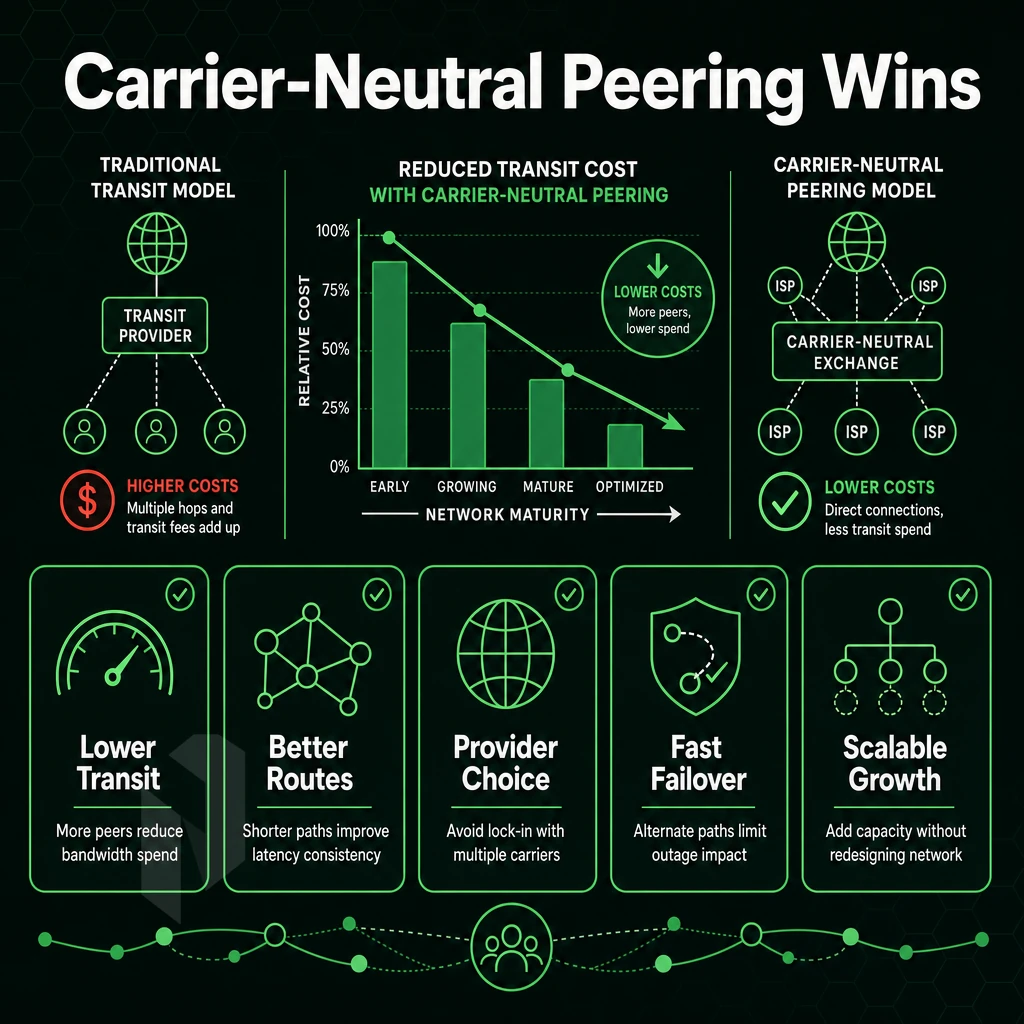
The network architecture of a colocation data center facility is far more important than the amount of rack space they have to offer when it comes to factors like latency, redundancy and flexibility in the long run.
What Carrier-Neutral Means for Colocation Companies
A carrier-neutral facility is one where you can use your own upstream carrier.
A carrier-neutral colocation facility has none of these limitations.
IX Peering and High Speed Network Connectivity
This reduces latency, increases redundancy and saves money.
These connections are operating below 40% average port utilisation.
BGP, BYOIP, and Direct Connections for Global Colocation Providers
For customers that are enterprises or global data center colocation facilities with their own IP space, that do Full BGP and BYOIP (Bring Your Own IP) for a number of reasons.
This allows your traffic to go shortest path, and not through a transit.
It is an interconnection services platform. When evaluating network quality of colocation providers, you should require at least two things: IX density and BGP flexibility.
Network quality is a strong differentiator.
Why Choose Netrouting for Colocation Services
Netrouting delivers carrier-neutral data center colocation built for IT teams that need real infrastructure, not a hyperscaler abstraction layer. Our data center colocation facilities span 10 cities across Europe, North America, and Asia, with every deployment backed by verified, audited operations.
- Certified secure data centers: ISO 9001, ISO 27001, and SOC 2 certified across our network. Physical security includes access control, perimeter fencing, and 24/7 on-site monitoring.
- High-density ready: Up to 20 kW per footprint with N+1 redundant power and redundant cooling, engineered for mission-critical workloads, not just standard rack deployments.
- Carrier-neutral colocation hosting services: Co-locate in Amsterdam, Frankfurt, The Hague, Rotterdam, Stockholm, Bucharest, Miami, New York, Hong Kong, or Singapore. Bring your own IP (BYOIP) and run full BGP. No lock-in to a single upstream.
- Always-on DDoS protection: L3/L4 mitigation included on every colocation service, no add-on required for baseline network security.
- Remote hands services included: Basic remote hands support at no extra cost. 24/7 NOC with a 1-hour ticket guarantee backs every colocation solution.
- Scalable colocation space: Start with a 1U server colocation slot and scale to private suites. Reliable infrastructure grows with your business demands.
For teams evaluating managed colocation services or comparing global colocation providers, Netrouting is worth a direct conversation. Explore our colocation hosting options or contact sales to discuss your specific footprint and requirements.
Still weighing the fundamentals?
Is Colocation Worth It? Key Questions Answered
There are a handful of moving parts behind is colocation worth it? key questions answered. We cover who are colocation providers?, what are the big categories of data center providers?, and who are the largest colocation companies? below.
Who Are Data Center Colocation Providers?
Colocation providers are companies who rent out space, redundant power, cooling and network connectivity within a secure data center. You own the server(s) but they operate the data center facility.
What are the big categories of data center providers?
Each type of player serves different business needs and IT infrastructure requirements.
Who Are the Largest Data Center Colocation Companies?
The largest colocation providers, such as Equinix, Interxion and Telx, operate their own data centers in over 40 markets around the world. No provider is dominant in all markets, as the footprint of different providers, the peering density and the portfolio of data center services offered can vary dramatically from market to market.
Is Data Center Colocation Worth It for Your Business?
For mission critical workloads the answer is yes. Colocation hosting saves you the capital expenditure for the room and the infrastructure for power and cooling. It will ensure uptime, physical security and even enables you to build up a disaster recovery colocation which your own datacenter is not able to provide. Our colocation services are complemented with carrier neutral interconnect services and on-site technical assistance across 10 data center locations around the globe.
When choosing a colocation provider, there are three key things to consider: network, facility and support. A data center colocation facility with extensive IX peering, redundant power, and a guaranteed SLA response time will drastically outperform a cheaper alternative when things start to go wrong.
Shared cabinets are suitable for small footprint server colocation installations, whereas private suites and high-density deployments require a data center service provider with the power and ability to custom configure to meet individual customer requirements. Not all service providers are able to offer these things.
Netrouting offers carrier-neutral data center colocation across Europe, North America, and Asia, backed by a 2.4 Tbps+ network on AS6206, N+1 power and cooling, always-on DDoS protection, and a 24/7 NOC with a one-hour ticket guarantee. If you're evaluating colocation for a production workload, explore Netrouting's colocation options or contact the sales team to discuss your specific requirements.

Savvas Bout Founder & CEO
Savvas Bout is founder and CEO of Netrouting, Data Facilities and Prefixx. He is busily expanding out bare metal, IaaS, network and data center services.