


Picking a colocation provider is one of the most important decisions an IT organization makes. By choosing the right one, you can get a carrier-neutral data center with fixed costs, control of your own server hardware, and network performance that typically far exceeds that of cloud platforms. Choose poorly and you will find yourself in a data center with limited connectivity, abysmal support, and unexpected charges for seemingly random things on your invoices.
The market for colocation facilities ranges from a single rack in a local facility to a multi-cabinet private suite in a Tier III interconnection facility. What sets good colocation providers apart is not rack space but network density. For more context, see colocation solutions.
Colocation Evaluation Guide: This guide will walk through the main points to evaluate when choosing among colocation providers. From the facility and power/cooling to connectivity and SLA’s.
This guide will be relevant for those looking to move services off of cloud to save money, as well as those planning a data center deployment to expand their hybrid infrastructure into additional regions. The guide will start with the basics of what a colocation provider is and what they offer. Organizations planning their first data center deployment should evaluate colocation as a cost-effective alternative to building proprietary facilities from scratch.
What Are Colocation Services and How Do Colocation Providers Work?
A colocation service provider rents out physical space in a data center facility and you bring your own servers and network hardware. Colocation providers supply the surrounding environment (cabinets, power, cooling, bandwidth, etc.) for your own servers and IT equipment. It is somewhere between building your own data center and moving to 100% cloud compute.
What a Colocation Service Provider Supplies to Clients
We deliver Data Center space, Redundant Power, Cooling and Network Connectivity. Physical security such as Biometric access, CCTV and on site staff is included. You own your own servers and other hardware.
How Colocation Solutions Differ from Cloud
A key point of differentiation for Cloud hosting versus Colocation hosting is that Cloud hosting abstracts the end customer from the hardware entirely, unlike Colocation hosting or running an in house data center. At a Colocation facility, your servers are your servers. In a colocation data center, you have complete control over the Operating System, firmware and configuration of the servers as well as all other hardware in your cabinet.
This level of control is critical for data center organizations requiring strict compliance as well as those requiring fine-tuned performance from their servers. Organizations in regulated industries such as healthcare, finance, and government often choose colocation to meet stringent compliance requirements that mandate physical hardware control and audit trails. Fine-grained control over hardware configurations, firmware versions, and kernel parameters allows technical teams to improve performance through optimization strategies that would be impossible in abstracted cloud environments.
Large enterprises particularly benefit from this granular control when deploying complex multi-tier architectures that demand precise resource allocation and predictable performance characteristics. Colocation facilities provide the infrastructure reliability and hardware sovereignty that mission critical workloads demand, particularly when performance degradation or service interruptions would result in significant business impact.
When Cross Connects Make Sense
A dedicated data center hosting service is ideal for customers outgrowing their on-premise data center infrastructure who don't want to be locked into a cloud solution with no hardware control. A good example is a media company running streaming origin servers from a dedicated colocation facility within a carrier-neutral site. This data center colocation approach has dramatically reduced latency for their customers while retaining 100% control of the infrastructure.
Global colocation providers operate across multiple regions, letting you place your servers near your users without building your own data center. Netrouting is a carrier-neutral data center colocation provider with facilities in Europe, North America, and Asia-Pacific. This article examines the engineering behind such data centers: power, cooling, security, and connectivity.
This geographic distribution helps enterprises build resilient digital ecosystems spanning multiple continents while maintaining consistent performance and security. The largest colocation providers operate hundreds of facilities worldwide, giving enterprises the ability to deploy infrastructure across strategic markets with consistent service levels.
Colocation Services vs. Public Cloud: Choosing the Right Model
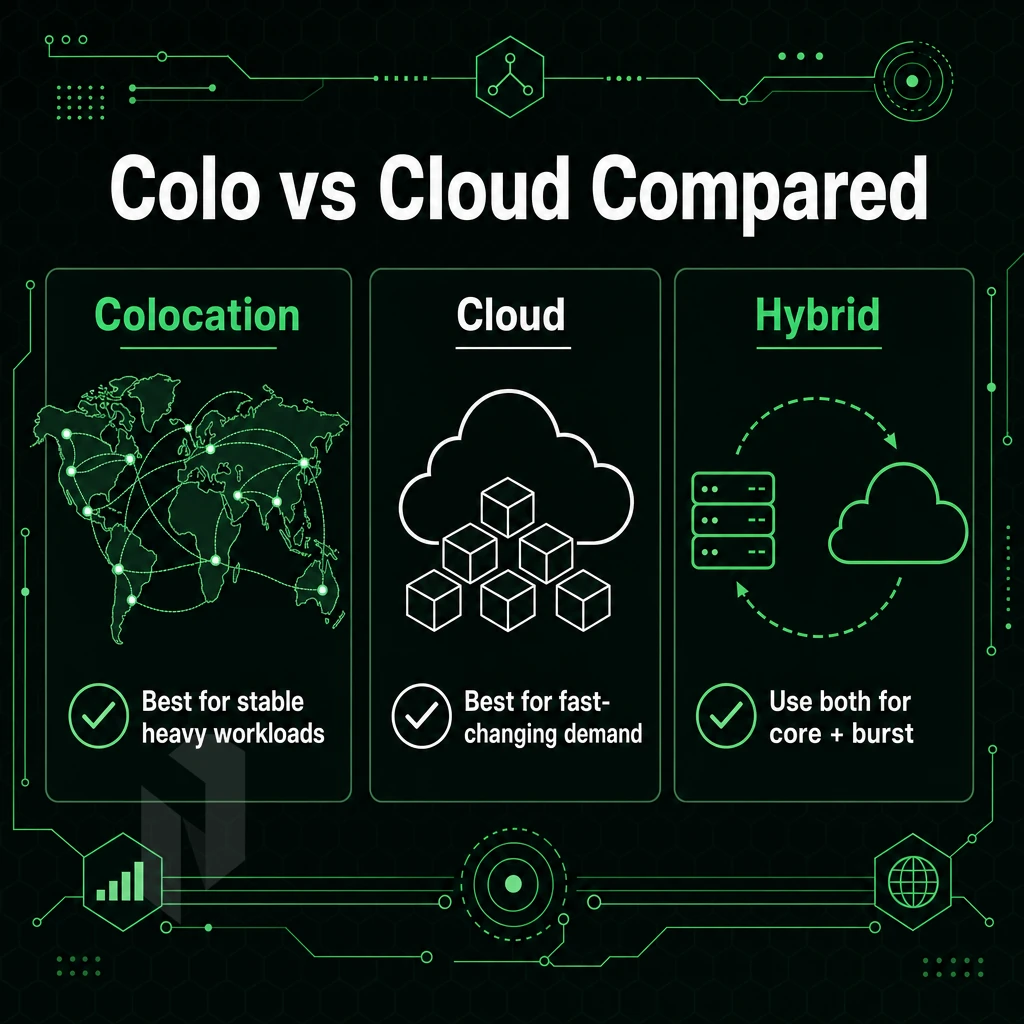
Whether to use a colo provider with robust infrastructure or a public cloud platform depends on factors including the nature of your workloads, compliance issues, and cost predictability. Many organizations evaluate multiple colo providers to compare network density, peering options, and the availability of direct cross-connects before committing to a facility. Most organizations find that a hybrid approach combining colocation for stable workloads with cloud for variable demand delivers optimal cost efficiency and operational flexibility.
Physical Control vs. On-Demand Access
With colocation solutions, you have complete control over the servers, a fixed block of bandwidth, and physical access to the servers in your cabinet.
For truly mission critical services, renting space in a colocation facility is a very important option to consider, as the variable nature of cloud-based services can be completely unacceptable for such applications. Colocation facilities deliver high availability through redundant power systems, multiple network paths, and geographically distributed infrastructure that ensures continuous operation even during component failures. Organizations deploying mission critical infrastructure require the predictable performance and redundancy that colocation facilities provide through their engineered systems and service level agreements.
Cloud platforms offer on demand access to elastic compute resources. But as a platform for shared infrastructure, cloud providers charge variable egress costs and do not allow for physical control of servers and storage. Therefore cloud providers, unlike colocation providers, are not well suited for high-performance computing or for projects that must comply with strict regulations.
Cloud Computing and Hybrid IT
Mature IT environments mix colocation and cloud hosting. For example, a secure colocation data center is typically used to host the most business-critical applications, databases, trading platforms, and real-time applications. Cloud hosting, alongside a colocation data center setup, is then used for 'burst' requirements, such as seasonal peaks in usage or for development / test environments. Thus, you avoid the typical over-provisioning of resources, while the most sensitive applications remain on dedicated servers in a colocation environment.
When Colocation Facilities Win
A third party data center such as Netrouting's data center facilities in Amsterdam, Frankfurt, Miami and Hong Kong provides carrier-neutral connectivity, 99.9% uptime SLAs and 24/7/365 DDoS protection, all without the high price tag of the hyperscalers. For latency-sensitive applications and regulated environments, this mix is powerful. Next, we'll cover the advantages that colocation providers offer.
Frequently Asked Questions About Colocation Services
How Data Center Colocation Services Work and What Providers Offer
A data center provider rents rack space inside a professional data center so you can house your own servers and networking gear. The provider supplies the building, power, cooling, on-site security, and network connectivity. This model, offered by colocation providers, gives you direct control over your infrastructure without the capital cost of building and operating your own facility. By avoiding capital expenditures on facility construction, organizations can allocate budget toward servers and network equipment that directly support business objectives. Organizations shifting from on-premise infrastructure to colocation can redeploy capital expenses previously tied to facility maintenance into revenue-generating technology investments. Leasing data center space from a colocation provider eliminates the need for long-term real estate commitments and allows organizations to scale their footprint incrementally as demand grows. Colocation providers enable organizations to achieve lower costs through operational efficiency and shared infrastructure investments that would be prohibitively expensive for individual companies to replicate.
How Does Data Center Colocation Differ From Cloud Hosting?
Colocation means your physical hardware runs inside a shared data center facility, you own the servers, you control the software stack. Cloud hosting runs your workloads on virtualized infrastructure owned and operated by the provider. Colocation delivers predictable costs and full hardware control. Cloud hosting trades that control for on-demand elasticity and a broader managed-service catalog. For stable, high-throughput workloads, colocation typically delivers a lower total cost of ownership.
What Does a Colocation Data Center Provider Typically Include?
Unlike cloud computing, a colocation facility provides rack space or private caged suites, dual power feeds feeds with UPS and generator backup, precision cooling, physical access controls, and 24/7 on-site security. Network infrastructure, cross-connects, uplinks, and often IX peering, is included or available as an add-on. Reputable providers also offer remote hands support at the data center, so technicians can perform basic hardware tasks on your behalf without you traveling to the site. Tier III and Tier IV facilities also deploy advanced cooling systems that maintain optimal temperature and humidity levels even during peak load conditions. Redundant backup generators ensure continuous operation during utility power failures, automatically activating within seconds to maintain uptime for critical infrastructure. Carrier-neutral colocation facilities often host internet exchange points where members can exchange traffic directly with other networks, reducing latency and transit costs. Some colocation providers also bundle managed services that include server monitoring, patch management, and backup administration for customers who prefer operational support alongside their infrastructure.
How can a carrier-neutral colocation data center benefit my business?
Carrier-neutral facilities let you connect to any network provider operating in that data center, you are not locked into a single ISP or transit provider.
For businesses with strict latency or routing requirements, carrier-neutral data center colocation is the standard choice.
What Certifications Should Colocation Services Providers Have?
At minimum, look for ISO 27001 (information security management), ISO 9001 (quality management), and SOC 2 Type II (security, availability, and confidentiality controls) when evaluating any colocation data center. ISO 27001 confirms the provider has a structured approach to protecting your data and physical assets. SOC 2 Type II is an independent audit, not a self-assessment, covering operational controls over time. Netrouting holds ISO 9001, ISO 27001, and SOC 2 certifications across its facilities.
What is the largest colo provider?
By total data center footprint and global revenue, a small number of large-scale operators dominate the colocation market. Specialized data center providers offering colocation services, like Netrouting, with locations across Stockholm, Amsterdam, Rotterdam, The Hague, Frankfurt, Bucharest, Miami, New York, Hong Kong, and Singapore, deliver carrier-neutral infrastructure, custom configurations, and direct technical support that large-scale operators rarely match.
Are Colocation Services Suitable for Disaster Recovery?
Yes, colocation is a proven disaster recovery strategy. Placing secondary hardware in a geographically separate colocation data center protects against site-level failures: power outages, natural disasters, or network disruptions at your primary location. Carrier-neutral colocation strengthens this further by giving your DR site independent network paths. Netrouting supports DR deployments across its multi-city colocation data center network, including Rotterdam as a dedicated DR-oriented presence for clients whose primary footprint is at The Hague facility.
Colocation services allow you to have control of a dedicated infrastructure without the costs of building and operating your own data center. You own the servers and have access to enterprise-class power, cooling and redundancy. You connect directly to Carrier Neutral facilities and benefit from interconnection services linking you to all service providers in that facility, something that no standard data center room can offer.
Colocation is a cost effective alternative to Public Cloud for users who require predictable costs and a consistent level of performance.
Your colocation provider is just as important as your model. All of these play a large part in how your infrastructure will perform under load.
Netrouting operates carrier-neutral colocation facilities across Europe, North America, and Asia, backed by a 2.4 Tbps+ network, ISO 27001 and SOC 2 certifications, and 24/7 support with a one-hour ticket guarantee. Explore Netrouting colocation to find the right fit for your deployment.

Savvas Bout Founder & CEO
Savvas Bout is founder and CEO of Netrouting, Data Facilities and Prefixx. He is busily expanding out bare metal, IaaS, network and data center services.
Founder & CEO
Savvas Bout is the founder and CEO of Netrouting. He has more than 20 years of experience in network engineering, data center design and operations, and infrastructure automation. He writes about building and running bare-metal, networking and hosting infrastructure at Netrouting.