
惯性聚合 高效追踪和阅读你感兴趣的博客、新闻、科技资讯
阅读原文 在惯性聚合中打开

推荐订阅源

cs.CL updates on arXiv.org
cs.AI updates on arXiv.org
Hacker News - Newest:
Hacker News - Newest: "LLM"
S
Security Affairs
PCI Perspectives
PCI Perspectives
Google Online Security Blog
W
WeLiveSecurity
www.infosecurity-magazine.com
Recent Commits to openclaw:main
P
Privacy & Cybersecurity Law Blog
Threat Intelligence Blog | Flashpoint
S
Security @ Cisco Blogs
Security Archives - TechRepublic
Cyberwarzone
Cyberwarzone
L
Lohrmann on Cybersecurity
TaoSecurity Blog
TaoSecurity Blog
V
Visual Studio Blog
博客园 - 聂微东
Scott Helme
Scott Helme
博客园 - 【当耐特】
K
Kaspersky official blog
Security Latest
Security Latest
K
KPMG report finds enterprise disconnect between AI and its ROI | CIO
MyScale Blog
MyScale Blog
Schneier on Security
WordPress大学
WordPress大学
博客园 - 叶小钗
C
Check Point Blog
V2EX - 技术
V2EX - 技术
钛媒体:引领未来商业与生活新知
钛媒体:引领未来商业与生活新知
博客园 - Franky
T
Tor Project blog
Apple Machine Learning Research
让小产品的独立变现更简单 - ezindie.com
腾讯CDC
雷峰网
雷峰网
博客园_首页
美团技术团队
Y
Y Combinator Blog
C
CERT Recently Published Vulnerability Notes
AWS News Blog
AWS News Blog
月光博客
月光博客
N
Netflix TechBlog - Medium
Last Week in AI
Last Week in AI
Recent Announcements
Google DeepMind News
Help Net Security
Help Net Security
P
Proofpoint News Feed
MongoDB | Blog
MongoDB | Blog
C
Cybersecurity and Infrastructure Security Agency CISA

Mintlify Blog

22 UX improvements to the web editor Introducing the Mintlify Help Center Starter Kit Introducing the collaborative editor built for teams and agents Workflows, rebuilt Is your documentation agent-ready? Mintlify raises $45M Series B led by Andreessen Horowitz and Salesforce Ventures 5 things you didn't know you could do in the Mintlify web editor The improved Mintlify CLI Docs on autopilot: From zero to self-maintaining with Mintlify The state of agent traffic in documentation (March 2026) How we built a virtual filesystem for our Assistant We Replaced Our Internal Wiki With a Slack Bot. You Should Too. 8 ways teams use Mintlify to keep docs updated automatically Documentation is your AI interface What three years of watching AI in production taught us Bridging two JSX runtimes: How we solved Astro's React children problem AI agents are shipping faster than anyone can document Knowledge management systems for technical teams Workflows: Automate documentation maintenance Mintlify acquires Helicone to redefine AI knowledge infrastructure Why more product managers are switching to Mintlify Auto-generating documentation sites from GitHub repos Your docs, your frontend, our content engine Take control of your documentation system Almost half your docs traffic is AI, time to understand the agent experience @mintlify for better docs, faster Mintlify for Enterprise Real llms.txt examples from leading tech companies (and what they got right) Mintlify + Claude Opus 4.6: Powering AI-native knowledge management Declaring Clankruptcy: An experiment in agent orchestration Analytics for AI and agent traffic A better way to edit and publish in Mintlify Improved agent experience with llms.txt and content negotiation Your docs are now discoverable by agents Why do we need MCP if skills exist now? skill.md: An open standard for agent skills install.md: A Standard for LLM-Executable Installation Why documentation is one of the most important surfaces for marketers How I built our knowledge base in an afternoon Closing the loop between user questions and documentation 2025: A Year in Review Mintlify Security Event - November 2025 Inside our effort to improve the Mintlify assistant Introducing the next step towards self-updating docs How we eliminated cold starts for 72M monthly page views with edge caching 10 UI fixes I shipped in 10 days The Mintlify agent, now in your dashboard Impact of SHA1-Hulud: The Second Coming on the Mintlify CLI Documentation is dead. Long live documentation. What I shipped in my first 60 days at Mintlify Terminal agents are the future - We're launching mint new How we’re making Mintlify documentation more accessible Building an LSP for your docs The role of good code blocks in documentation The /api Namespace is Now Open Introducing the Mintlify Agent to write documentation with AI We built our coding agent for Slack instead of the terminal Top 7 ways to blend SEO with GEO for explosive brand growth How Mintlify uses Claude Code as a technical writing assistant AI Documentation Trends: What's Changing in 2025 Debugging a mysterious HTTP streaming issue How Pinecone writes documentation How to generate llms.txt Mintlify acquires Trieve to improve RAG search in documentation Behind Replit's Documentation Transformation How often do LLMs visit llms.txt? How Claude's memory and MCP work (and when to use each) Introducing AI Assistant: Turning docs into your product expert My quick formula for docs that convert It's not a race How to hire your first technical writer GEO guide to optimize writing for LLMs How Windsurf writes docs How Anaconda writes documentation Should you generate docs from your API schema? The value of llms.txt: Hype or real? Why we sunsetted mcpt How to use MCP servers to generate docs AI can write your docs, but should it? What is llms.txt? Breaking down the skepticism mcpt: The curated registry for MCP servers Why I joined Mintlify How to audit and overhaul your software documentation What is MCP and how to get started Generate MCP servers from your docs Mintlify vs. Readme: A 2025 Comparison How Generative Engine Optimization is Reshaping Docs Should you build or buy an API documentation tool? When do you really need a monorepo? Fireside Chats: Gong's Approach to Software Documentation The Next Chapter of Mintlify Themes New Devs Don't Read Docs? Maybe It's Not Their Fault Founder Mode: Dub's journey from side project to enterprise link attribution platform Refactoring mint.json into docs.json Breaking down common documentation mistakes What makes good API documentation? Best tools and examples 2024 in Review: Getting Ship Done Five changelog principles from best-in-class developer brands Founder Mode: How Windsurf builds product, from 0 to 1M users Introducing AI Assistant
Docs as an abstraction layer for coding agents
Han Wang · 2026-06-08 · via Mintlify Blog

A company we work with has a dedicated team whose sole mandate is making AI coding agents more efficient across their engineering org.

That focus on efficiency tells you something about how enterprises are thinking about token spend today.

They're running Claude Code, primarily on Sonnet, across monolith repos with millions of lines of code. The agents are expensive and unreliable. The engineers using them spend more time prompting and re-prompting than they would just writing the code themselves.

We ran a controlled experiment with them to measure how much documentation structure matters for agent performance. The results were good enough that I think this applies to almost every company doing serious AI-assisted development at scale.

When you point a coding agent at an undocumented codebase it crawls files, guesses at structure from naming conventions, and pieces together intent from patterns in the code. With no memory of what it figured out last time, this gets expensive.

You'll burn an enormous amount of context budget on orientation before the agent gets to whatever you asked it to do.

The second problem is that code only tells you what got built, not why. The reasoning behind architectural decisions lives in old Slack threads and a couple people's brains. An agent working from code doesn't have the intent layer. Even a hammer is complex if you don't know you're supposed to hit nails with it.

Structured documentation is an abstraction over the codebase that improves agents by encoding intent alongside implementation. That's the hypothesis we went in to test.
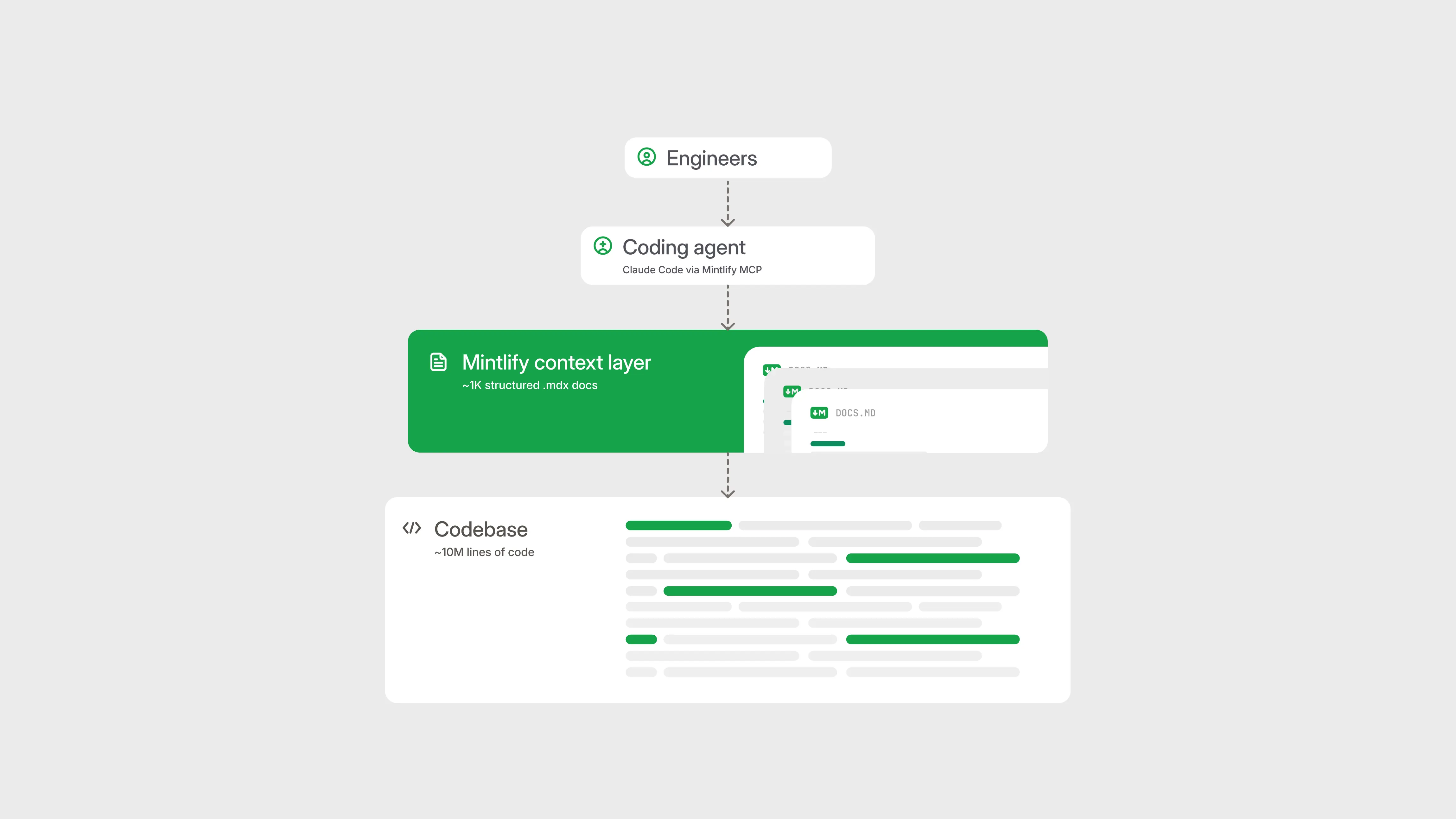
Graphic of the Mintlify context layer between coding agents and the codebase.

The team ran tests across their largest, most actively used repositories. For each one, they defined around 15 deterministic tasks spanning easy, medium, and hard. Things like "how do you compile the server," "identify whether this service has a dependency on library X," and several code generation tasks. Success was measured deterministically: shell exit codes, specific string matches, verifiable outputs. Each task ran five times per condition for statistical reliability.

Three conditions:

No docs — a branch with the README, CLAUDE.md, agents.md, and all documentation stripped. Clean baseline.

Improved docs — README plus human-written docs and AI/agent markdown files. The best realistic self-hosted outcome.

Mintlify-generated docs — the improved docs ingested into Mintlify, with Claude Code connected via MCP.

The primary metrics were precision (did the agent get the right answer) and discoverability (did it find the right context to work from).
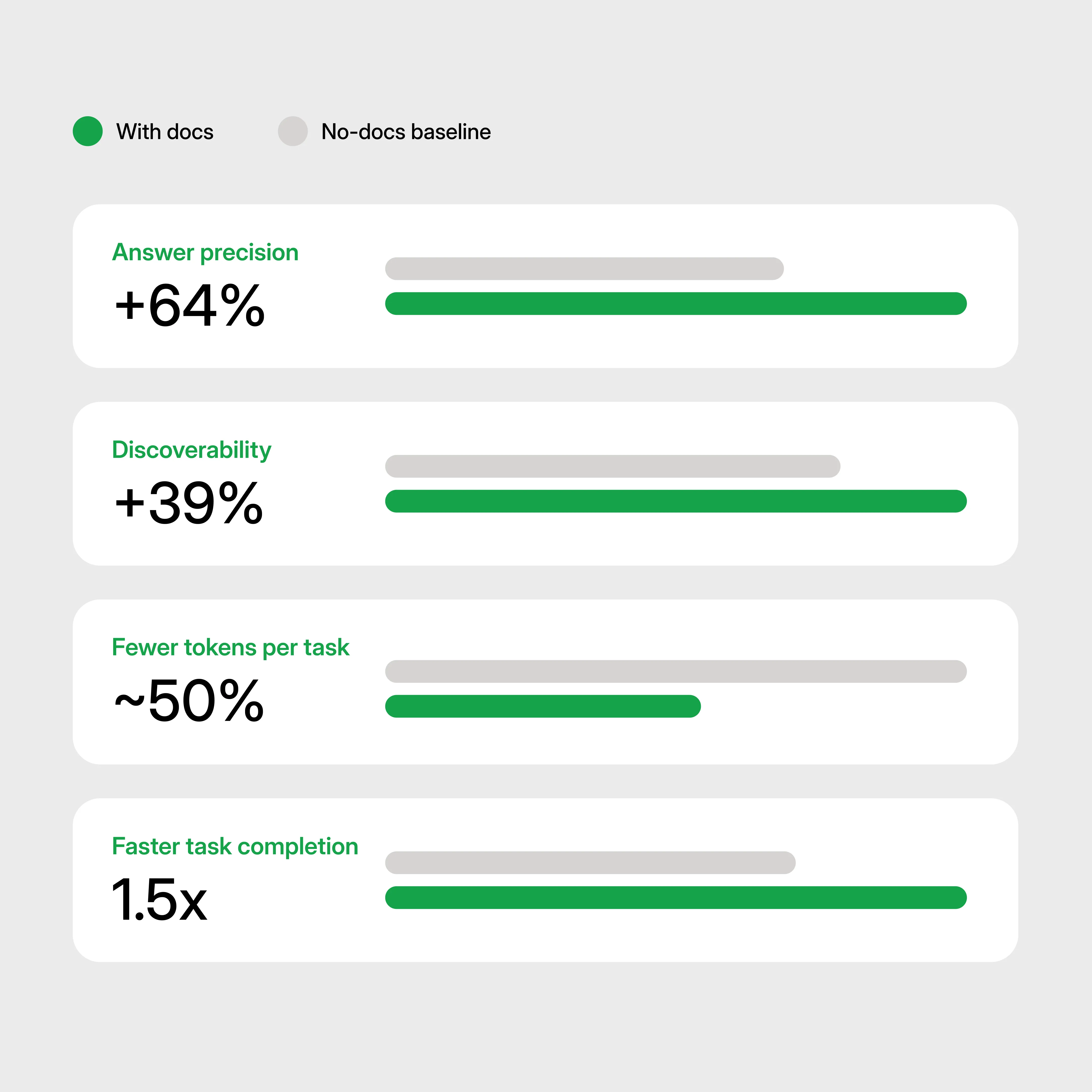
Chart showing the results of the experiment.

Against the no-docs baseline:

  • 64% more precise answers across all task types
  • 39% better discoverability — agents found the right information significantly more often
  • ~50% fewer tokens consumed per task
  • 1.5x faster task completion

I expected structured docs to help, but was surprised by the extent of the improvements. The token reduction in particular changes how you think about the economics of AI-assisted development.

Letting agents work from raw code is a baseline. To compete and get the best results, you need to give them the structure that docs provide.

READMEs can be a great solution, but just adding a file or inline comments isn't enough. These are snapshots that decay into another source of stale information for agents to hallucinate from. Automating updates for your documentation when your code changes is the best way to keep your intent layer up to date. You want to get documentation as close to the code as possible.

Big engineering orgs are spending millions on tokens for AI coding tasks, and that number is climbing. Every budget holder we talk to is asking "why are we paying so much for results this inconsistent?"

Cutting per-task token consumption by 50% can be huge savings. If you're spending $1M per year on AI coding tokens, that's $500K back (assuming throughput stays constant, and throughput goes up when agents are faster and more accurate).

An agent using MCP to search structured docs retrieves precise, relevant context in a single targeted query. An agent without that infrastructure crawls files until it finds something usable or runs out of context. Cheap and accurate versus expensive and flaky.

The obvious counterargument is that if models are getting better at navigating code, won't this problem just go away?

The experiments we ran are saying no. A more capable model working from raw code is still relearning the codebase from scratch every session. It's still burning context on orientation and missing the intent layer that lives outside the code.

What we found is that this architecture scales with model capability. Well architected docs plus a capable model outperforms the same model working from raw code.

We are planning to release a full public benchmark suite soon, so you can see more clearly how to replicate our experiment.

In the meantime, the easiest entry point is mintlify.wiki/explore, which generates a Mintlify docs instance from your repository. Connect your coding tools via MCP to give your agents structured search over that knowledge instead of raw file crawling.

The second step is to make it automatically maintained via workflows. They run on repository pushes or cron jobs, detect when code changes require documentation updates, and make the updates for you.

If you want to run a similar evaluation for your own codebase, reach out.