
惯性聚合 高效追踪和阅读你感兴趣的博客、新闻、科技资讯
阅读原文 在惯性聚合中打开

推荐订阅源

大猫的无限游戏
大猫的无限游戏
博客园 - 【当耐特】
Cloudbric
Cloudbric
H
Hackread – Cybersecurity News, Data Breaches, AI and More
Attack and Defense Labs
爱范儿
爱范儿
The Cloudflare Blog
腾讯CDC
Security Archives - TechRepublic
TaoSecurity Blog
TaoSecurity Blog
云风的 BLOG
云风的 BLOG
Recent Announcements
C
Check Point Blog
Schneier on Security
S
Schneier on Security
J
Java Code Geeks
B
Blog RSS Feed
Cisco Talos Blog
Cisco Talos Blog
Vercel News
Vercel News
Stack Overflow Blog
Stack Overflow Blog
博客园_首页
cs.AI updates on arXiv.org
A
About on SuperTechFans
Threat Intelligence Blog | Flashpoint
Google DeepMind News
阮一峰的网络日志
阮一峰的网络日志
罗磊的独立博客
A
Arctic Wolf
S
Secure Thoughts
P
Palo Alto Networks Blog
The Last Watchdog
The Last Watchdog
SecWiki News
SecWiki News
cs.CV updates on arXiv.org
博客园 - 三生石上(FineUI控件)
D
Darknet – Hacking Tools, Hacker News & Cyber Security
量子位
U
Unit 42
I
InfoQ
D
DataBreaches.Net
P
Privacy International News Feed
T
Troy Hunt's Blog
博客园 - 叶小钗
T
Threatpost
博客园 - Franky
K
Kaspersky official blog
Hugging Face - Blog
Hugging Face - Blog
IT之家
IT之家
www.infosecurity-magazine.com
CTFtime.org: upcoming CTF events
C
Cisco Blogs

Mintlify Blog

22 UX improvements to the web editor Introducing the Mintlify Help Center Starter Kit Introducing the collaborative editor built for teams and agents Workflows, rebuilt Mintlify raises $45M Series B led by Andreessen Horowitz and Salesforce Ventures 5 things you didn't know you could do in the Mintlify web editor The improved Mintlify CLI Docs on autopilot: From zero to self-maintaining with Mintlify The state of agent traffic in documentation (March 2026) How we built a virtual filesystem for our Assistant We Replaced Our Internal Wiki With a Slack Bot. You Should Too. 8 ways teams use Mintlify to keep docs updated automatically Documentation is your AI interface What three years of watching AI in production taught us Bridging two JSX runtimes: How we solved Astro's React children problem AI agents are shipping faster than anyone can document Knowledge management systems for technical teams Workflows: Automate documentation maintenance Mintlify acquires Helicone to redefine AI knowledge infrastructure Why more product managers are switching to Mintlify Auto-generating documentation sites from GitHub repos Your docs, your frontend, our content engine Take control of your documentation system Almost half your docs traffic is AI, time to understand the agent experience @mintlify for better docs, faster Mintlify for Enterprise Real llms.txt examples from leading tech companies (and what they got right) Mintlify + Claude Opus 4.6: Powering AI-native knowledge management Declaring Clankruptcy: An experiment in agent orchestration Analytics for AI and agent traffic A better way to edit and publish in Mintlify Improved agent experience with llms.txt and content negotiation Your docs are now discoverable by agents Why do we need MCP if skills exist now? skill.md: An open standard for agent skills install.md: A Standard for LLM-Executable Installation Why documentation is one of the most important surfaces for marketers How I built our knowledge base in an afternoon Closing the loop between user questions and documentation 2025: A Year in Review Mintlify Security Event - November 2025 Inside our effort to improve the Mintlify assistant Introducing the next step towards self-updating docs How we eliminated cold starts for 72M monthly page views with edge caching 10 UI fixes I shipped in 10 days The Mintlify agent, now in your dashboard Impact of SHA1-Hulud: The Second Coming on the Mintlify CLI Documentation is dead. Long live documentation. What I shipped in my first 60 days at Mintlify Terminal agents are the future - We're launching mint new How we’re making Mintlify documentation more accessible Building an LSP for your docs The role of good code blocks in documentation The /api Namespace is Now Open Introducing the Mintlify Agent to write documentation with AI We built our coding agent for Slack instead of the terminal Top 7 ways to blend SEO with GEO for explosive brand growth How Mintlify uses Claude Code as a technical writing assistant AI Documentation Trends: What's Changing in 2025 Debugging a mysterious HTTP streaming issue How Pinecone writes documentation How to generate llms.txt Mintlify acquires Trieve to improve RAG search in documentation Behind Replit's Documentation Transformation How often do LLMs visit llms.txt? How Claude's memory and MCP work (and when to use each) Introducing AI Assistant: Turning docs into your product expert My quick formula for docs that convert It's not a race How to hire your first technical writer GEO guide to optimize writing for LLMs How Windsurf writes docs How Anaconda writes documentation Should you generate docs from your API schema? The value of llms.txt: Hype or real? Why we sunsetted mcpt How to use MCP servers to generate docs AI can write your docs, but should it? What is llms.txt? Breaking down the skepticism mcpt: The curated registry for MCP servers Why I joined Mintlify How to audit and overhaul your software documentation What is MCP and how to get started Generate MCP servers from your docs Mintlify vs. Readme: A 2025 Comparison How Generative Engine Optimization is Reshaping Docs Should you build or buy an API documentation tool? When do you really need a monorepo? Fireside Chats: Gong's Approach to Software Documentation The Next Chapter of Mintlify Themes New Devs Don't Read Docs? Maybe It's Not Their Fault Founder Mode: Dub's journey from side project to enterprise link attribution platform Refactoring mint.json into docs.json Breaking down common documentation mistakes What makes good API documentation? Best tools and examples 2024 in Review: Getting Ship Done Five changelog principles from best-in-class developer brands Founder Mode: How Windsurf builds product, from 0 to 1M users Introducing AI Assistant Simplifying docs for AI with /llms.txt
Is your documentation agent-ready?
Ethan Palm · 2026-04-27 · via Mintlify Blog

Agents are reading your documentation. Whether it's Cursor pulling context for a developer, Claude answering a support question, or an autonomous agent evaluating your API, your docs have a new audience that never tells you if it got what it needed from your site.

To be agent-ready, your documentation must be structured so agents can find it, understand it, and use it. That means clear entry points, well-formed content, consistent terminology, and the right signals in the right places.

Agent score tests your documentation against 29 checks and tells you exactly how ready it is for agents.

Coding agents are rapidly becoming the primary surface for developer experience. To tackle anything meaningfully complex, agents require detailed, trustworthy context. For APIs and SDKs, that means documentation. When docs are accurate, well-structured, and agent-accessible, devs can pull off nearly hands-free integrations, saving huge amounts of time and effort. It's early days, but in customer conversations we're already seeing this emerge as a competitive differentiator.

— Mo King, Lead DX Engineer at Together AI

Enter your documentation site URL at mintlify.com/score. You'll get a score and an explanation of each category in seconds.
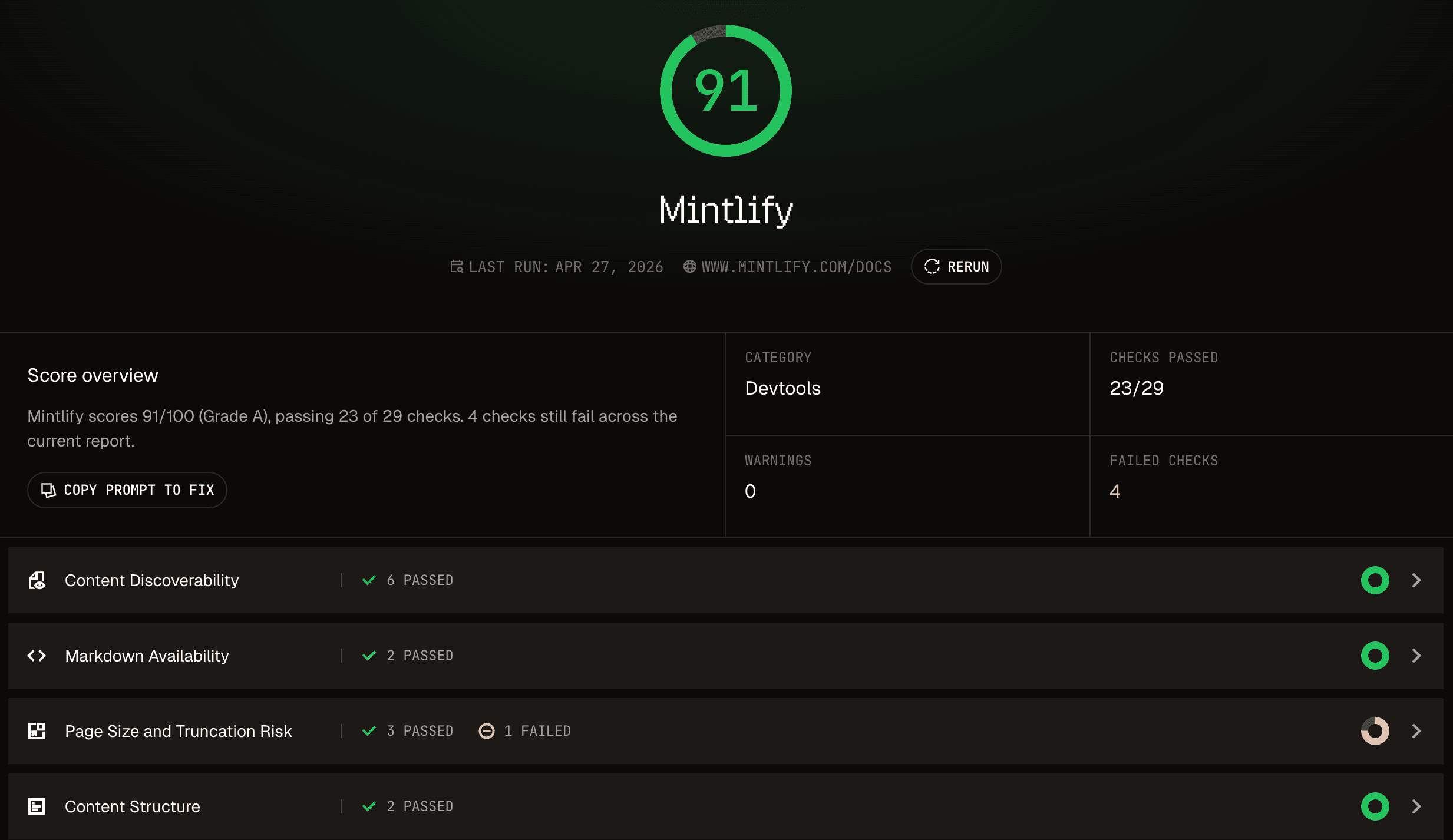
Agent score dashboard showing checks and scores

You'll see what your site does well and where you can improve.

Keep in mind, it's a snapshot. Your score reflects the current state of your documentation. It changes as your docs change.

A low score isn't a failure. Most documentation wasn't written with agents in mind, because agents weren't a primary audience until recently. Use your score to guide where you take your documentation rather than judge it's current state. Documentation maintenance will always be an ongoing process.

Agent score is built on the Agent-Friendly Documentation Spec, an open standard that defines what good documentation looks like for agents. It runs checks across seven categories:

  • Content Discoverability — Can agents find your docs?
  • Markdown Availability — Can agents get clean Markdown?
  • Page Size — Are pages a reasonable size or will agents truncate them?
  • Content Structure — Is the content well-formed for agents?
  • URL Stability — Are URLs going to help or hinder agents?
  • Observability — Do resources stay accurate over time?
  • Authentication — Can agents reach your docs?

The spec covers the foundations very well. We added checks on top based on how we observe agents using documentation:

  • Full content discoverability — Can long-context agents find and retrieve a corpus without repeated crawling?
  • Agent skill discoverability — Can agents find and use your agent skills?
  • MCP server discoverability — Can agents find and call tools on your site programmatically?

These additions reflect what we're seeing matter most right now, and how we expect agent-mediated documentation use to evolve.

We built an internal tool with proprietary scoring. It worked well, but building on top of a closed standard didn't make sense.

Agent-readiness isn't a problem anyone will solve alone. Standards like llms.txt only work when they're widely adopted. The signals agents rely on only matter when they're consistent. The ecosystem only improves when the whole documentation environment iterates together.

The Agent-Friendly Documentation Spec is an open standard, with a companion open source library that implements all the checks.

We're building with the community and want to encourage others to contribute to the standard and the tooling.

Agent score is built on the spec. The checks are transparent. We're highlighting additional patterns we believe will improve documentation for all of our users.

Writing documentation for agents is a new discipline. We're all learning, and everyone improves with collaboration. More voices will help the standards and best practices develop faster.

If you think we're missing something, we want to hear from you. If you disagree with how we've implemented a check, let us know. If you've found something in your own docs that correlates with good or bad agent behavior, that's exactly the kind of signal that can help everyone who maintains documentation.

Score your docs at mintlify.com/score.