








When Han and I started Mintlify, we built for people like us: early-stage founders shipping devtools. We knew our users because we were our users. That's why Mintlify was CLI-first and git-native from day one. This will always be at the core of our product.
Our first customers were founders and founding employees at early-stage startups. They stored their docs in a GitHub repo, previewed changes locally through our CLI, and published from their terminal. It worked because that's how they already worked.
But today, thousands of teams use Mintlify, and the people contributing to docs go well beyond engineering such as product managers, customer support, marketing. Teams across the entire org need to contribute to documentation, and they need a workflow that meets them where they are, without compromising the developer-first foundation.
Today, I'm excited to share our new editor, built for collaboration across teams and agents.
The first thing you'll notice is that the editor is visual. What you see is what you ship.
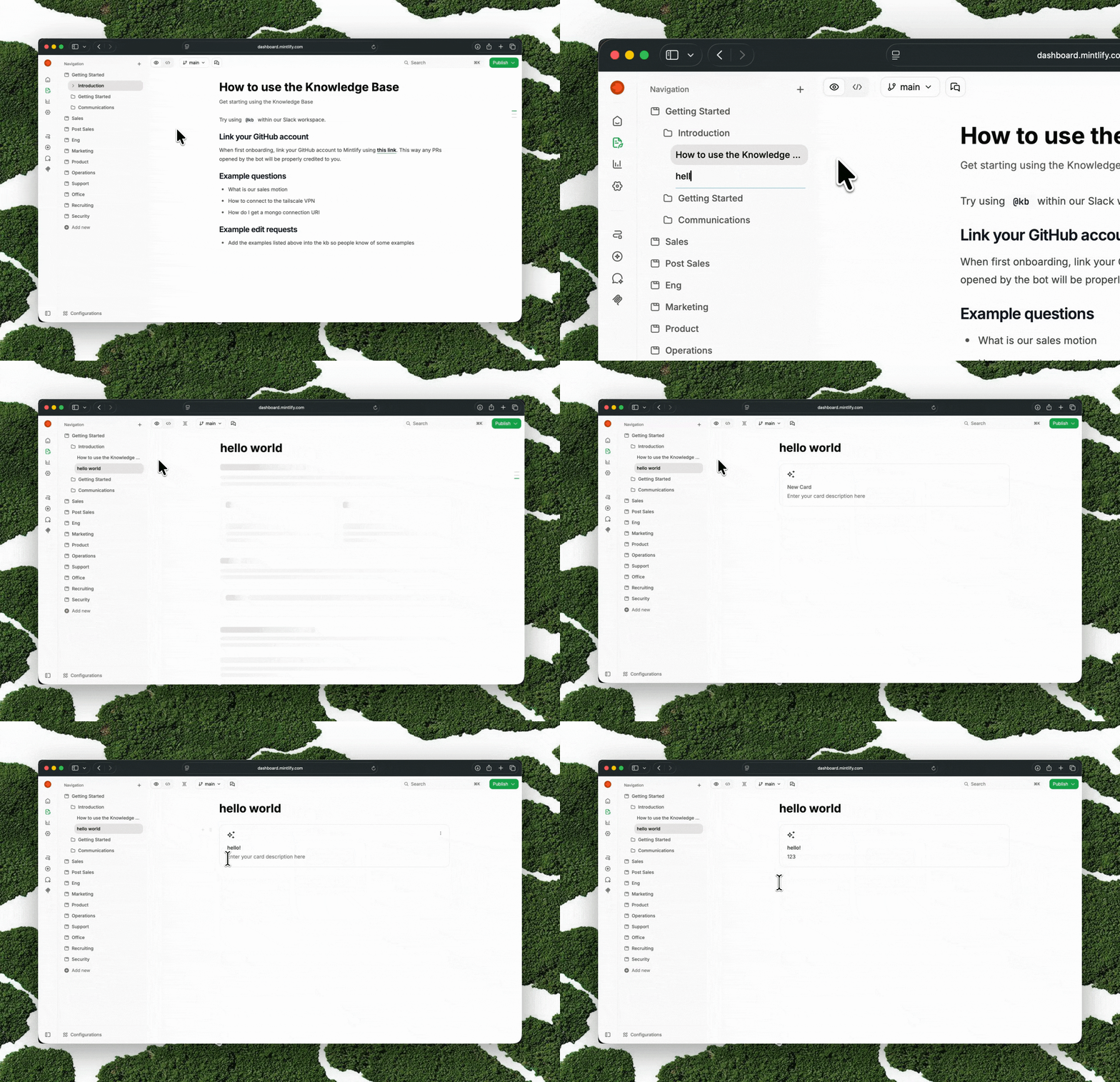
Teammates who don't live in a code editor get an intuitive, “what you see is what you get” (WYSIWYG) editing experience. They can write, format, add images, and publish, all from the browser. No markdown syntax to learn, no local dev environment to set up. Slash commands let you quickly insert components, callouts, code blocks, and more without finagling with syntax. Your docs navigation is also editable directly in the editor, so reorganizing your site structure doesn't require touching config files.
However, CLI/IDE-first users keep their git-native workflow. Every edit made in the visual editor is a clean commit in your repo, and every commit pushed to git automatically appears in the editor. Changes flow both ways. You can review it, revert it, or build on it from your terminal. Neither workflow is sacrificed. Your docs can live where your code lives and be versioned and reviewable in the same way. Every edit is tracked, every change is rollbackable, and a single source of truth is preserved.
Most documentation tools force you to choose between an accessible editing experience and the rigor of version control. We don't think that's a tradeoff you should have to make.
The new editor supports live collaboration. Your whole team can collaborate in real time, jump in together, make decisions, and ship without the review cycle bottleneck.
You see who's editing, what they're working on, and you can work alongside them in real time. Review cycles that used to take days of back-and-forth can be collapsed into a single live session.
This opens up war room-style workflows for your docs. Shipping a new feature? Engineering, product, and marketing can all be in the same doc at the same time, making sure content is accurate and aligned before go-live. Questions get resolved in the doc, not scattered across Slack threads and comment chains.
AI support has become the expectation, not the exception.
With MCP support, you can bring your own AI to collaborate with you on your content. And because agents can synthesize context from relevant sources such as your codebase, support tickets, changelogs, and internal wikis, they help your team synthesize information across sources and turn it into accurate, up-to-date content faster.
Agents can also edit alongside you in real time, making changes directly in the editor as you work. Whether it's a first draft, a follow-up edit, or a review, agents participate in the same process as everyone else on your team. You stay in control.
When your editing experience is visual, collaborative, and AI-native, the doors open to something bigger.
The best knowledge is built when everyone who has context can contribute, whether that's an engineer, a PM, or an AI agent.
And in the age of AI, your content matters more than ever. Agents depend on it. Your users' agents are reading your docs to figure out how to integrate your product. The quality of your content is now the quality of your AI experience.
We're making sure your team is ready. Try the new editor today.
此内容由惯性聚合(RSS阅读器)自动聚合整理,仅供阅读参考。 原文来自 — 版权归原作者所有。