



Jesse Seldess runs documentation at Pinecone, where he's shaping how developers learn and succeed with one of the leading vector database platforms. Previously, he's scaled developer education from the ground up at renowned organizations like Cockroach Labs.
In this conversation, we cover:
When Jesse joined Pinecone, he noticed the docs were structured around internal product hierarchies rather than user goals.
It's a common pattern that companies fall into: logical if you know the system, but hard to navigate if you're new.
His first priority was to overhaul the information architecture to make it easier for new users to get from zero to value. Documentation needs to reduce friction, not force users to reverse-engineer the product's architecture.
To fix the information architecture, Jesse started by doing the work himself. He went through the Pinecone onboarding flow just like a user would, noting where things broke down or felt out of order.
He also reviewed competitors' docs, spoke with PMs and support, and used that collective insight to identify a handful of key user stages such as onboarding, data modeling, and ingestion. That mental model became the foundation for restructuring content.
Along the way, he corrected many common pitfalls that trap a lot of doc sites:
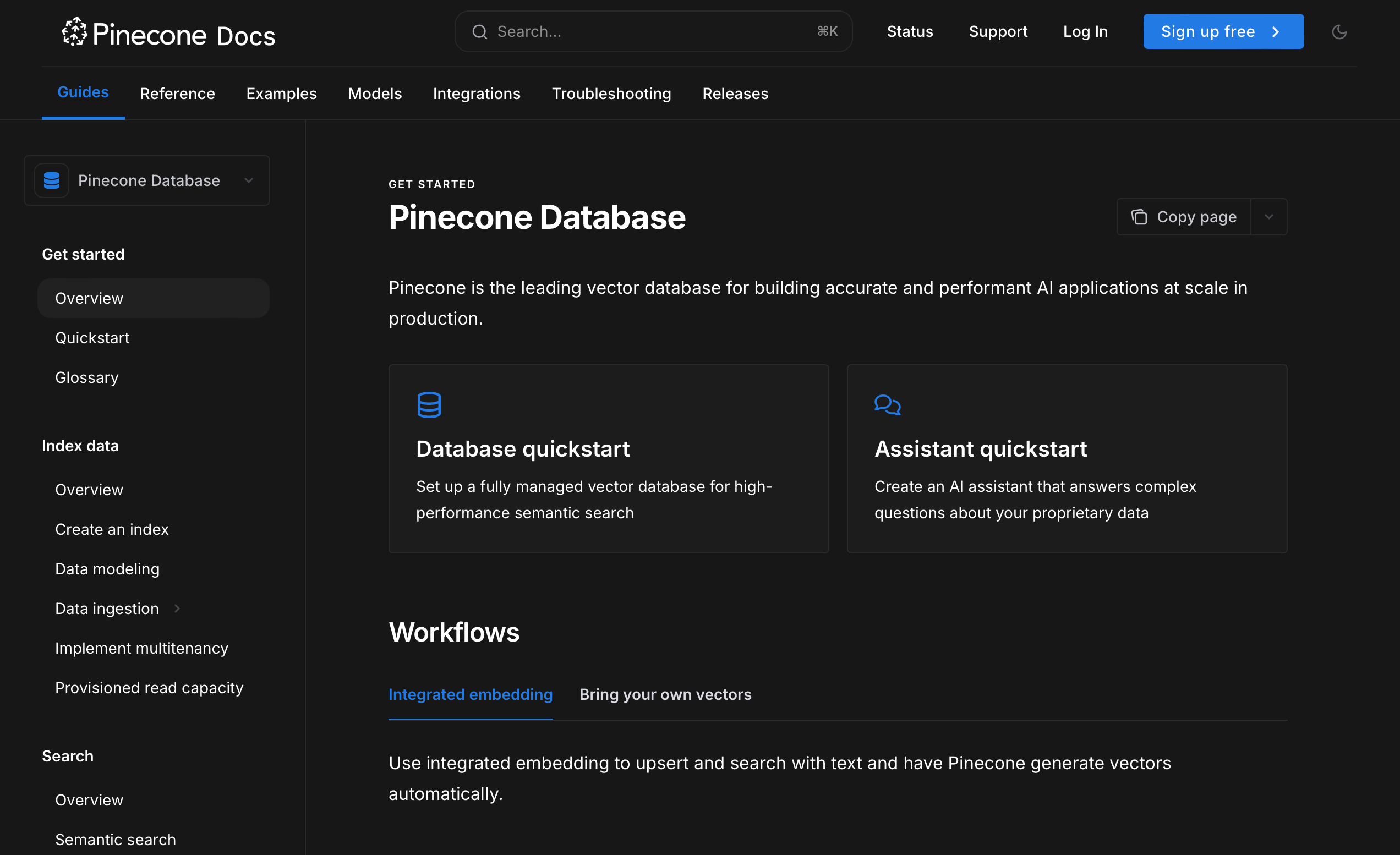
Pinecone's new information architecture mirrors user expectations
The solution wasn't to write more, but to decide what level of detail belongs where, based on the reader's experience and goals.
More recently, Jesse started looking for ways to use AI to speed up his writing workflows. His tool of choice is Claude Code.
But rather than treat Claude as a content generator, Jesse uses it more like a peer reviewer.
In one example, Pinecone had overlapping content across guides and support docs. Jesse asked Claude to identify redundancies, suggest a more focused structure, and rewrite sections based on their internal style guide. Claude wasn't perfect, but it got him 80% of the way there very quickly.
From there, Jesse fine-tuned the flow, revised headings, and brought it in line with Pinecone's voice. It felt more like a collaborative edit than a handoff to AI.
He's also using GitHub workflows to have Claude respond to issues or PRs directly, acting as a linting layer for structure and tone. (For teams interested in replicating this setup, Mintlify's Claude Code guide shares a playbook for docs-specific prompts and workflows.)
Jesse sees AI as a tool that sharpens great writing, not a substitute for it. The right systems can boost velocity, but only if you have the right people behind them.
Having built out teams at multiple organizations, Jesse typically looks for a few key traits in technical writing hires: curiosity, structure, and a hands-on approach.
He values people who can think like a user, poke at the product, and shape content that reflects real developer needs, not just describe what's been shipped.
Writing skill matters, but it's not just about clean prose. It's about organizing information around user context, layering in complexity appropriately, and collaborating across teams to get the details right.
Strong writers focus less on what was built, and more on what outcomes to drive for users.
With Jesse's oversight, Pinecone's documentation isn't just cleaner or easier to navigate—it's helping the business scale.
As Jesse notes, “One of the holy grails of documentation is reducing when a user needs to interact with a human being.”
When the docs foundation is strong, support volume drops, onboarding gets faster, and teams don't have to spend cycles answering the same questions.
At Mintlify, we've seen firsthand how the right documentation systems can create that kind of leverage across a company. If you're interested in leveling up your organization, get in touch with our documentation experts.
此内容由惯性聚合(RSS阅读器)自动聚合整理,仅供阅读参考。 原文来自 — 版权归原作者所有。