



The Model Context Protocol was introduced by Anthropic in November 2024 to standardize how LLMs connect to different data sources and tools, acting like a universal adapter for AI applications.
That means you can now use AI tools like Claude, Windsurf, or Cursor to pull accurate data and perform virtually any task on your behalf with MCP.
We'll explain what MCP means in everyday terms and how to incorporate it using your existing documentation.
Let's say you want to book a place to stay in Mexico City from April 15-18.
Before MCP, you could ask an LLM like Claude to find options, but it would rely on scraping publicly available data, typically returning inaccurate results. Since sites like Airbnb and Priceline present data in different formats, LLMs had no reliable way to interact with them directly—leading to guesswork and hallucinations.
MCP changes this by providing a standardized way for applications to present their data. Instead of parsing disparate data formats, an LLM can now access structured responses from these sites, ensuring accurate results.
More importantly, MCP enables two-way interaction. Instead of just researching places to stay, an LLM can now book one for you (provided you've given it the necessary permissions and API credentials.)
MCP follows a client-server architecture:
Anyone—from indie developers to enterprise companies—can create an MCP Server to integrate their products with AI tools. Servers can be built for local usage or shared publicly on MCP marketplaces like cursor.directory or windsurf.run, making them accessible to a growing network of AI applications.
As MCP adoption accelerates, direct integrations will become standard. Products that expose functionality through an MCP Server will be easier for AI tools to incorporate, leading to broader usage.
For products with APIs, supporting MCP won't just be a bonus—it'll be table stakes. Understanding and working with MCP is necessary to stay relevant in an ecosystem where AI is increasingly handling complex tasks autonomously.
If your product has documentation, you already have everything you need to build an MCP Server.
Normally, setting up an MCP Server requires custom code to translate your APIs into an MCP-compatible format.
But documentation platforms like Mintlify handle that step for you. Mintlify automatically generates an MCP Server for all customers—covering both API references (via your OpenAPI spec) and long-form content like tutorials. End users can use this MCP Server to both interact with your APIs or get real-time, contextual answers about how to use your product.
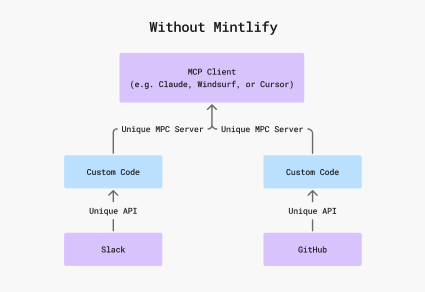
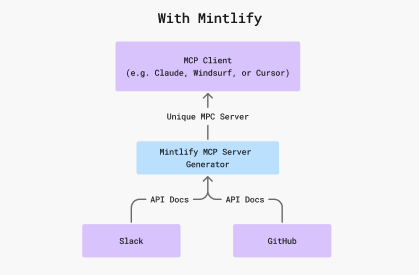
By generating these servers automatically, Mintlify removes the need for engineers to build them from scratch, while also driving broader adoption of MCP by expanding the ecosystem.
If you're a customer of Mintlify, your written content is already automatically generated as an MCP Server. For your API docs (those generated through an Open API spec), they can be turned into an MCP Server with a simple opt-in via the dashboard.
For your end customers to use your docs MCP Server, they can follow these instructions:
You can read more in our MCP documentation.
Now, customers can use their MCP Client, whether that's Claude Desktop, Cursor, or Windsurf, to interact with your APIs or ask questions about your product.
We're still in the early stages of MCP adoption, but it's the biggest leap yet toward AI agents becoming a practical, everyday reality rather than just a novelty.
There's never been a better time to build, and we're excited to keep accelerating our customers. If you have thoughts on this movement or want to learn more, get in touch.
此内容由惯性聚合(RSS阅读器)自动聚合整理,仅供阅读参考。 原文来自 — 版权归原作者所有。