

惯性聚合 高效追踪和阅读你感兴趣的博客、新闻、科技资讯
阅读原文 在惯性聚合中打开

推荐订阅源

cs.AI updates on arXiv.org
Hacker News - Newest:
Hacker News - Newest: "LLM"
NISL@THU
NISL@THU
Know Your Adversary
Know Your Adversary
The Hacker News
The Hacker News
D
Docker
Scott Helme
Scott Helme
有赞技术团队
有赞技术团队
罗磊的独立博客
A
Arctic Wolf
P
Privacy International News Feed
Google DeepMind News
Spread Privacy
Spread Privacy
B
Blog
A
About on SuperTechFans
L
LINUX DO - 最新话题
博客园 - 司徒正美
T
The Blog of Author Tim Ferriss
P
Proofpoint News Feed
W
WeLiveSecurity
Exploit-DB.com RSS Feed
Google DeepMind News
aimingoo的专栏
aimingoo的专栏
T
The Exploit Database - CXSecurity.com
美团技术团队
J
Java Code Geeks
Cloudbric
Cloudbric
雷峰网
雷峰网
Vercel News
Vercel News
P
Proofpoint News Feed
Webroot Blog
Webroot Blog
Security Archives - TechRepublic
人人都是产品经理
人人都是产品经理
Martin Fowler
Martin Fowler
G
Google Developers Blog
T
Tenable Blog
PCI Perspectives
PCI Perspectives
Engineering at Meta
Engineering at Meta
cs.CL updates on arXiv.org
H
Hackread – Cybersecurity News, Data Breaches, AI and More
钛媒体:引领未来商业与生活新知
钛媒体:引领未来商业与生活新知
博客园_首页
OSCHINA 社区最新新闻
OSCHINA 社区最新新闻
Apple Machine Learning Research
C
Cybersecurity and Infrastructure Security Agency CISA
S
Secure Thoughts
N
News and Events Feed by Topic
GbyAI
GbyAI
S
SegmentFault 最新的问题
cs.CV updates on arXiv.org

Mintlify Blog

22 UX improvements to the web editor Introducing the Mintlify Help Center Starter Kit Introducing the collaborative editor built for teams and agents Workflows, rebuilt Is your documentation agent-ready? Mintlify raises $45M Series B led by Andreessen Horowitz and Salesforce Ventures 5 things you didn't know you could do in the Mintlify web editor The improved Mintlify CLI Docs on autopilot: From zero to self-maintaining with Mintlify The state of agent traffic in documentation (March 2026) How we built a virtual filesystem for our Assistant We Replaced Our Internal Wiki With a Slack Bot. You Should Too. 8 ways teams use Mintlify to keep docs updated automatically Documentation is your AI interface What three years of watching AI in production taught us Bridging two JSX runtimes: How we solved Astro's React children problem AI agents are shipping faster than anyone can document Knowledge management systems for technical teams Workflows: Automate documentation maintenance Mintlify acquires Helicone to redefine AI knowledge infrastructure Why more product managers are switching to Mintlify Auto-generating documentation sites from GitHub repos Your docs, your frontend, our content engine Take control of your documentation system Almost half your docs traffic is AI, time to understand the agent experience @mintlify for better docs, faster Mintlify for Enterprise Real llms.txt examples from leading tech companies (and what they got right) Mintlify + Claude Opus 4.6: Powering AI-native knowledge management Declaring Clankruptcy: An experiment in agent orchestration Analytics for AI and agent traffic A better way to edit and publish in Mintlify Improved agent experience with llms.txt and content negotiation Your docs are now discoverable by agents Why do we need MCP if skills exist now? skill.md: An open standard for agent skills install.md: A Standard for LLM-Executable Installation Why documentation is one of the most important surfaces for marketers How I built our knowledge base in an afternoon Closing the loop between user questions and documentation 2025: A Year in Review Mintlify Security Event - November 2025 Inside our effort to improve the Mintlify assistant Introducing the next step towards self-updating docs How we eliminated cold starts for 72M monthly page views with edge caching 10 UI fixes I shipped in 10 days The Mintlify agent, now in your dashboard Impact of SHA1-Hulud: The Second Coming on the Mintlify CLI Documentation is dead. Long live documentation. What I shipped in my first 60 days at Mintlify Terminal agents are the future - We're launching mint new How we’re making Mintlify documentation more accessible Building an LSP for your docs The role of good code blocks in documentation The /api Namespace is Now Open Introducing the Mintlify Agent to write documentation with AI We built our coding agent for Slack instead of the terminal Top 7 ways to blend SEO with GEO for explosive brand growth How Mintlify uses Claude Code as a technical writing assistant AI Documentation Trends: What's Changing in 2025 Debugging a mysterious HTTP streaming issue How Pinecone writes documentation How to generate llms.txt Mintlify acquires Trieve to improve RAG search in documentation Behind Replit's Documentation Transformation How often do LLMs visit llms.txt? How Claude's memory and MCP work (and when to use each) Introducing AI Assistant: Turning docs into your product expert My quick formula for docs that convert It's not a race How to hire your first technical writer GEO guide to optimize writing for LLMs How Windsurf writes docs How Anaconda writes documentation Should you generate docs from your API schema? The value of llms.txt: Hype or real? Why we sunsetted mcpt How to use MCP servers to generate docs AI can write your docs, but should it? What is llms.txt? Breaking down the skepticism mcpt: The curated registry for MCP servers Why I joined Mintlify How to audit and overhaul your software documentation What is MCP and how to get started Generate MCP servers from your docs Mintlify vs. Readme: A 2025 Comparison How Generative Engine Optimization is Reshaping Docs Should you build or buy an API documentation tool? When do you really need a monorepo? Fireside Chats: Gong's Approach to Software Documentation The Next Chapter of Mintlify Themes New Devs Don't Read Docs? Maybe It's Not Their Fault Founder Mode: Dub's journey from side project to enterprise link attribution platform Refactoring mint.json into docs.json Breaking down common documentation mistakes What makes good API documentation? Best tools and examples 2024 in Review: Getting Ship Done Five changelog principles from best-in-class developer brands Founder Mode: How Windsurf builds product, from 0 to 1M users Introducing AI Assistant
Markdown is the easy part
Han Wang · 2026-06-03 · via Mintlify Blog

We survived the saaspocalypse. But at some point, every team is still having the same conversation.

"Do we really need to pay for this? Can we build it ourselves?"

It's a fair question.

Recently, I've been talking to a lot of teams who are trying to build their own content infrastructure. Markdown to HTML isn't rocket science. You can stand up a static site with a single prompt if you know what you're doing. If you have dedicated engineering resources, why buy something you could build?

When it comes to maintaining the knowledge infrastructure that powers your team and agents, Markdown hosting is just the tip of the iceberg.

The visible part of Mintlify to your end users is, yes, a website that renders your Markdown content. Clean, fast, looks great. That part is obvious. It's often the reason people first become interested in what we have to offer.

But the reason people stay, and the reason people don't build their own solution, is everything else.

If you start taking apart the most beloved developer tools, you find layers of intention, taste, and domain knowledge built into the product. Every element builds off of accumulated knowledge and carries a maintenance burden.
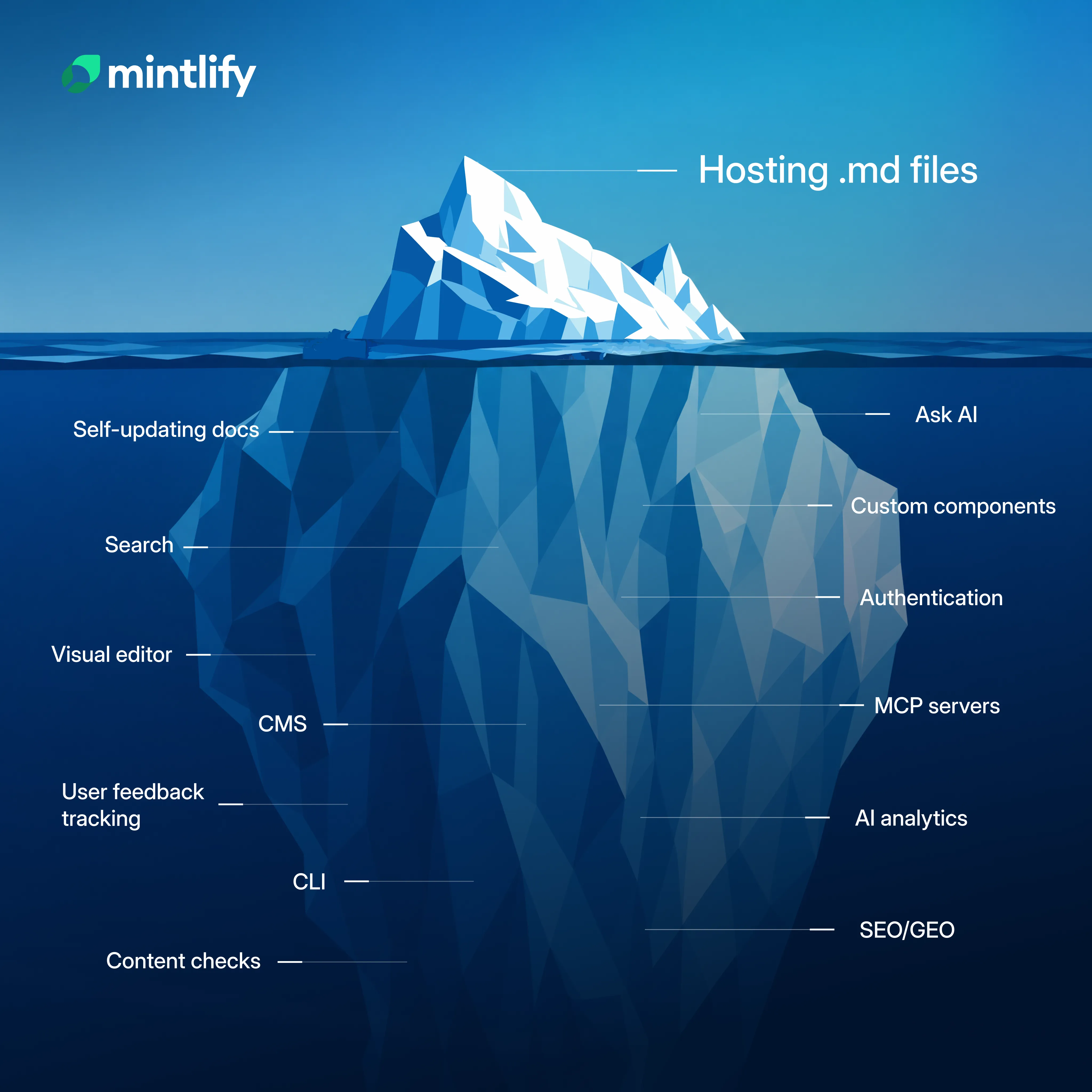
Diagram showing hosting Markdown files as the tip of the iceberg and Mintlify's other features beneath the surface.

Self-updating content

Let's start with one of the biggest things: self-updating content.

When your product changes, you have to update every relevant content surface. Your developer docs, internal knowledge bases, help centers, and so on.

With Mintlify, you can connect a source code repository as context and update your content whenever you ship. So your hosted Markdown files are always up to date with your product, your users (people and agents) have accurate information, and you free up time for other tasks.
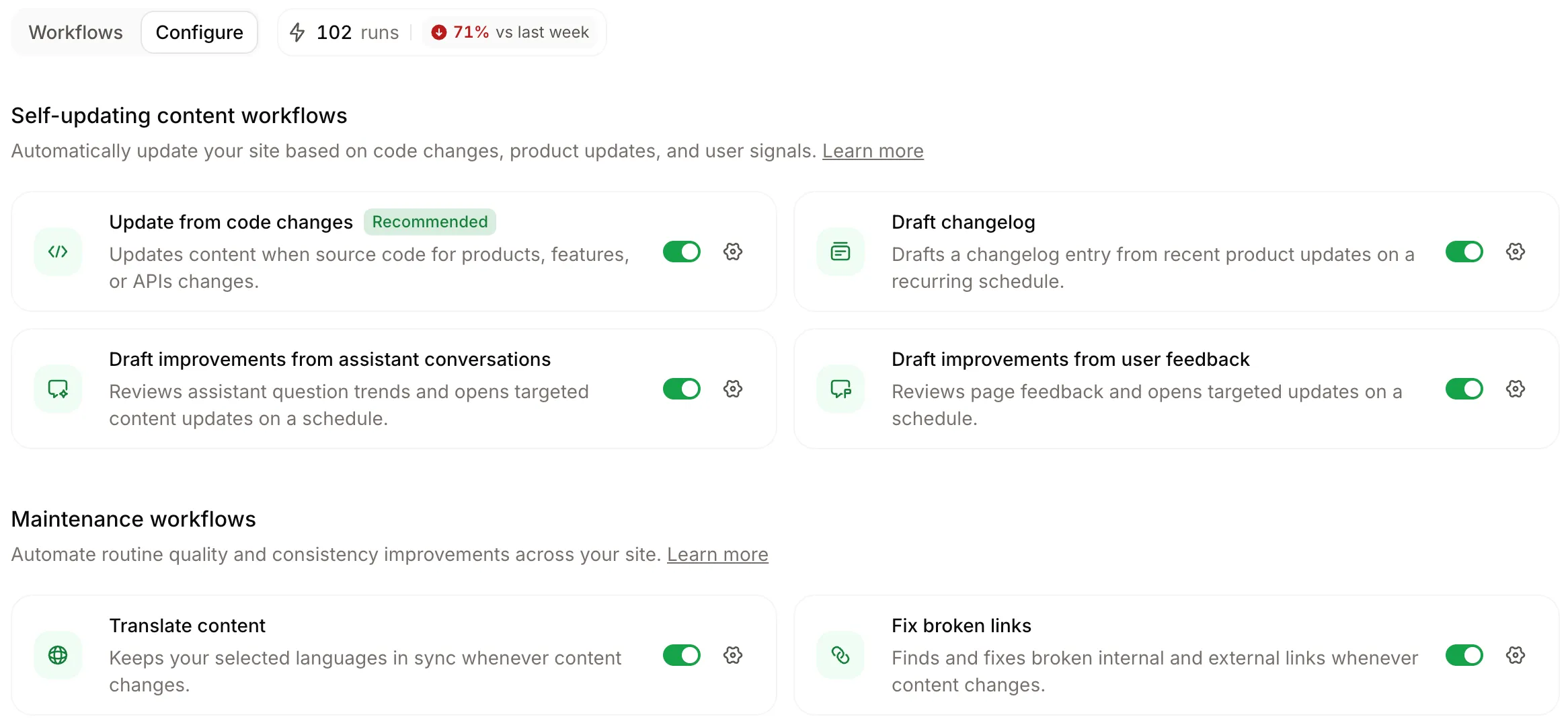
Screenshot of the Mintlify web editor

Building search that feels good to use is a product in itself. The difference between "it technically works" and "it returns results that help users" is small and nuanced.

Search that understands your content structure, handles typos, returns relevant results, and updates the instant your content changes is a fun challenge to solve for some people. But it's going to take time and effort to keep running.

Visual editor, CMS, CLI

A web-based writing environment. An API for programmatic content management. A CLI for people who want to work locally and deploy in CI. These offer different interfaces for different people on your team, but they all point at the same content.
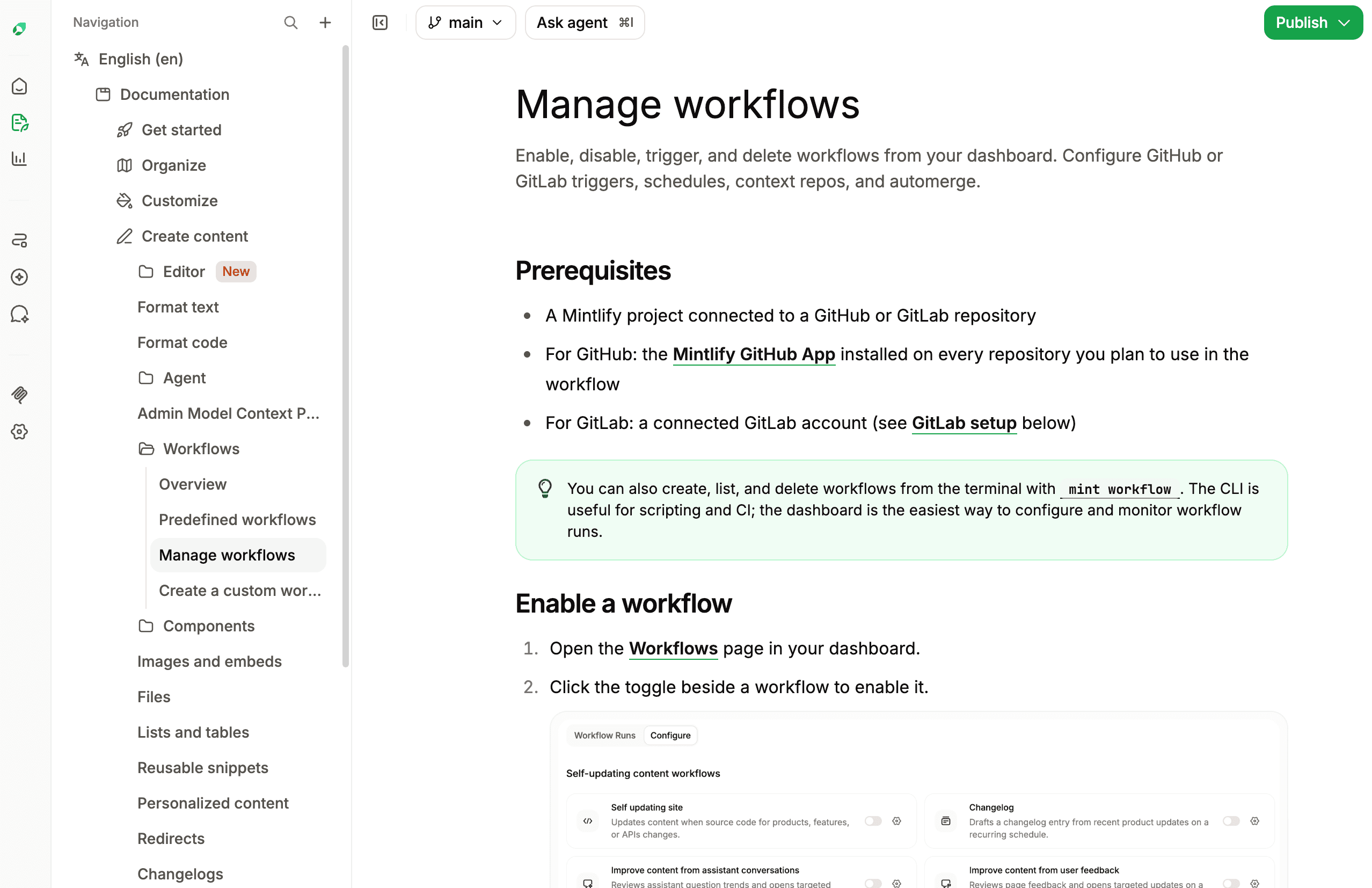
Screenshot of the Mintlify web editor

When you're building an in-house tool, do you consider the different preferences and needs of everyone on your team? Or do you build a single interface and force it to work for everyone?

User feedback tracking

User feedback on your content is some of the most valuable data you can collect. Your users tell you what they want to know about your product, what's challenging, when they're frustrated. And sometimes even when they're happy. With feedback, it's easy to improve your content over time exactly how your users want it. If you put content out into the world without a way to collect feedback, you're leaving so much on the table.

Content checks

Automated checks for simple things like broken links or more complex problems like factual drift and contradictions. Automate this with Mintlify.

Ask AI

People expect chat interfaces for querying knowledge. If your site doesn't have a native AI assistant, your users are going to ask another tool and risk getting inaccurate answers. You should power AI-mediated conversations with your own content. But do you want to maintain one yourself?

Custom components

What's better than hosting Markdown? Hosting Markdown that you can build on top of.

MDX supports interactive components. But you have to build them. Or use a platform with a library of components for all the most common patterns.

Authentication

SSO, SAML, per-page access control. The full security surface for protecting private or gated content goes deep. Every one of these is a spec, a build, an integration with your IdP, a maintenance burden. Or a toggle in a dashboard.

MCP servers

When developers use Claude, Cursor, or any other AI tool, you want them to pull from your content directly. If you have an MCP server for your content, they can do this easily.

And you can offer an agent-first content management experience for your team with an MCP server for updating content. Mintlify automatically generates and hosts these MCP servers.

AI analytics

Most teams don't measure agentic traffic at all. Even though it's the majority of traffic to sites.

User interactions with AI are even more valuable than page views. If you can see what users ask chatbots about your content or what your MCP returns, you can understand how your content is being used and how to improve it. And if you're mapping your AI spend to business outcomes, this is the data that connects content investment to P&L categories.

SEO and GEO

People need to find your content. Mintlify handles all this behind the scenes. Structured for crawling, metadata added, optimized for both traditional search and AI-powered answer engines. Getting this right has compounding returns.

None of these features are impossible to build.

You need to build each of them though.

For any devtool, build versus buy might look simple if you only look at the outcome of using the tool. Ask the people using it what makes the tool nice to use, how often they turn to it to solve a problem, when it saves them time and money.

Building a content platform means building out every feature for the maintainers and users. Search is a product. An agent that updates content well is a product. Authentication is a product. Analytics is a product. And you need to maintain these while building your actual product.

The teams that built their own content infrastructure and then migrated to Mintlify rarely encountered technical challenges they couldn't overcome if they dedicated the resources to it. But they could never justify how long it took, how much it cost, and how many times they wished they could have shipped something else instead.

You can look at a build versus buy decision as a line item or as freeing up six months of engineering time, an on-call rotation, and a pile of half-finished internal tools.

If you want to chat about how Mintlify can help your team, get in touch.